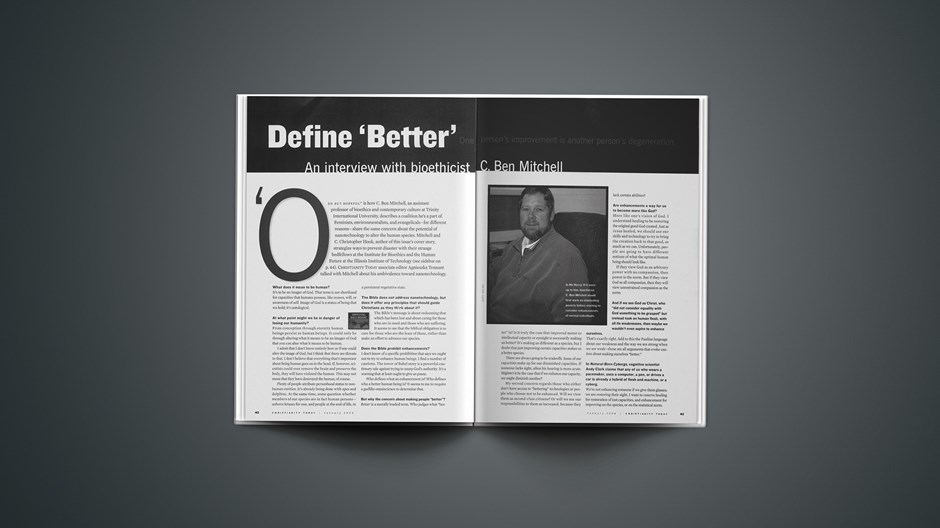
"Odd but hopeful" is how C. Ben Mitchell, an assistant professor of bioethics and contemporary culture at Trinity International University, describes a coalition he's a part of. Feminists, environmentalists, and evangelicals—for different reasons—share the same concern about the potential of nanotechnology to alter the human species. Mitchell and C. Christopher Hook, author of this issue's cover story, strategize ways to prevent disaster with their strange bedfellows at the Institute for Bioethics and the Human Future at the Illinois Institute of Technology. Christianity Today associate editor Agnieszka Tennant talked with Mitchell about his ambivalence toward nanotechnology.
What does it mean to be human?
It's to be an imager of God. That term is not shorthand for capacities that humans possess, like reason, will, or awareness of self. Image of God is a status of being that we hold; it's ontological.
At what point might we be in danger of losing our humanity?
From conception through eternity human beings persist as human beings. It could only be through altering what it means to be an imager of God that you can alter what it means to be human.
I admit that I don't know entirely how or if one could alter the image of God, but I think that there are threats to that. I don't believe that everything that's important about being human goes on in the head. If, however, scientists could ever remove the brain and preserve the body, they will have violated the human. This may not mean that they have destroyed the human, of course.
Plenty of people attribute personhood status to nonhuman entities. It's already being done with apes and dolphins. At the same time, some question whether members of our species are in fact human persons—unborn fetuses for one, and people at the end of life, in a persistent vegetative state.
The Bible does not address nanotechnology, but does it offer any principles that should guide Christians as they think about it?
The Bible's message is about redeeming that which has been lost and about caring for those who are in need and those who are suffering. It seems to me that the biblical obligation is to care for those who are the least of these, rather than make an effort to advance our species.
Does the Bible prohibit enhancements?
I don't know of a specific prohibition that says we ought not to try to enhance human beings. I find a number of cautions. The tower of Babel story is a powerful cautionary tale against trying to usurp God's authority. It's a warning that at least ought to give us pause.
Who defines what an enhancement is? Who defines who a better human being is? It seems to me to require a godlike omniscience to determine that.
But why the concern about making people "better"?
Better is a morally loaded term. Who judges what "better" is? Is it truly the case that improved motor or intellectual capacity or eyesight is necessarily making us better? It's making us different as a species, but I doubt that just improving certain capacities makes us a better species.
There are always going to be tradeoffs. Some of our capacities make up for our diminished capacities. If someone lacks sight, often his hearing is more acute. Mightn't it be the case that if we enhance one capacity, we might diminish another?
My second concern regards those who either don't have access to "bettering" technologies or people who choose not to be enhanced. Will we view them as second-class citizens? Or will we see our responsibilities to them as increased, because they lack certain abilities?
Are enhancements a way for us to become more like God?
More like one's vision of God. I understand healing to be restoring the original good God created. Just as Jesus healed, we should use our skills and technology to try to bring the creation back to that good, as much as we can. Unfortunately, people are going to have different notions of what the optimal human being should look like.
If they view God as an arbitrary power with no compassion, then power is the norm. But if they view God as all compassion, then they will view unrestrained compassion as the norm.
And if we see God as Christ, who "did not consider equality with God something to be grasped" but instead took on human flesh, with all its weaknesses, then maybe we wouldn't even aspire to enhance ourselves.
That's exactly right. Add to this the Pauline language about our weakness and the way we are strong when we are weak—those are all arguments that evoke caution about making ourselves "better."
In Natural-Born Cyborgs, cognitive scientist Andy Clark claims that any of us who wears a pacemaker, uses a computer, a pen, or drives a car is already a hybrid of flesh and machine, or a cyborg.
We're not enhancing someone if we give them glasses; we are restoring their sight. I want to reserve healing for restoration of lost capacities, and enhancement for improving on the species, or on the statistical norm.
The statistical norm gives us the average person's way of inhabiting the world. For instance, normal cabinet height in a kitchen is 30 inches because of most people's height. But we know that some people find it difficult because they have the gene for short stature, so we build lower cabinets for them.
Article continues below
You build a world that serves the majority of people and then you make adjustments for those who lack certain capacities or fall below the norm—you make restorations.
But in a world that already has a multi-tiered health care system, should we create a class of genetically or cybernetically enhanced individuals? That's what certain enhancements would do.
But inequality seems to be the way it is in a fallen world. Some people drive expensive cars or shop at Brooks Brothers; others work in sweatshops to barely put food on the table.
I think these injustices are terrible and we ought to repent if we perpetuate them. But as bad as they are, they don't involve the alteration of our species.
This is the first era in which we will have, as far as we know, the ability to alter ourselves in ways that we can then pass on to others through sexual reproduction (for example, in the manipulation of genes). If we get it wrong—if we make a mistake—and pass that on to the next generation, then we could harm the next generation.
If nanotechnology could give our soldiers the greatest chance of survival possible, would you recommend we use it?
Technologies have a tendency to bite back, as Edward Tenner points out in Why Things Bite Back: Technology and the Revenge of Unintended Consequences. The U.S. used Agent Orange—a chemical it sprayed to defoliate the jungle—to protect our soldiers during the Vietnam War. Now they are suffering the consequences of Agent Orange contamination, long after they left Vietnam.
In the case of the soldier, I'd find enhancements acceptable if the soldier volunteered for the alteration, understanding its consequences, and if it would be an enhancement that's reversible and cannot be passed on to the next generation.
How can we lobby lawmakers on these issues?
We ought to call on lawmakers first to address the needs of the suffering and the poor and people who have diseases before we talk about making them "better." I think as long as we have unjust systems of health care provision in this country, and as long as we have many people in poverty and children who suffer, it's a luxury to talk about enhancement technologies.
But the government is already spending about $1 billion per year for nano research.
Part of the answer is that we first have to build an informed citizenry. My guess is that average Christians don't know about the federal nanotechnology project. Or, like a lot of us, they didn't pay attention in science class in high school, and their eyes glaze over when you talk about DNA.
Article continues below
An informed citizenry can elect officials who can make good decisions. But I don't know of a quick fix.
What other groups, besides conservative Christians, are concerned about abuses of nanotechnology?
Feminists see a lot of these technologies as oppression of women by big businesses and other interests preying on the population. Some members of the Institute for Bioethics and the Human Future include those who work with environmental concerns, people from the Sierra Club and Greenpeace. There's also Judy Norsigian, who's head of the Boston Women's Collective and co-author of [the feminist manifesto] Our Bodies, Ourselves. On the other side of the table, as friends, are people like Wilberforce Forum bioethicist Nigel M. de S. Cameron and C. Christopher Hook. It's a very odd but hopeful coalition.
What can churches do to prepare to deal with the enhancement dilemmas?
We have to begin talking about technologies not as something we can consume without thinking about it, but as something that requires scrutiny. Some of us suggest that Christians should perhaps be the new techno Amish since the Amish don't reject every technology, but they realize that the use of a technology alters the way you inhabit the world.
Most of our churches have wonderful resources in the persons of doctors, nurses, and other educators who could help us understand these new developments. What some of us have chosen to do is get our information about science and technology only from the secular community, and then we think we can throw a Bible verse or two at it and all of a sudden we have Christianized the technology. But how you understand the technology and how you talk about it informs the ways that you use it.
Article continues below
Voices of reason
Key coalitions on biotech ethics
The Center for Bioethics and Human Dignity www.cbhd.org The group's members are leading evangelical experts on all kinds of bioethical dilemmas, and its website is a comprehensive collection of related articles and links.
Among CBHD's key voices are the group's president John F. Kilner; this issue cover story's author C. Christopher Hook; C. Ben Mitchell; and public interest law attorney Paige C. Cunningham.
The Council for Biotechnology Policy www.biotechpolicy.org Part of the Wilberforce Forum, the group seeks policy solutions for "scientific and cultural issues related to bioethics and human dignity."
Among CBP's key voices are CT columnist Chuck Colson; CBP's director Nigel M. de S. Cameron; and founder of Center for Bioethics and Culture Jennifer Lahl.
Institute on Biotechnology & the Human Future www.biotechhumanfuture.org A coalition of evangelical, feminist, and environmentalist experts who share a "determination to ensure that developments in biotechnology sustain, and do not subvert, social values."
Among its key voices are biotech legal expert Lori B. Andrews; Christian bioethics commentator Nigel M. de S. Cameron; Duke University Divinity School theologian Amy Laura Hall; and co-author of Our Bodies, Ourselves Judy Norsigian.















 While we pray for peace, we need moral clarity about this war.
 Church movements need magnetic leaders. But the best leaders need more than charm.
 The champion of “native missions” trained more than 100,000 evangelists but got in trouble for financial mismanagement.