Does the world need yet another cinematic reworking of the Cinderella story, and so soon after Ella Enchanted went all Shrek on the fairy tale? Well, no. But teen starlets like Hilary Duff need to work, lest their fickle fans forget they exist, and one rehashed storyline is as good as another—so here comes yet another modernized riff on the old fable.
You don't have to follow the teen magazines to know that there has, of late, been some sort of rivalry between Duff and her fellow teen idol Lindsay Lohan. Whatever might be going on behind the scenes, it is probably fair to say that Duff is losing the battle for big-screen supremacy. While Lohan has shown impressive range and lent her wide-eyed, crinkle-faced bewilderment to such intelligent romps as Freaky Friday and Mean Girls, Duff is all cherubic cuteness and bland perkiness; she doesn't have much of a screen presence, and she often rattles off her lines as though she has just learned them and wants to get them out of the way before they fade from her memory.
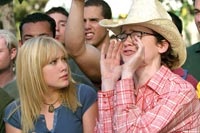
Hilary Duff and Dan Byrd
What's more, Duff's choice in films suggests a reluctance or an inability to grow up. In A Cinderella Story, Duff plays Sam, a high-school senior with a mean, selfish stepmother (a suitably daffy Jennifer Coolidge) and two dumb, selfish "out-of-step-sisters." Sam dreams of going to Princeton University because her father used to call her a princess and, well, "Princeton" kind of sounds like "princess," doesn't it? Sam has a secret admirer—they swap anonymous e-mails—who turns out to be Austin (Chad Michael Murray), football jock and student body president. Meanwhile, Sam's best friend Carter (Dan Byrd) has a crush on Shelby (Julie Gonzalo), a snobby but air-headed cheerleader (when Carter bids her "Adieu," she says, "A what?") and Austin's ex-girlfriend. So far, so typically high school—but the Cinderella template imposed on these characters makes the story seem more infantile than that.
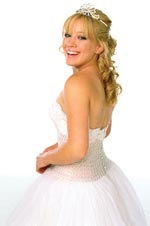
Hilary Duff plays Sam in the lead role
Consider this. Sam learns that Austin is her secret admirer when they meet at the school's homecoming dance, but because Sam's face is hidden behind a sequined mask, and because she has to leave before Austin can remove her mask and kiss her, Austin has no idea who she is. So he puts up signs all over the school asking where his "Cinderella" is—the name being applied to Sam because she went to the dance dressed in a wedding gown provided by one of her father's friends and colleagues (Regina King). And somewhere in all this, you may begin to wonder whether high-school seniors—and especially jocks—would actively, and publicly, identify themselves with such a children's story.
The story's fairy-tale parallels are necessitated by its central theme, which has something to do with the difference between reality and fantasy, and the way we adopt personae that allow us to express aspects of ourselves that usually remain hidden, even as they hide who we really are; Sam's friend Carter, a self-proclaimed "method actor," is especially prone to adopting new identities, from rap stars to Zorro. But it's hard to take this theme seriously when the characters literally assume fairy-tale roles that, at this stage in their lives, they would probably prefer to leave in the nursery—and it is hard to take the film's dialectic between reality and fantasy seriously when the film itself is very much a fantasy in its own right. At one point, Sam worries that Austin will reject her if he finds out she isn't the "Malibu Barbie" that she thinks he wants her to be. And yet, even as she says this, you can't help but notice that Duff is, herself, something of a Barbie doll—pretty in the way that all teen pop stars are pretty, even when they are playing unattractive outsiders.
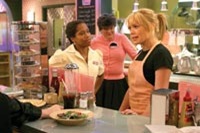
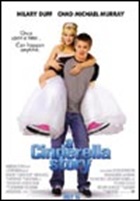
She's Duff, he's buff—Chad Michael Murray as the hunky football star
The film, directed by TV veteran Mark Rosman from a script by novice writer Leigh Dunlap, throws in other elements that skew the film toward a younger viewership, such as a catfight between the two step-sisters in a car wash. While Duff's arch-nemesis Lohan has moved on to making films for teens that are smart enough to appeal to adults too, Duff herself seems to be pursuing the Mary-Kate-and-Ashley crowd, making films for children who are not yet high school students but who dream about becoming them some day. The ironic thing is, children who really want to appear more mature might very well give films like this a pass, precisely because they can sense that such films play down to them. Indeed, I took a friend's 10-year-old daughter to see the film, and she found it "too childish." And who am I to argue with a member of this film's target audience?
Talk About It
Discussion starters
What role do fairy tales (and other stories) play in our lives? What role should they play? When is it a good thing to model our lives or behavior after these stories? When is it a bad thing?
Is it possible to know who somebody really is without knowing their name? Can you get to know someone exclusively through letters and e-mails, or do you need to meet them in the flesh, too? What effect does the Incarnation have on how we understand such things?
Article continues below
Sam's father tells her, "Never let the fear of striking out keep you from playing the game." Is this good advice? How do we know which games are worth playing? How do we choose which dreams to pursue? Why does Austin quit the football game—out of fear, or for some other reason? Is it a good reason?
The Family Corner
For parents to consider
The film is rated PG for "mild language and innuendo." There are several mocking references to the step-mother's attempts at physical self-enhancement, from her breast implants and Botox treatments to her time spent nude in a tanning bed. There is also a bit of underwater flatulence, and a female teacher casts a suggestive glance at a teenaged boy.
Right now in theatres, a popular young actress has stepped up into a more mature role as an intelligent high school student in a film that takes a complex look at the social dynamics of school and the challenges facing young people today. The movie is an intelligent and surprising satire, a smart alternative to the routine teen comedy. The movie is called Mean Girls, and the star is Lindsay Lohan.
Meanwhile, Hilary Duff continues to play "cherubic" adolescents in typical fairy tale formulas. According to most critics, A Cinderella Story is just the "Teenage Girls Should Have Faith in Themselves" movie of the month.
Peter T. Chattaway (Christianity Today Movies) writes, "I took a friend's 10-year-old daughter to see the film, and she found it 'too childish.' And who am I to argue with a member of this film's target audience?"
He also describes the media-celebrated rivalry between Duff and Lohan. "Whatever might be going on behind the scenes, it is probably fair to say that Duff is losing the battle for big-screen supremacy. While Lohan has shown impressive range and lent her wide-eyed, crinkle-faced bewilderment to such intelligent romps as Freaky Friday and Mean Girls, Duff is all cherubic cuteness and bland perkiness; she doesn't have much of a screen presence, and she often rattles off her lines as though she has just learned them and wants to get them out of the way before they fade from her memory."
Lacey Mical Callahan (Christian Spotlight) says, "The love story of this film is actually not based on lust as are most silver screen flings. Because they have formed a relationship on the Internet, the two do not even know what each other looks like. The downside of portraying this Internet romance is that it encourages some unsafe behavior. Bottom line, this movie probably does not have something for the whole family, but it is a cute chick flick for a mother-daughter outing."
Article continues below
"Duff has yet to show any range beyond what she has already displayed as Lizzie Maguire," says Michael Elliott (Movie Parables). "She manages to smile, cry, and stare blankly on cue which is all that is really asked of her. It is a 'safe' performance in a 'safe' film. Parents with young children will be pleased. I'm not so sure about the rest of us."
Steven Isaac (Plugged In) says, "While the structure of this film's plot follows that of the age-old Cinderella fairy tale, it's feel is that of a half-hour Disney series." He then sums up the film's rather shallow conclusions: "Happily ever after only comes to those who make it happen for themselves. Princes will fail you. Moms will neglect you. Friends may even flake out on you. But none of that matters if you do the right thing, conserve water, watch out for the less fortunate and go to the college of your choice."
Annabelle Robertson (Crosswalk) praises the filmmakers for the movie's "lack of obscenities (one exception only), profanities and nudity, although the potty humor could and should have been bypassed as well. It truly takes the film down a notch to see young women passing gas in a pool."
Robertson concludes that A Cinderella Story "fails to achieve any cinematic heights and offers a trite moral message. It's also a blatant advertisement for teenage dating and romance. The cheesiest part of the film is its message, which consists of banalities like 'believe in yourself' and 'have faith in yourself'—all clichés without any real substance."
Ted Baehr (Movieguide), who insists that the writers on his site are "not film reviewers," calls A Cinderella Story "one of the three best produced movies of the summer of 2004 … a must-see movie for all ages. … "[The movie] should be used in script classes to help demonstrate good scriptwriting. Bravo! It's the perfect complement to Spider-man 2." Moreover, he says Duff "does a terrific job in this movie expressing nuanced emotions in a profound yet humorous way."
Meanwhile, only about 11% of mainstream critics are willing to give A Cinderella Story a thumbs-up. Most of them agree with Karen Karbo (The Oregonian), who calls it a "poorly written, poorly acted exercise in banality and studio greed."
Article continues below
from Film Forum, 07/29/04
Coffin (World) also has only the most tepid of praise for A Cinderella Story, "a clichéd, mostly lifeless trifle, most praiseworthy for what it's not—in that it's not particularly profane, crude, or offensive, as children's movies go. Chock-full of groan-inducing moments that even—or perhaps especially—preteen girls will see through. Its message is mixed at best, occasionally extolling positive virtues, but mostly applying a morality that is convenient for the story and its heroine, ending the fantasy on the particularly sour note of payback."
from Film Forum, 08/05/04
He describes A Cinderella Story as "a clichéd, mostly lifeless trifle, most praiseworthy for what it's not—in that it's not particularly profane, crude, or offensive, as children's movies go."
The champion of “native missions” trained more than 100,000 evangelists but got in trouble for financial mismanagement.
Daniel Silliman
A Cinderella Story
1 of 4
Hilary Duff and Dan ByrdHilary Duff plays Sam in the lead roleShe's Duff, he's buff—Chad Michael Murray as the hunky football starA Cinderella Story












 While we pray for peace, we need moral clarity about this war.
 Alcoholism among women is rising. Can the church help?
 The champion of “native missions” trained more than 100,000 evangelists but got in trouble for financial mismanagement.