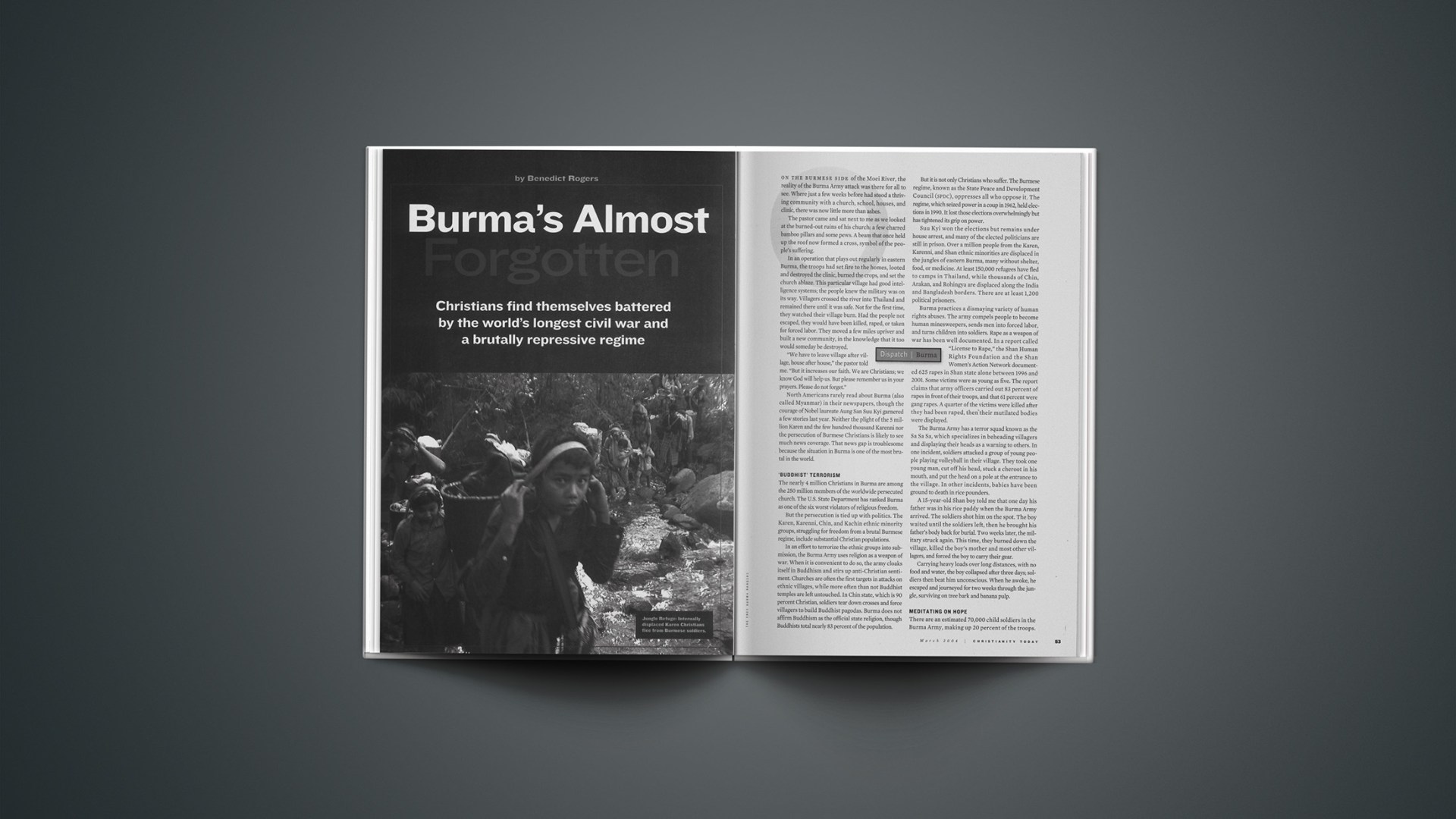

On the Burmese side of the Moei River, the reality of the Burma Army attack was there for all to see. Where just a few weeks before had stood a thriving community with a church, school, houses, and clinic, there was now little more than ashes.
The pastor came and sat next to me as we looked at the burned-out ruins of his church: a few charred bamboo pillars and some pews. A beam that once held up the roof now formed a cross, symbol of the people’s suffering.
In an operation that plays out regularly in eastern Burma, the troops had set fire to the homes, looted and destroyed the clinic, burned the crops, and set the church ablaze. This particular village had good intelligence systems; the people knew the military was on its way. Villagers crossed the river into Thailand and remained there until it was safe. Not for the first time, they watched their village burn. Had the people not escaped, they would have been killed, raped, or taken for forced labor. They moved a few miles upriver and built a new community, in the knowledge that it too would someday be destroyed.
“We have to leave village after village, house after house,” the pastor told me. “But it increases our faith. We are Christians; we know God will help us. But please remember us in your prayers. Please do not forget.”
North Americans rarely read about Burma (also called Myanmar) in their newspapers, though the courage of Nobel laureate Aung San Suu Kyi garnered a few stories last year. Neither the plight of the 5 million Karen and the few hundred thousand Karenni nor the persecution of Burmese Christians is likely to see much news coverage. That news gap is troublesome because the situation in Burma is one of the most brutal in the world.
‘Buddhist’ Terrorism
The nearly 4 million Christians in Burma are among the 250 million members of the worldwide persecuted church. The U.S. State Department has ranked Burma as one of the six worst violators of religious freedom.
But the persecution is tied up with politics. The Karen, Karenni, Chin, and Kachin ethnic minority groups, struggling for freedom from a brutal Burmese regime, include substantial Christian populations.
In an effort to terrorize the ethnic groups into submission, the Burma Army uses religion as a weapon of war. When it is convenient to do so, the army cloaks itself in Buddhism and stirs up anti-Christian sentiment. Churches are often the first targets in attacks on ethnic villages, while more often than not Buddhist temples are left untouched. In Chin state, which is 90 percent Christian, soldiers tear down crosses and force villagers to build Buddhist pagodas. Burma does not affirm Buddhism as the official state religion, though Buddhists total nearly 83 percent of the population.
But it is not only Christians who suffer. The Burmese regime, known as the State Peace and Development Council (SPDC), oppresses all who oppose it. The regime, which seized power in a coup in 1962, held elections in 1990. It lost those elections overwhelmingly but has tightened its grip on power.
Suu Kyi won the elections but remains under house arrest, and many of the elected politicians are still in prison. Over a million people from the Karen, Karenni, and Shan ethnic minorities are displaced in the jungles of eastern Burma, many without shelter, food, or medicine. At least 150,000 refugees have fled to camps in Thailand, while thousands of Chin, Arakan, and Rohingya are displaced along the India and Bangladesh borders. There are at least 1,200 political prisoners.
Burma practices a dismaying variety of human rights abuses. The army compels people to become human minesweepers, sends men into forced labor, and turns children into soldiers. Rape as a weapon of war has been well documented. In a report called “License to Rape,” the Shan Human Rights Foundation and the Shan Women’s Action Network documented 625 rapes in Shan state alone between 1996 and 2001. Some victims were as young as five. The report claims that army officers carried out 83 percent of rapes in front of their troops, and that 61 percent were gang rapes. A quarter of the victims were killed after they had been raped, then their mutilated bodies were displayed.
The Burma Army has a terror squad known as the Sa Sa Sa, which specializes in beheading villagers and displaying their heads as a warning to others. In one incident, soldiers attacked a group of young people playing volleyball in their village. They took one young man, cut off his head, stuck a cheroot in his mouth, and put the head on a pole at the entrance to the village. In other incidents, babies have been ground to death in rice pounders.
A 15-year-old Shan boy told me that one day his father was in his rice paddy when the Burma Army arrived. The soldiers shot him on the spot. The boy waited until the soldiers left, then he brought his father’s body back for burial. Two weeks later, the military struck again. This time, they burned down the village, killed the boy’s mother and most other villagers, and forced the boy to carry their gear.
Carrying heavy loads over long distances, with no food and water, the boy collapsed after three days; soldiers then beat him unconscious. When he awoke, he escaped and journeyed for two weeks through the jungle, surviving on tree bark and banana pulp.
Meditating on Hope
There are an estimated 70,000 child soldiers in the Burma Army, making up 20 percent of the troops. Kyow’s story was typical. At the age of 11, he stood at a bus stop in Rangoon, on his way to visit an aunt. Before the bus arrived, an army truck pulled up beside him. Soldiers jumped out and forced him into the vehicle.
“My choice was to join the army or go to jail,” he said. He has never seen his parents since.
After three years in the Burma Army, he decided to escape. The officers had regularly fed the troops anti-Karen propaganda, telling them they would suffer terrible torture at the hands of the Karen if captured by them. Kyow believed the propaganda and knew he stood a strong chance of being captured. But he no longer cared.
“I did not want to live,” he said. He ran away and was indeed captured by the Karen—who treated him very well.
“With the Karen, I feel safe, free, and loved,” said Kyow, now 14. “With the Burma Army, life was like hell.”
Amid this suffering springs incredible faith and hope. A Karen known only as Pastor Simon, for example, gave up his position as a seminary professor and theologian when he fled to the camps in Thailand. But once there, he put his time to good use. Seeing the needs of young people for education, he started a Bible school, which today offers bachelor’s degrees in divinity recognized by the Baptist World Alliance. Pastor Simon composes meditations that speak of his people’s suffering—and hope:
They call us a displaced people,
But praise God; we are not misplaced.
They say they see no hope for our
future,
But praise God; our future is as bright
as the promises of God.
They say they see the life of our
people is a misery,
But praise God; our life is a mystery.
For what they say is what they see,
And what they see is temporal.
But ours is the eternal.
All because we put ourselves
In the hands of the God we trust.
Strength in Weakness
A few years ago, Meredith Nunu was in her village in Karenni state when she saw Burmese soldiers shoot her husband in his rice paddy. Gathering up her children, she fled to Thailand. But she did not surrender to despair.
In the camp, she discovered many children who had been separated from their parents. Some were orphaned. Nunu started a school and an orphanage to care for them. On the walls of her bamboo hut, alongside words of Scripture (and quotes from Albert Camus and Albert Einstein), are the words of YMCA missionary Howard Walter, which sum up the spirit of the Christians under fire in Burma: “I would be true, for there are those who trust me; I would be humble, for I know my weakness; I would be strong, for there is much to suffer.”
A year ago, I visited a Karen resistance army base in Burma. The Karen National Liberation Army is a tiny, poorly equipped guerrilla force that can do little more than temporarily stave off the Burma Army.
“We fight with love, not with hate,” said the battalion commander, Colonel Nerdah Mya. “We fight simply to defend our people.”
A Karen known as Pastor Timothy spoke to the soldiers as they lined up. “We cannot depend on men, on nations, or on the United Nations,” he said. “But with God, all things are possible.” Holding up a Bible, he said: “Only this book can deliver freedom for our people.”
I was asked to speak to the soldiers. I read Psalm 91. After Pastor Timothy preached Christ as the one whose death and resurrection saves people from sin, he invited forward any soldier who wanted to give his life to Jesus. Eleven men came forward; three were baptized in the river. I was asked to pray for each one individually. (It was the first time I had ever prayed for someone with an M-16 on his back and a hand grenade on his belt.) I prayed for their protection.
The Karen struggle has been going on since the end of World War II; it is the world’s longest civil war. In the past five years more than 30,000 Karen, and thousands more from other ethnic groups, have been killed.
During a public speech a few years ago, a senior Burmese general spoke of the regime’s desire to eliminate all opposition. “In 10 years, all Karen will be dead,” he threatened. “If you want to see a Karen, you will have to go to a museum in Rangoon.”
Another Burma Army commander, speaking after he had led an attack on a village—slaughtering people and urinating on the head of a villager—summed up the spirit of the SPDC: “I do not respect any religion. My religion is the trigger of my gun.”
Missionary Rangers
Some organizations questing after dispersed Jewish descendants of the Assyrian captivity regard the Karen as remnants of “the lost tribes of Israel.” The Karen are often described as a “Christian tribe” (though only 40 percent are Christian), due in part to legends that are eerily similar to Old Testament narratives.
These stories predate the arrival of missionaries by hundreds of years, yet they tell of one creator God named Y’wa who made man and woman. The Karen have poems that tell of a man and a woman who lived in a garden, and a snake who gave the woman some forbidden fruit. And they believe they once possessed a “Golden Book” that contained the truth about life. This book was lost, they believe, but one day a young white brother who lived across the seas would come and return it.
So when Bible-bearing missionaries, led by American Baptist Adoniram Judson, came to Burma in the 19th century, the Karen welcomed them warmly.
More “young white brothers” armed with the Golden Book have come to the Karen since Judson first set foot in Burma. One is an American missionary, a former U.S. Special Forces officer, known as Tha-U-Wah-A-Pah (“Father of the White Monkey”).
He leads a missionary group known as the Free Burma Rangers, which aims to bring “help, hope, and love” to the internally displaced people in the conflict-ridden jungles of Burma. He and his teams frequently risk their lives, often working in close proximity to the Burma Army, to provide medical assistance and deliver medical supplies, Bibles, and prayer to the internally displaced. They let the people know they are not forgotten. And they bring packs of supplies donated for displaced mothers and children by individuals and churches around the world, as part of what they call the Good Life Club.
On every mission, which usually covers hundreds of miles, they treat an average of 2,000 patients in the jungle. The Free Burma Rangers include medics, videographers, photographers, pastors, musicians—and armed soldiers to protect their efforts. In all, more than 4,000 Burmese receive assistance of some kind. The Rangers’ key Scripture is Zechariah 4:6: ” ‘Not by might nor by power, but by my Spirit,’ says the Lord.”
In 1996, Tha-U-Wah-A-Pah was able to visit Rangoon, where he met with Suu Kyi, who is a practicing Buddhist, but whose mother was a Christian. A regular reader of the Bible, Suu Kyi told the missionary that her favorite verse was John 8:32: “You shall know the truth, and the truth shall set you free.”
She asked him to urge Christians around the world to pray for Burma. He responded to that request, started Christians Concerned for Burma, and organized an annual Global Day of Prayer for Burma, which takes place on the second Sunday of March.
Faithful Unto Death
Six months after the village on the banks of the Moei River was burned down, I visited the new settlement a few miles upriver. A new church had been built. The people gathered, dressed in their traditional red tunics and sarongs or longyis, and sang. Hymns ranged from “Amazing Grace” to “Onward Christian Soldiers.” Hanging on the wall above the platform in the church were words from Revelation 2:10: “Be thou faithful unto death, and I will give thee a crown of life.”
The Christians of Burma are indeed faithful, often literally unto death. Although they may often feel as though the world has forgotten them, they are not entirely alone. Actively helping for several years are Christian groups such as Partners Relief and Development, which provides humanitarian relief along the Thai border; the U.K.-based Karen Action Group, which sends teams of British Christians several times a year; and Christian human rights advocacy groups. U.S. Congressman Joseph Pitts and British parliamentarians Baroness Cox and Lord Alton have taken up the cause, visiting the Thai-Burma border several times.
Martin Panter, a British doctor practicing in Australia, has been visiting the Karen and Karenni twice a year since 1989 on medical training and fact-finding missions. In 1995, soon after the Burma Army and its Karen militia, the Democratic Karen Buddhist Army, overran the Karen headquarters at Manerplaw, the Karens lost their last significant outpost at Kawmoora. Panter visited the home of Colonel Taou Lo, Karen commander of Kawmoora, during some of the heaviest fighting, and prayed with his wife and daughter while the colonel was on the front line.
Colonel Lo, a Christian, would often pray with his troops on the front line via two-way radio. Some months earlier, the commander had twice dreamt of seeing an elderly man with his hands raised in front of him. On his left hand was the number 16, on his right 85, and above his head 101. After praying about what this might mean, he concluded that he needed to read Psalms—the only book in the Bible with either 101 verses or chapters.
He looked at . Then he plastered the walls of his bunker with these and other verses, and renamed his troops Battalion 101, after Psalm 101‘s first verse: “I will sing of your love and justice to you, O Lord.”
As the doctor left the colonel’s home, Lo’s 20-year-old daughter, Saleh, thanked him and turned to wipe away tears from her face. The colonel’s wife held Panter’s hand in hers and said: “It’s as if Jesus Christ has come to our home tonight.” The doctor was embarrassed but encouraged.
“I trembled at such a comment, knowing full well the multitude of shortcomings in my own life, and my failure to measure up to anything like that which my Lord would require,” Panter said. “Yet on reflection, I rejoiced that somehow, in some small way, we had been able to represent the love of Jesus to them at that time, and stand with them in solidarity in this, their darkest hour.”
Benedict Rogers is a consultant to Christian Solidarity Worldwide (www.csw.org.uk), and author of A Land Without Evil: Stopping the Genocide of Burma’s Karen People (Monarch Books, 2004).
Copyright © 2004 Christianity Today. Click for reprint information.
Related Elsewhere:
The License to Rape report is available online.
More articles about Burma include:
Compassion Confusion | We should serve the needy even when it has bad political consequences. (Aug. 28, 2001)
The Homeless Church of Myanmar | In 1990, after decades of cruel military regimes, democratic elections were held in Myanmar, and the National League for Democracy party won with over 80 percent of the vote. The military ignored the election results, seized control, and has set up the illegitimate (and wrongly named) State Peace and Development Council (SPDC) government. (Oct. 5, 1998)
Ethnic Politics Suppresses Outreach | The stunning success of Christian outreach among some ethnic minorities in Asia has fueled religious resentment and repression. (May 19, 1997)
More is available in our Persecution section.