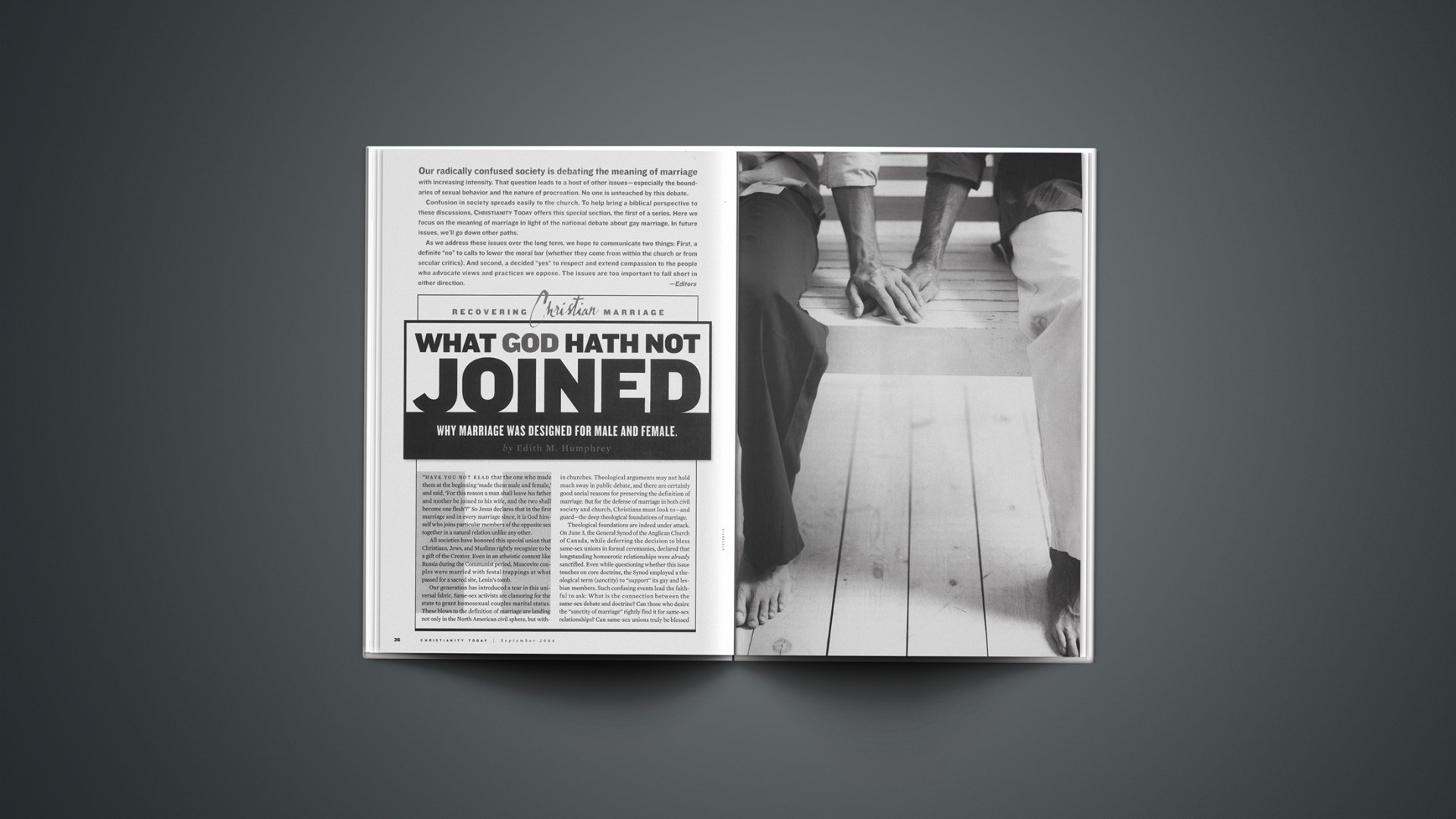

Our radically confused society is debating the meaning of marriage with increasing intensity. That question leads to a host of other issues—especially the boundaries of sexual behavior and the nature of procreation. No one is untouched by this debate.
Confusion in society spreads easily to the church. To help bring a biblical perspective to these discussions, Christianity Today offers this special section, the first of a series. Here we focus on the meaning of marriage in light of the national debate about gay marriage. In future issues, we’ll go down other paths.
As we address these issues over the long term, we hope to communicate two things: First, a definite “no” to calls to lower the moral bar (whether they come from within the church or from secular critics). And second, a decided “yes” to respect and extend compassion to the people who advocate views and practices we oppose. The issues are too important to fall short in either direction. —Editors
“Have you not read that the one who made them at the beginning ‘made them male and female,’ and said, ‘For this reason a man shall leave his father and mother, be joined to his wife, and the two shall become one flesh’?” So Jesus declares that in the first marriage and in every marriage since, it is God himself who joins particular members of the opposite sex together in a natural relation unlike any other.
All societies have honored this special union that Christians, Jews, and Muslims rightly recognize to be a gift of the Creator. Even in an atheistic context like Russia during the Communist period, Muscovite couples were married with festal trappings at what passed for a sacred site, Lenin’s tomb.
Our generation has introduced a tear in this universal fabric. Same-sex activists are clamoring for the state to grant homosexual couples marital status. These blows to the definition of marriage are landing not only in the North American civil sphere, but within churches. Theological arguments may not hold much sway in public debate, and there are certainly good social reasons for preserving the definition of marriage. But for the defense of marriage in both civil society and church, Christians must look to—and guard—the deep theological foundations of marriage.
Theological foundations are indeed under attack. On June 3, the General Synod of the Anglican Church of Canada, while deferring the decision to bless same-sex unions in formal ceremonies, declared that longstanding homoerotic relationships were already sanctified. Even while questioning whether this issue touches on core doctrine, the Synod employed a theological term (sanctity) to “support” its gay and lesbian members. Such confusing events lead the faithful to ask: What is the connection between the same-sex debate and doctrine? Can those who desire the “sanctity of marriage” rightly find it for same-sex relationships? Can same-sex unions truly be blessed in the churches?
The cry goes up that the biblical teaching must be surpassed, since “God is doing a new thing.” What is the style of God’s action in the world? How does the Bible describe God’s activity and homoeroticism itself? In Romans 1:18-32, Paul traces the drama of creation, sin, idolatry, and rebellion. Wonderfully, the created order provided a window through which God’s glory can be seen (20). Humanity drew the blinds over this window, however, when it acted willfully, giving neither honor nor thanks to the Creator.
But true atheism is not possible for those made to worship. Human beings simply exchanged loyalties, worshiping creatures rather than God (23). God’s response to this senseless idolatry was to permit the natural consequences (24, 26). Paul gives a vivid example of this fallout: Human passions are disturbed and the primary created relationship (male and female) is distorted into homoerotic behavior (24, 26-27).
Though the emphasis is on bodily disruption, the consequences go beyond the body to the entire self (27). Thus Romans 1 understands homoerotic behavior as an example of what happened to humanity in terms of the body and the passions, before it goes on to consider sins that arise within the disordered mind (28-31).
Homoerotic activity, then, is symptomatic of the primal rebellion against God—alongside covetousness, murder, strife, gossip, deceit, disloyalty, and pride.
No doubt Paul places it first because this condition shows brokenness in God’s creative order and within the ordained union of male and female (Gen. 1:27). Homoeroticism thus represents an exchange (Rom. 1:26) of what is “natural” for what is “against nature,” and is a primary breach between the two designed for each other. These relations dramatize human rejection of God’s primal purposes.
Some have claimed that, because Paul uses homoeroticism only as an illustration, Romans 1 does not speak regarding sexual ethics. This can hardly be so. Would anyone apply the same reasoning to the other signs of depravity cited here, like murder? Paul assumes that his readers agree with his assessment of homoerotic activity, and helps them to understand it in the context of the scriptural story of origins.
Holiness Narratives
In light of this larger narrative, we go back to the Old Testament. In Genesis 18:16–19:29 (and a similar story in Judges 19), the male inhabitants of a city attempt to rape visitors. Some have argued that Sodom’s sin was not sexual but simply a breach of hospitality. This is highly unlikely, since Lot’s daughters were offered as a sexual substitute.
The intended sin here is gang rape, though it is true that where other passages mention Sodom (Isa. 1:10ff., Jer. 23:14, Eze. 16:49ff.), they emphasize hypocrisy, falsehood, and arrogance over sexual sin. Yet as Judaism and Christianity encountered later Hellenistic acceptance of homoeroticism, the sexual element in the Genesis story was highlighted: Intertestamental writings cite Sodom as an example of sexual perversion (cf. Jude 7).
We turn from narratives to injunction. Leviticus 18:22 says bluntly: “You shall not lie with a male as with a woman; it is an abomination” (cf. Lev. 20:13). Some within the church argue that such prohibitions concern only cultic practices in ancient Israel and so are no longer binding on Christians. But some Levitical proscriptions concern immoral behavior, not simply ritual uncleanness. We need to ask, How does the general pattern of the Scriptures direct us to understand this prohibition?
The answer is that homoerotic behavior contradicts God’s purpose for all his creatures. It is not in the same category as the cultic or cultural prohibitions regarding non-kosher foods and the twining together of two types of thread. Like the prohibition of incest (Lev. 18:6-18), the prohibition of homoerotic acts addresses every age.
As the New Testament epistles show, the early church did not discard what the Hebrew Bible said about sexual ethics. When Corinthian Christians thought that their spiritual sophistication gave them license to sin, Paul challenged them (1 Cor. 6:9ff.): “Do you not know that evildoers will not inherit God’s kingdom?” Then he offered as examples those who steal, get drunk, scorn what is holy, pursue sexual immorality, and practice two modes of male homoerotic behavior.
Some argue that we cannot understand Paul’s reference to these two behaviors (malakoi and arsenokoitai, as in 1 Cor. 6 and 1 Tim. 1) in terms of homoeroticism. But arsenokoitai is in fact a compound word derived from the Greek version of Leviticus 20:13 for those men “who lie with a male.” Malakoi means literally “soft ones” and in Greek writings frequently identified the passive homoerotic partner. It is a mistake to limit the term’s meaning, as do some, to masturbation, or as the NRSV does, to male prostitution.
The Genesis narratives, because they are stories, and the Levitical passages, because they are part of a code given to Israel in particular, must be considered in light of the whole biblical narrative. When we do this, the lists of immoral behavior in and show that the early Christian communities held firm to Old Testament views of sexual immorality—for reasons consistent with Romans 1.
Revising Paul
The moral tradition of the church, from the earliest period into the Reformation and since, has been emphatic: Homoerotic behavior is against the will of God.
Those who reject this tradition take several tacks, for example: “The church has fudged on other controversial issues, and homosexuality is the same.” What about female ministry and slavery, critics ask; doesn’t the Bible forbid the one and accept the other, yet the church does what it thinks best anyway?
In fact, female ministry and slavery are handled differently from text to text in the Bible (e.g., on female ministry: 1 Cor. 14:33b-35 vs. 1 Cor. 11:4-5; 1 Tim. 2:11 and 1 Tim. 3:11, cf. Rom. 16:1). Without addressing these issues at length, we can see that, at the least, there are internal tensions in Scripture regarding female ministry and slavery. But there is no internal tension among the passages that speak of homoerotic behavior.
Others undermine the biblical teaching by suggesting, “Paul was talking about something else.” That is, he forbids homosexual practice to people who are by nature heterosexual; he judges those who are not truly homosexual but who act homoerotically “against [their] nature” (Rom. 1:26). Thus, they say, Paul would not disapprove the practice by those who are by nature homosexual.
The mistake here is to think that in Romans 1, Paul has in mind certain individuals or types. Instead, he is painting on a large canvas, speaking about the problems of Israel in the context of God’s dealings with all humanity (Adam and the Gentiles). He is not speaking of individuals, but of humanity in general, and of one sign (homoeroticism) that our original wholeness has been broken. To introduce specific categories, those who act homosexually “according to nature,” and those who do so “against nature,” is to muddle Paul’s point.
Some limit Paul’s words by saying that he is decrying those who sell their bodies for gain (so making malakoi or arsenokoitai to mean male prostitution). There is simply no evidence whatever for this, notwithstanding the serpentine arguments of John Boswell’s Christianity, Social Tolerance, and Homosexuality (1980) and in L. William Countryman’s Dirt, Greed and Sex (1988). Paul’s problem with homoerotic behavior is specifically its same-sex quality, not power-relations or the economics of sexual trade.
But could Paul’s disapproval of homoeroticism be limited to those who practiced pederasty, that ancient Hellenistic practice of erotic behavior with young males? In fact, the Graeco-Roman “ideal” of the “love of boys” did not mean children, but teenage males, of the same age that young women would be given in marriage. The exploitation of children is not the issue, as we can see from the parallel judgment upon lesbianism in Romans 1:26.
Still other revisionists sidestep Scripture and tradition in claiming, “It’s not immoral; they just thought like that back then.” They dismiss the Old Testament as outmoded, then argue similarly that the New Testament material is culturally conditioned. Paul insisted in 1 Corinthians 11 that women cover their heads in worship because it meant something in that culture, but they say it doesn’t mean anything now. Similarly, he prohibited same-sex erotic relations because they were not acceptable in his circles at that time, but times have changed.
But Paul’s times, in fact, were “gay-positive” or at least “gay-tolerant.” Paul and other New Testament writers take a decisive stand against behavior frequently condoned and sometimes idealized in the surrounding cultures. What was wrong then is wrong now.
Sometimes an appeal is made to contemporary opinions about same-sex relations: “Yes, Paul disapproved of such activity, but he had nothing whatsoever to say about homosexuality as we understand it today.” The biblical writers, they claim, assumed that homoerotic behavior was an avoidable moral choice, but if Paul had had the benefit of our psychological studies, he would have taken a different position. If people are born gay, how can it be sinful?
In reality, it makes little difference whether nature or nurture inclines us toward any one sexual behavior. Paul was well aware of the compulsive nature of sin. He put forth the gospel as God’s means of dealing with the sin that enslaves us, as well as with sins we deliberately choose.
A bold variation on the argument that Paul was scientifically limited is that he was theologically limited. So Eugene Rogers (Sexuality and the Christian Body, 1999) argues that God’s grace is wider even than Paul himself suspected, embracing same-sex couples as well as Jew and Gentile.
Paul, Rogers claims, says that God himself acts “against nature” in “grafting” Gentiles into the olive tree, the people of God (Rom. 11). Similarly, Rogers argues, God can act “against nature” in approving same-sex relations. This, however, reads against the sense of both Romans 1 and 11. Romans 1 speaks about what is contrary to nature in the created order. Romans 11 offers a figure of speech to help the Roman Gentile Christians appreciate their inclusion by God.
Rogers strangely clinches his argument: Same-sex couples find in their union “a means of grace,” so it must be holy. This appeal to experience that contradicts Scripture is the most common revisionist position today. We know better than Paul and other writers of Scripture, he says, because they just didn’t understand the grace that characterizes the loving union of two men or two women. Wasn’t Jesus always welcoming outcasts from Israel among his followers? Now God, Rogers says, is doing something similar but new in the church.
A Distorted Image
But what does it mean for the church to give an authentic welcome of people? No one is to be excluded from the church or any aspect of its life by being Jew or Gentile, male or female, slave or free. The revisionists insist that homoerotic orientation (and, they imply, expression) is just as central to a person’s identity and equally no bar to inclusion in the church.
But what of Jesus’ call to repentance? To a woman caught in another sexual sin, adultery, he says, “Go and sin no more.” The revisionists remove homoerotic sin from the lists of sins in the New Testament and treat homoerotic relations as though they fit with Paul’s list of Jew or Greek, slave or free, male and female. They obscure the crucial distinction between characteristics over which one may have little or no control (such as same-sex desires), and actions for which one must answer to God. It is true: There is no “gay” or “straight” in the church, but God’s purpose in including us all within the household is to heal, not to bless our sinful behaviors (Rom. 6:1-4). Loving those who call themselves gay or lesbian means including them in God’s universal call to repentance.
How, then, should Christians view the promotion of the “marriage” or “blessing” of same-sex couples? For 2,000 years Christians have recognized these sexual relations as grievous sin; how could we in a few short years come to call it sanctified? The recklessness of the gay-positive project and the resulting schisms should show even its champions that this change is not from God.
Some would say that this reversal in Christian sexual ethics does not touch the core of the faith and is therefore no grounds for church splits. They are mistaken. This accommodation to a society’s declining mores, instead, divides those who embrace it from the church historic.
Is the attempt to bless homoerotic relations truly heretical? It is true that this is not an obvious theological attack on, say, the divinity of Christ or the necessity of the Atonement. But it is indirectly heretical because it upholds a corrupt imitation of marriage, which should properly be a living icon of Christ and the church—a theological picture that mediates God’s glory and truth, directing us to the greater reality. Paul calls marriage a “great mystery” that speaks of Christ and the church (Eph. 5:32). So, for example, husbands are to love their wives as Christ loves the church. Indeed, the relations of husband and wife, and of Christ and the church, illuminate each other.
Husband and wife, representing Christ and the church, can only be parodied in same-sex “marriage.”
What else do we see in this icon for marriage? For one thing, without Eve, Adam was alone and had no companion fit for him (Gen. 2:20). God gave Eve to Adam and Adam to Eve. The difference in gender of husband and wife, united in marriage, points to the wonder of the Trinity, our ultimate pattern of “other-but-same in relationship.” Homoerotic relations reject the gift of sexual otherness and cannot echo the nature of the Trinity.
Furthermore, marriage is not an end in itself but overflows, most obviously to the procreation of children. The original couple is exhorted to “be fruitful and multiply” and thus to take care of creation. By its nature, gay sex cannot bear fruit or fulfill this ecstatic (“going out”) role.
God himself enacted the first marriage covenant. A marriage, like the relation of Christ to the church, is not finally a human creation. (Hence the Orthodox insist that a marriage is effected by God himself, and Roman Catholics say the priest is only a witness.) In contrast, God does not join people of the same sex together but calls the behavior they seek to sanctify an abomination. To bless homoerotic relations underscores human willfulness.
If the character of marriage is iconic, what would a same-sex “blessing” or marriage supposedly show us? For one, the church would be giving thanks to God for the sexual union of two men, or two women—declaring that the pair represents God’s love and salvation. It would be declaring that couples that exclude one gender represent such love and salvation. It would be claiming that they are taken up together into God’s own actions and being. It would be proclaiming that they have a fruitful part in creation, and that they are symbols of the in-breaking rule of God.
“To bless” (Grk., eu-logein) is to “speak a good word” about this alliance, asserting that it brings together the way of the Cross and the way of new life. Such a blessing alleges that the relationship fosters repentance, healing, and glorification for the couple. Precisely here, the church would be saying, you can see the love of God in human form and the glory of humanity. Here would be, in one sense at least, a sacrament—an occasion where God meets us.
A church doing this is replacing God with an idol. It is commending to the family of God, and thus to the world, activities that lead to spiritual death. It is praying against its true nature, indeed, denying its true nature. Finally, the particular body (congregation or communion) is rending itself from the one, holy, catholic, and apostolic church. As Karl Barth has observed, heresy raises the troubling question of the boundaries of the church. While the church may learn from its conflict with heresy, there is no “middle way” here between faithfulness and the revisionist position.
In communions where homoerotic behavior has been accepted, there have been other signs of departure from the faith in the ethical sphere, such as the acceptance of divorce and remarriage on nonbiblical grounds, and of abortion. Promotion in the churches of same-sex blessings or marriages is only the most recent and flamboyant accommodation to declining Northern or Western mores.
This is not the first time the church has had to wrestle with capitulation to the spirit of the age, nor will it be the last.
As serious as things may seem, we hope in the One who said that the gates of hell would not prevail against his church. So we will not lose perspective and begin to treat homoerotic behavior as though it were the worst sin, or as though we did not have to take heed lest we stumble ourselves (see Rom. 2).
Again, we must not assume that those promoting this blessing in the churches cannot change their minds, or that those involved in this lifestyle cannot repent; many have, and many more will. Those wrestling with same-sex desires need support for their healing as persons. Their full inclusion into the life of the church, including the discipline of repentance and the grace of transformation, points to the God who “makes all things new.”
Edith M. Humphrey is associate professor of New Testament at Pittsburgh Theological Seminary.
Copyright © 2004 Christianity Today. Click for reprint information.
Related Elsewhere:
Christianity Today‘s past coverage of the gay marriage debate includes:
The Next Sexual Revolution | By practicing what it preaches on marriage, the church could transform society. (Aug. 27, 2003)
My Two Dads? Not in Florida | U.S. Circuit Court upholds ban on gay adoption (March 11, 2004)
Speaking Out: Why Gay Marriage Would Be Harmful | Institutionalizing homosexual marriage would be bad for marriage, bad for children, and bad for society. (Feb. 19, 2004)
Let No Law Put Asunder | A constitutional amendment defending marriage is worth the effort. (Jan. 26, 2004)
Massachusetts Court Backs Gay Marriage | Christians say gay activists will overturn marriage laws (Dec. 10, 2003)
‘AMan and a Woman’ | Activists say the Federal Marriage Amendment will be the defining issue in the next election. (Nov. 24, 2003)
The Marriage Battle Begins | Profamily and gay activists agree: Texas decision sets significant precedent. (Aug. 11, 2003)
Canada Backs Gay Marriages | Conservatives say decision could put pressure on dissenting churches. (July 16, 2003)
Marriage in the Dock | Massachusetts case on gay marriage could set off chain reaction. (April 25, 2003)
Christian Conservatives Split on Federal Marriage Amendment | Law would protect marriage from courts, but legislatures could still extend marital benefits to same-sex unions. (July 20, 2002)
Defining Marriage | Conservatives advocate amendment to preserve traditional matrimony. (October 1, 2001)
No Balm in Denver | Episcopalians defer debate over same-sex blessings for another three years. (July 17, 2001)
Marriage Laws Embroil Legislatures | New Englanders push for domestic-partner benefits. (April 26, 2001)
Presbyterians Propose Ban on Same-Sex Ceremonies | Change to church constitution, which passes by only 17 votes, now goes to presbyteries. (July 5, 2001)
Sticking With the Status Quo | United Methodists reject gay marriage, ordination. (May 15, 2000)
Presbyterians Vote Down Ban on Same-Sex Unions | Opponents say vague wording led to defeat. (March 29, 2001)
States Consider Laws on Same-Sex Unions California to vote on ‘limit on marriage’ in March (Jan. 10, 1999)
Presbyterians Support Same-Sex Unions (Dec. 10, 1999)
Pastor Suspended in Test of Same-Sex Marriage Ban (Apr. 26, 1999)
Same-Sex Rites Cause Campus Stir (Aug. 11, 1997)
State Lawmakers Scramble to Ban Same-Sex Marriages (Feb. 3, 1997)
Clinton Signs Law Backing Heterosexual Marriage (Oct. 28, 1996)
The Alliance for Marriage site includes a section on its proposed marriage amendment. The site also has collected press excerpts on the amendment.
The Defense of Marriage Act (DOMA) does two things: it provides that no State shall be required to give effect to a same-sex marriage law of another state, and it defines the words “marriage” and “spouse” for purposes of Federal law. It was passed in 1996.
In a 1996 Christianity Today column, Charles Colson said that “accepting same-sex relationships as the moral and legal equivalent of marriage will transform the very definition of marriage—with far-reaching repercussions.”
Concerned Women for America have an archive of articles in response to the same-sex marriage issue.