You're in a burning room with a wheelchair-bound adult and a freezer full of blastocysts. You can't save both the tiny embryos and the adult, so whom do you save?
I was asked this question by Hans S. Keirstead, an embryonic stem-cell researcher at the Reeve-Irvine Research Center in Southern California. He wanted to show that, when push comes to shove, all of us grade human life on a sliding scale. What he didn't realize was that he was talking to a woman who had once chosen the life of the embryo growing inside her over her own life as she had envisioned it.
Ever since speculation over the healing potential of human embryonic stem cells began circulating after scientists isolated them in 1998, I have wondered what I would do if scientists ever extracted a cure for my child's incurable disease from tiny human lives like the one I had cherished. I set out to find answers by talking to two stem-cell scientists about the ethics of their work. It was a remarkable entry into a world of half-truths, hesitancy, and awkward logic.
'That Thing Could Make a Child'
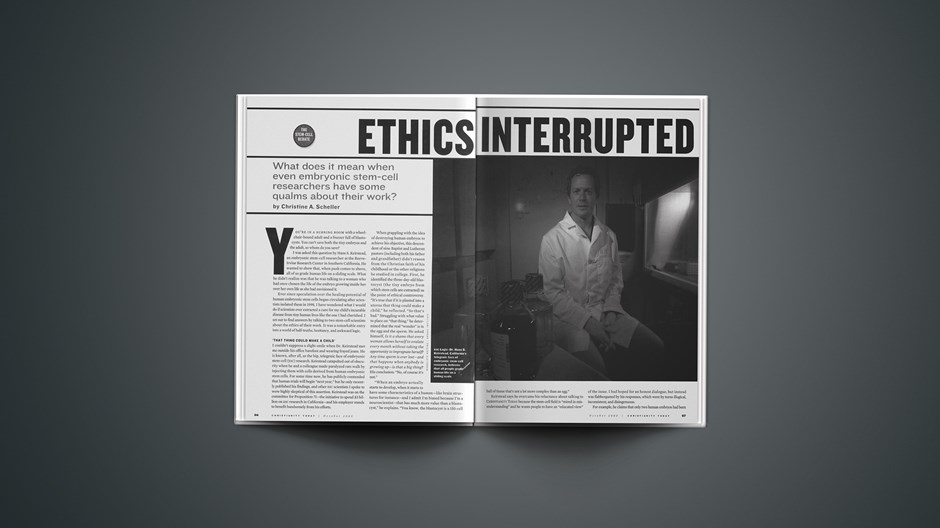
I couldn't suppress a slight smile when Dr. Keirstead met me outside his office barefoot and wearing frayed jeans. He is known, after all, as the hip, telegenic face of embryonic stem-cell (ESC) research. Keirstead catapulted out of obscurity when he and a colleague made paralyzed rats walk by injecting them with cells derived from human embryonic stem cells. For some time now, he has publicly contended that human trials will begin "next year," but he only recently published his findings, and other ESC scientists I spoke to were highly skeptical of this assertion. Keirstead was on the committee for Proposition 71—the initiative to spend $3 billion on ESC research in California—and his employer stands to benefit handsomely from his efforts.
When grappling with the idea of destroying human embryos to achieve his objective, this descendent of nine Baptist and Lutheran pastors (including both his father and grandfather) didn't reason from the Christian faith of his childhood or the other religions he studied in college. First, he identified the three-day-old blastocyst (the tiny embryo from which stem cells are extracted) as the point of ethical controversy. "It's true that if it is planted into a uterus that thing could make a child," he reflected. "So that's bad." Struggling with what value to place on "that thing," he determined that the real "wonder" is in the egg and the sperm. He asked himself, Is it a shame that every woman allows herself to ovulate every month without taking the opportunity to impregnate herself? Any time sperm is ever lost—and that happens when anybody is growing up—is that a big thing? His conclusion: "No, of course it's not."
"When an embryo actually starts to develop, when it starts to have some characteristics of a human—like brain structures for instance—and I admit I'm biased because I'm a neuroscientist—that has much more value than a blastocyst," he explains. "You know, the blastocyst is a 150-cell ball of tissue that's not a lot more complex than an egg."
Keirstead says he overcame his reluctance about talking to Christianity Today because the stem-cell field is "mired in misunderstanding" and he wants people to have an "educated view" of the issue. I had hoped for an honest dialogue, but instead was flabbergasted by his responses, which were by turns illogical, inconsistent, and disingenuous.
For example, he claims that only two human embryos had been destroyed to create the federally approved stem-cell lines used in his research. Surprised by this declaration, I asked if he anticipated the destruction of any other embryos in his work. "No," he said. "For the rest of my career, probably no. I have what I need." (He later back-pedalled, admitting that he would like one or two more lines for "racial diversity.")
Then he added, "This idea of the destruction of multiple embryos being a problem … is complete nonsense. And I think that if you talk to any scientist for or against stem cells, they're going to tell you that's the case. … You only need a couple, and they will service the research community—that's hundreds and hundreds of scientists—for 20 to 30 years."
According to Phil Schwartz, director of a National Institutes of Health Human Embryonic Stem-Cell Culture training course that I attended, establishing a successful stem-cell line is a very difficult thing to do. In order to create 17 privately funded lines at Harvard University last year, 286 embryos were destroyed. And if no new lines are necessary, what was the point of Proposition 71?
Keirstead downplayed the promise of adult stem-cell research, saying, "Getting the tissue is difficult, their efficacy is limited, many of the results have been challenged, [and] the diseases you can apply them to are very, very few." When I mentioned the work of Carlos Lima, a Portuguese scientist who has reported success in treating paralyzed patients by injecting stem-cell-like olfactory glia cells into their spinal cords, Keirstead denounced Lima's research as "controversial" and "unethical."
Article continues below
He said Lima had taken biopsies of his subjects' spinal cords during surgery. This would "never, ever be allowed in North America" because one of the tenets of ethical research is to do no harm to the research subject.
Did he miss the irony?
Next I asked him about the findings of Evan Snyder, a researcher at the Burnham Institute in La Jolla, California, who days before our conversation reported that neural stem cells have a homing capacity that causes them to target brain tumors. Again, Keirstead's logic lapsed. "It's not done in humans. That's done in rats and mice." Just like Keirstead's own research.
The conversation moved to cloning. I asked whether women would be exploited to collect their eggs for what he calls the "mach two" phase of embryonic stem-cell research. In it, human embryos will be created to provide "custom stem cells" as "research tools." He said, "That is absolutely hogwash." And yet, a couple weeks later, Schwartz showed me an advertisement he had pulled from an in-flight magazine offering women cash for their eggs to be used in "somatic cell nuclear transfer." Such nomenclature is designed to promote the science of "therapeutic" cloning without the unpleasant implications.
Our conversation intensified after I asked Keirstead if he ever has any doubts about his work. That's when he proposed the burning-room analogy and launched into an exuberant sales pitch. It began, "I think the use of these cells is an ethical and responsible thing to do. … It's beautiful. It's a wonderful, wonderful thing, and how can we sleep if we don't use it?" Next he described a litany of difficulties faced by people in wheelchairs, and told me the story of a quadriplegic coworker's hellish weekend, which she spent lying in her own waste because of a home health aide scheduling mix up.
The Trump Card of Compassion
I explained that I empathized with the suffering of quadriplegics: My husband had witnessed a close friend's all-terrain-vehicle accident when they were young adults, and we had watched that friend deteriorate and die in his mid-30s.
Keirstead assumed the close: "It's heartbreaking. We've got to do the best we can to help. When I look at the field as a scientist, human embryonic stem cells, like it or not, are the best cells out there."
I asked, "Is there a limit to the virtue of compassion?"
Article continues below
"Very good question," he enthused, "How far should we go?"
I recalled that one of the architects of Proposition 71, the parent of a diabetic child, had declared that parents would go as far as they have to go to save a child.
He agreed: "This is a beautiful point you're raising here."
I didn't think it was fair to let him go on like this, so I finally offered my tight-throated, nervous confession: The choice that was obvious to him in his burning-room analogy wasn't so clear-cut for me. I said that when I was a pregnant unwed 19-year-old, the size of the embryo inside me wasn't a consideration. I simply knew it was a life that I had no right to take. Then I claimed my own stake in the drama of human suffering by relating the moral dilemma that any potential ESC cures would create for parents who, like me, have children with incurable diseases. It's one thing to deny yourself medical treatment you object to on moral grounds; it's quite another to deny your sick child treatment.
All that emotional energy suddenly burst and went rolling out the door of his tiny office as I composed myself and he absorbed what I had said. With a newly subdued demeanor, he changed course, arguing immediately for "choice." He did make some concessions, declaring that he would be "uncomfortable working on anything that hadn't been rigorously debated in a public forum."
"That's why I'm talking to you," he added. "I don't think anybody should be afraid of the viewpoints of any opposition. You should really embrace them and try to work together through them. … If there is something wrong with this morally that I can be convinced of, then I want to hear it. I don't want to be using my life's energy to propagate anything but good."
Determining what the good is presents a conundrum for this heavily invested scientist. He doesn't like the idea of "deferring" to ethicists, but does like the idea of peer review within the scientific community. In an e-mail I asked him about his religious affiliation. He replied, "After studying several religions, I … decided that spirituality is a personal matter."
As the conversation wound down, Keirstead mounted a retreat from his conciliatory posture. I weakly asked, "As a society, are we bound by the research imperative?" (Must we use embryos in research because we can?)
"No," he replied. "You're not bound by it. You don't have to go out and buy Rogaine." Baldness was a trait his nine pastoral ancestors had shared, and which he feared growing up.
Article continues below
Four years ago, Dennis Hollinger, president and professor of Christian ethics at Evangelical School of Theology in Myerstown, Pennsylvania, outlined an ethical framework that reads like a map of my conversation with Hans Keirstead. In an essay for the Center for Bioethics and Human Dignity (www.cbhd.org/resources/stemcells/ hollinger_2001-11-15.htm), Hollinger said that at the heart of ESC proponents' argument is "a utilitarian calculus, combined with an unlimited emphasis on the virtue of compassion and undergirded by a worldview of … 'spiritualistic naturalism.'"
According to Hollinger, the problems with utilitarianism include: (1) insufficient evidence that "pleasure for the greatest number of people should be regarded as the defining end of moral action"; (2) justifying actions by their "sought ends" inevitably leads to "morally suspect" means; and (3) "difficult factual judgments" are required when calculating the greatest good for the greatest number, and the necessary objectivity for making those judgments simply does not exist among ESC proponents.
"Compassion as a virtue has become the moral trump card," he wrote. "It is heralded as the virtue above all virtues, for to subjugate compassion to any other moral claim is to exhibit an insensitivity toward and lack of empathy for others. … [This] is one more example of how our culture seeks to determine what is right, good, and just on the basis of what will secure self-enhancement and self-actualization."
Schwartz, director of the NIH training course I attended, is a Christian scientist and reluctant ESC researcher. He and Scott Rae, an ethicist at Talbot School of Theology in La Mirada, California, have come up with a position on ESC research that attempts to guard against Hollinger's fears—doing evil in order to do good.
Schwartz is director of the National Human Neural Stem-Cell Resource at Children's Hospital of Orange County in Southern California. In 2001, he was trying to get NIH funding for groundbreaking work he and a colleague were doing: harvesting neural stem cells from postmortem human brains. The NIH asked him to assist a dissolving company by banking and expanding nine embryonic stem-cell lines. He says, "That was how I got dragged into the embryonic stem-cell field."
Schwartz thinks therapies from ESC research are five to ten years away, but he doesn't necessarily believe they offer more hope than adult stem-cell research.
"Our understanding of all of this is still pretty rudimentary," he says. "We know quite a bit, but compared to what we need to know, we don't know enough. … That's why I'm in full favor of looking at both of them at the same time. I operate the lab that way. There are plenty of [federally approved] cells to work on and plenty of stuff to do with those right now." The consensus among his colleagues at the NIH training course was that there aren't enough trained scientists to work on federally funded lines now available or to take advantage of the NIH funding, which Schwartz says far exceeds the funding rate for most other types of research.
Article continues below
Nonheartbeating Donors
Schwartz generally agreed with President Bush's 2001 directive on ESC research because it put limits on the field while allowing it to move forward, but it took him two years "to get really comfortable" with his own participation. He considered the opinion of the Catholic church, which "came out staunchly against in vitro fertilization 30 years ago" (in part because Catholic thinkers anticipated that the production of excess embryos would create ethical difficulties). He also referenced ancient Jewish leaders who weighed the impact of their decisions on future generations. Schwartz says, "We don't do that at all. We think about what the effect is going to be on us for like two years, and the heck with anything else."
When Doug Melton, the father of two diabetic children who created the 17 stem-cell lines at Harvard, excoriated a member of President Bush's Council on Bioethics for coming up with an alternative to destroying viable embryos, Schwartz reacted strongly to the criticism: "I just want to take people like that and say, 'Listen, you've got a population of people who think this is immoral, and you're going to come up with a treatment that a population of people isn't going to make use of. … We're under a moral obligation to work with bioethicists and other scientists to come up with another way of doing this. … It's not a distraction. This is an obligation.'"
Schwartz is acting on his frustration. After visiting an IVF clinic and doing extensive research, he came up with his own alternative, which he outlined on paper and sent to his senior pastor for an opinion. While fellow Christian scientists told him they were praying for him to get out of the field, the pastor directed him to fellow parishioner Scott Rae. Together they worked through ten drafts of Schwartz's concepts, seeking input from ethicists, practitioners in intensive care medicine, and IVF physicians. Despite Schwartz's professional credentials, the paper was turned down by both The New England Journal of Medicine and Science.
Article continues below
Beginning with the premise that IVF is moral, Schwartz and Rae argue that a small number of leftover embryos are appropriate for research. Blastocysts created through IVF are classified into three grades according to their morphology. Schwartz says that low-grade "C" embryos are only implanted in a prospective mother when higher grade embryos are unavailable, and implantation results in a live birth only 1 percent of the time. He says these embryos are routinely discarded rather than frozen and cannot ethically be donated to another couple. Schwartz and Rae appeal to the nonheartbeating donor protocol in making their case, saying these embryos are analogous to terminally ill, imminently dying patients on life support.
I asked Rae how their position is different from any other utilitarian argument. He admitted that it still makes him nervous. "The thing that is different about the organ donor analogy is that the embryo is not technically dead. I'm not sure how we get over that." Even so, he says, "I think I'm still pretty hard-line because the number of embryos that fit the criteria is actually pretty small. … This really isn't a middle ground."
Rae agrees with Keirstead in identifying the three-day-old embryo as the center of controversy. He says, "The question is: Is it a person? It's a philosophical question, not a scientific one, and we shouldn't be surprised that scientists can't help us with that. They need to be careful that they're not trying to be amateur philosophers when they make philosophical pronouncements."
When it comes to the unique temptations that potential treatments pose for Christian parents, Rae offers a counterbalance to Keirstead: "Each person has to decide how important their principles are. … This is where it leaves the realm of philosophical discourse and goes to the bedside. For now I think we can be pretty confident that adult sources are going to continue to provide effective treatments—at least for the short term."
The scientist whose work resonates most with me turns out to be Evan Snyder, the researcher who discovered the homing capacity of neural stem cells. That's because my son's disease is neurofibromatosis, a nonfatal tumor disease. But we delude ourselves if we imagine solutions will be clear-cut. Like Schwartz, Snyder transcends the boundaries of stem-cell research, and he would prefer to grow neural stem cells from ESC.
Article continues below
Schwartz and Rae impressed me as men of the highest motives, but in the end, their views struck me as utilitarian, like Keirstead's. All these men say they have worked through the ethics of ESC research enough to continue their work. But they answered my ethical probing with some hesitancy, suggesting they are not completely comfortable with what they are doing. That discomfort makes sense. Despite their attempts to fine-tune the ethics, perhaps they grasp intuitively that the issue is not exactly when an embryo becomes a "person," or is given a soul, or whatever word we use to indicate full human status. That point simply cannot be proven biblically, philosophically, or scientifically. It has not been given for us to know.
Perhaps they somehow grasp what many of us have been saying, that this tiny bit of life will, whatever its early status, inevitably become a person, and it is not our prerogative to interrupt that divinely ordained process, even for the sake of compassion. It's a matter of humility before this growing life and our gracious Creator.
Christine A. Scheller is a writer and editor in Southern California.
Our weekly bioethics column, Life Matters, discusses stem cells and related life ethics issues. Nigel M. de S. Cameron's latest column was "Leon Kass, a Bioethics Legend, Steps Down."
More CT articles on stem-cell research includes:
The Stem-Cell Conspiracy | The Washington Post muddles a major breakthrough in adult stem-cell research, while the U.K. marches blindly on. (Aug. 29, 2005)
Post-Election Education | Pro-lifers weigh options after Californians fund embryonic stem-cell research. (Dec. 1, 2004)
The Politics of Stem Cells | Why do some scientists and politicians insist on exploiting embryos? (Nov. 17, 2004)
It's Not About Stem Cells | Why we must clarify the debate over harvesting embryos. (A Christianity Today editorial—Sept. 29, 2004)
















 While we pray for peace, we need moral clarity about this war.
 As my doubts about his teachings grew, so did a secret fascination with Jesus.
 The plan would organize UMC churches in four global regions, with each given more leeway around same-sex marriage and other theological issues.






