The universal language of relief needs no words. Clean water, high-protein food, cooking utensils, cups, water bottles, blankets, tents, mosquito nets to protect from the spread of cholera and malaria, and even feminine hygiene products—all are tangible phrases in the tongue understood by the victims of the disaster that tore into South Asia.
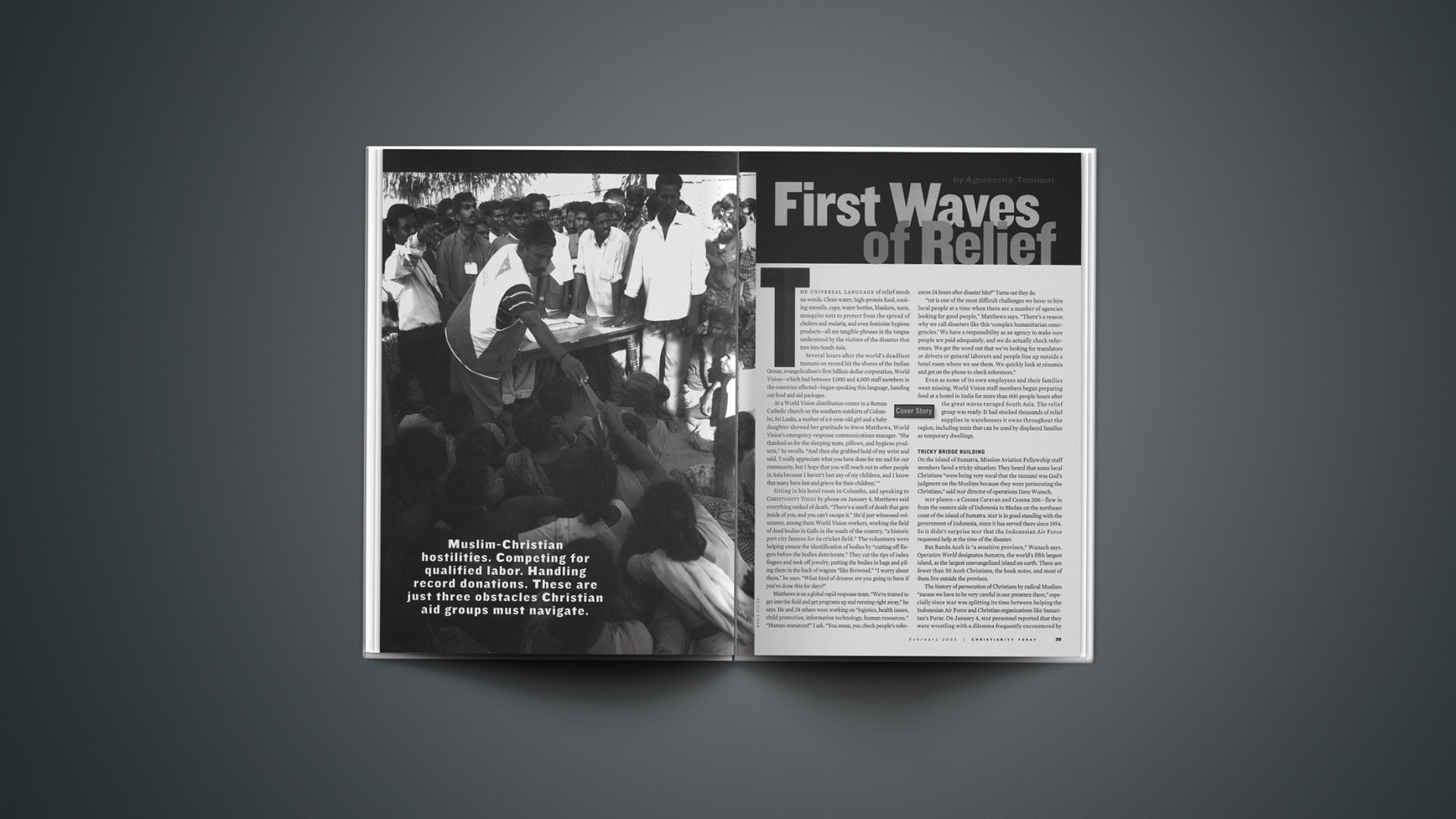
Several hours after the world’s deadliest tsunami on record hit the shores of the Indian Ocean, evangelicalism’s first billion-dollar corporation, World Vision—which had between 3,000 and 4,000 staff members in the countries affected—began speaking this language, handing out food and aid packages.
At a World Vision distribution center in a Roman Catholic church on the southern outskirts of Colombo, Sri Lanka, a mother of a 6-year-old girl and a baby daughter showed her gratitude to Steve Matthews, World Vision’s emergency-response communications manager. “She thanked us for the sleeping mats, pillows, and hygiene products,” he recalls. “And then she grabbed hold of my wrist and said, ‘I really appreciate what you have done for me and for our community, but I hope that you will reach out to other people in Asia because I haven’t lost any of my children, and I know that many have lost and grieve for their children.’ “
Sitting in his hotel room in Colombo, and speaking to Christianity Today by phone on January 4, Matthews said everything reeked of death. “There’s a smell of death that gets inside of you, and you can’t escape it.” He’d just witnessed volunteers, among them World Vision workers, working the field of dead bodies in Galle in the south of the country, “a historic port city famous for its cricket field.” The volunteers were helping ensure the identification of bodies by “cutting off fingers before the bodies deteriorate.” They cut the tips of index fingers and took off jewelry, putting the bodies in bags and piling them in the back of wagons “like firewood.” “I worry about them,” he says. “What kind of dreams are you going to have if you’ve done this for days?”
Matthews is on a global rapid response team. “We’re trained to get into the field and get programs up and running right away,” he says. He and 24 others were working on “logistics, health issues, child protection, information technology, human resources.” “Human resources?” I ask. “You mean, you check people’s references 24 hours after disaster hits?” Turns out they do.
“HR is one of the most difficult challenges we have: to hire local people at a time when there are a number of agencies looking for good people,” Matthews says. “There’s a reason why we call disasters like this ‘complex humanitarian emergencies.’ We have a responsibility as an agency to make sure people are paid adequately, and we do actually check references. We get the word out that we’re looking for translators or drivers or general laborers and people line up outside a hotel room where we see them. We quickly look at résumés and get on the phone to check references.”
Even as some of its own employees and their families went missing, World Vision staff members began preparing food at a hostel in India for more than 600 people hours after the great waves ravaged South Asia. The relief group was ready: It had stocked thousands of relief supplies in warehouses it owns throughout the region, including tents that can be used by displaced families as temporary dwellings.
Tricky Bridge building
On the island of Sumatra, Mission Aviation Fellowship staff members faced a tricky situation: They heard that some local Christians “were being very vocal that the tsunami was God’s judgment on the Muslims because they were persecuting the Christians,” said MAF director of operations Dave Wunsch.
MAF planes—a Cessna Caravan and Cessna 206—flew in from the eastern side of Indonesia to Medan on the northeast coast of the island of Sumatra. MAF is in good standing with the government of Indonesia, since it has served there since 1954. So it didn’t surprise MAF that the Indonesian Air Force requested help at the time of the disaster.
But Banda Aceh is “a sensitive province,” Wunsch says. Operation World designates Sumatra, the world’s fifth largest island, as the largest unevangelized island on earth. There are fewer than 50 Aceh Christians, the book notes, and most of them live outside the province.
The history of persecution of Christians by radical Muslims “means we have to be very careful in our presence there,” especially since maf was splitting its time between helping the Indonesian Air Force and Christian organizations like Samaritan’s Purse. On January 4, maf personnel reported that they were wrestling with a dilemma frequently encountered by Christian relief workers in developing countries: “How do we work with the church people there, the Christians”—while not alienating the Muslim officials?
Also in Banda Aceh was Galen Carey, World Relief’s director of advocacy and policy, who on January 4 assisted in relief training for Christians funded by World Relief. He, too, heard of some indigenous Christians aggravating the situation. A small group of Indonesian Christians was asked to leave after they put up a banner in front of their house. “I don’t know what the banner said, but it was an attempt to proselytize. There was an uproar about this.” He’s also seen some people wearing T-shirts with a red cross in front and a message about Jesus on the back. Carey has also heard about some local Christians blaming the disaster on the Muslims, but “it’s not the majority view.”
In fact, he said, the consensus is clear among the coalition of 30 Indonesian church leaders he’s been working with: “This is an unprecedented opportunity to serve the Muslims by giving them aid, and it is not time for proclamation.” These leaders were distributing food and medicine without discrimination by creed, and identified themselves by the neutral name Medan Cares. World Relief networks represent 60 percent of all the churches in Indonesia, Carey said. “They are pooling volunteers, setting up bank accounts to receive contributions, and there’s been incredible cooperation on all levels,” among both the local churches and the Western Christian ngos that have come into the country.
Often “people don’t even realize World Relief is there,” said spokesman Chris Pettit. “It’s our job to give the church the resources it needs and provide money to the volunteers from these countries.”
Starting January 6, about 80 of these volunteers were going to focus on reaching several groups of people who were two to three hours’ hike away and haven’t been seen by any assessment teams yet. “This will be our niche here,” Carey says. “We don’t want to duplicate what the other agencies are doing.”
Samaritan’s Purse is also coming alongside local churches throughout the South Asian region. The idea is to “support their standing with the local population so that after we leave they will have been able to open new and expanded doors of evangelism and other ministry opportunities,” said spokesman Ivan Giesbrecht. “We know these groups from our work the past several years in this country with our Operation Christmas Child program. These folks know the local language, culture, and general lay of the land. Their local knowledge and expertise is invaluable to us.”
Giving in a time of need
Back in North America and Europe, people who have learned to trust World Vision and other Christian relief organizations rushed from TV sets to their computers after hearing of the disaster. World Vision broke its fundraising record. Unsolicited donations (most of them made online) in the first 48 hours following the December 26 catastrophe amounted to $1 million. The night of January 3, as he rode to a Los Angeles airport to fly to Asia, World Vision International president Dean Hirsch told Christianity Today that the organization had raised between $40 million and $50 million worldwide. Other organizations have reported similar spikes in giving.
An organization’s presence in the region prior to a calamity is a key factor in how efficient that organization can be in using those donations, says Dale Hanson Bourke, a marketing and fundraising consultant to humanitarian organizations (including some mentioned in this story). If an aid group does not have personnel in the affected region, this means that it will have to devote more money to establishing a presence, shipping in supplies, and hiring people when victims need to be clothed and fed. Or it will simply have to pass the money on to another group, she said.
Christianity Today found that the major Christian relief organizations are able to use anywhere from 82 percent to 90 percent of their tsunami donations for relief. The one exception is Mission Aviation Fellowship, which will designate 100 percent of tsunami donations to the relief effort “until we’ve covered all the needs, which we don’t anticipate meeting for at least several years,” says Ghislaine F. Benney, director of development administration. Of course administrative costs still have to be paid, and Benney said that maf would cover overhead and fund-raising costs through the operating budget.
Bourke advised that donors remember the needs of others suffering around the world. “The outpouring [following December 26] is a wonderful example of our generosity,” she said. “But some organizations will take a huge dip in donations.” She noted that Compassion International, which has committed $375,000 to tsunami relief, will still need funds for its work fighting HIV/AIDS in Africa.
Of course, there’s nothing wrong with giving to secular relief groups such as the Red Cross. “I know of many Christians who work in secular relief organizations,” Bourke said. “Many of these groups do admirable work.”
And many—both Christian and non-Christian organizations—hope donors will stick it out with them for the long haul.
The long haul
“The moment disaster happens, we think long term,” said Joe Harbison, Asia director for World Concern. “The stages of relief are similar to stages of grief: shock, denial, acceptance. The types of relief we do must reflect our long-term plans for the people’s ability to care for themselves.” For example, this means caring for the financial well-being of the children whose fishermen fathers lost their lives and whose boats have been damaged.
“One of the biggest concerns in a crisis like this is how to manage the funds,” Carey said. “At the moment there is a lot of attention given to the area, and contributions are coming in. But in some time, the tsunami relief effort will drop off the headlines, and there will be less support coming in at the time of reconstruction, when more money may be needed.”
World Vision’s experts in long-term development were also thinking about what’s going to happen in six months. “We’re estimating that somewhere between 60,000 and 70,000 people in Banda Aceh are without homes,” said World Vision’s Hirsch. “It’s going to take one month to bury the dead there. Because of the extensive nature of this disaster, we’re still in emergency mode. We’re still feeding people, delivering necessities. But we’re there for the long term; there’s no doubt. Eventually, we want to stimulate the economy with microenterprise loans, and get kids back in school. I heard from communications officer Steve Leavitt that out of 300 teachers in Banda Aceh, only 17 showed up for work [on January 3] and only 25 percent of police officers showed up. What we have there is an infrastructure wiped out. Missing teachers and police are a long-term problem.” Which is why the language of relief has a way of morphing into the language of development.
Agnieszka Tennant is an associate editor of Christianity Today.
Copyright © 2005 Christianity Today. Click for reprint information.
Related Elsewhere:
First Waves of Relief | Muslim-Christian hostilities. Competing for qualified labor. Handling record donations. These are just three obstacles Christian aid groups must navigate.
Inside CT
Tsunami Response Team | Last minute disaster reporting
Our full coverage of the Indian Ocean tsunami includes:
Indonesian Christians in NYC Gather Money, Pray for Spiritual Healing | Church thankful that few friends and family were in worst-hit areas. (Jan. 03, 2005)
Church Building and Its Members Reported Swept to Sea | Horrific and hopeful stories emerging from Sri Lankan Christians. (Jan. 03, 2005)
Sri Lanka Bible College Aiding Victims, Churches | More than 30,000 of island nation’s 20 million people dead. (Jan. 03, 2005)
India’s Christians Prominent in Casualties and Aid | Velankanni basilica, Christian fishermen among hardest hit. (Dec. 30, 2004)
Disaster Prompts ‘Neighborly Love’ | The director of Youth for Christ in Sri Lanka meets Christian survivors straining to deliver aid to victims despite their own losses. (Dec. 30, 2004)
Tsunami Survivors Desperate for Aid | Christian groups worldwide mobilize massive relief effort to South Asia. (Dec. 29, 2004)
Other tsunami weblogs include articles on theodicy:
Tsunami Weblog: Combining the Gospel with Aid | Plus: Tensions increase between Muslim militants and aid workers; Christian, Hindu groups fighting to help; Churches giving aid; more theodicy debates; and more articles from online sources around the world. (Jan. 11, 2005)
Tsunami Weblog: UNICEF Confirms the Kidnapping of Tsunami Orphans | Plus: Ake Green condemns Phelps’s attacks on gay Swedes, tax deduction deadline extended for tsunami donations, Muslim radicals provide relief, and other stories from online sources around the world. (Jan. 07, 2005)
Tsunami Weblog: S. Korea Worries Christian Relief Groups May Face Terror Attacks | Plus: Where was God in the disaster? Churches giving aid, and orphaned children kidnapped. (Jan. 06, 2005)
Tsunami Weblog: The World Seeks Meaning | Is God to blame for the tragedy? Plus: the recent tsunami updates, ministry amid the wreckage, and Christians give $millions in relief. (Jan. 05, 2005)
Tsunami Blog: World Vision’s $50 Million Goal | Plus: Commanding the wave to stop in Jesus’ name, missing sponsorship kids, and other stories of faith and works in the wake of tragedy. (Jan. 05, 2005)