



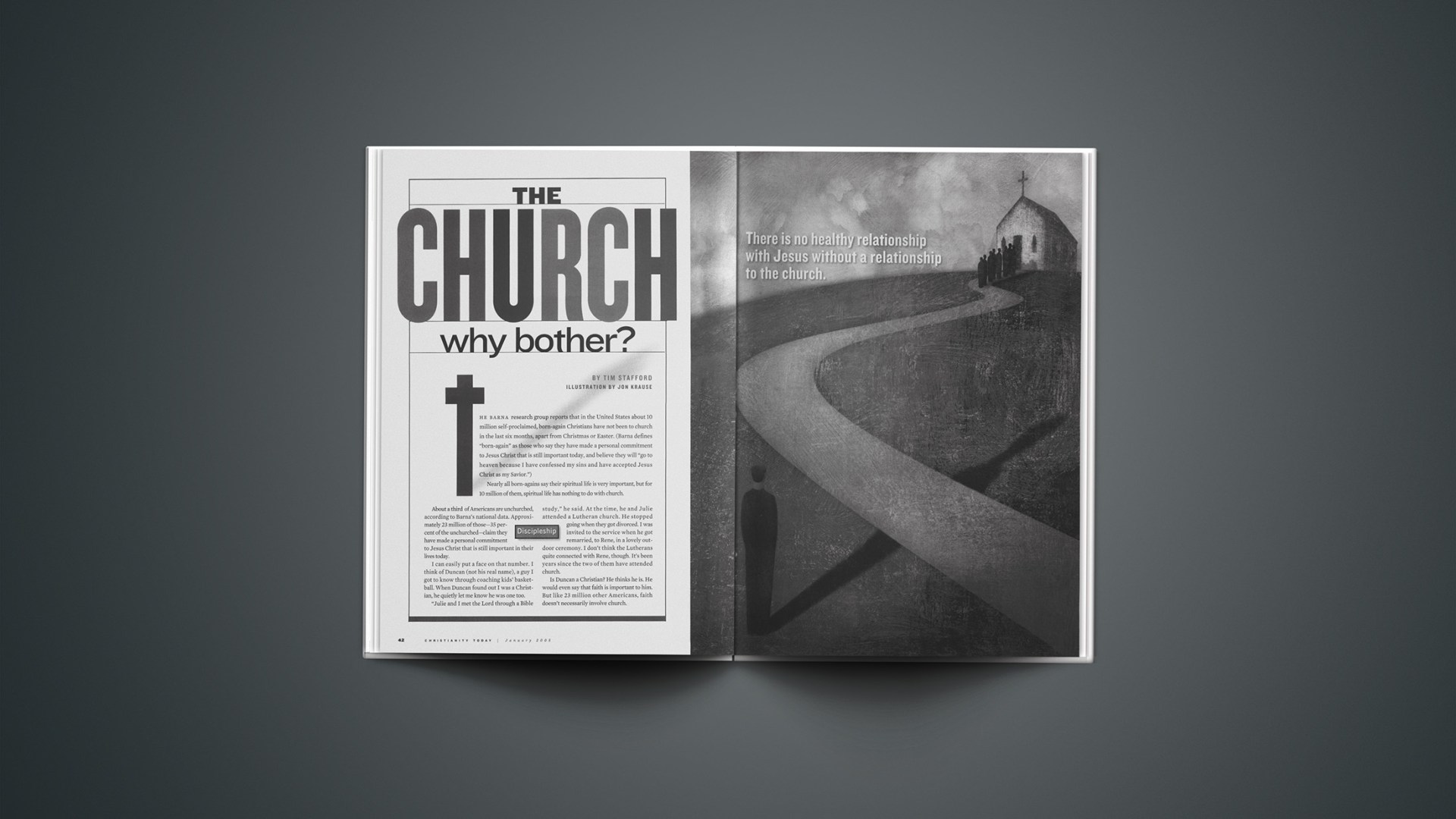

The Barna Research Group reports that in the United States about 10 million self-proclaimed, born-again Christians have not been to church in the last six months, apart from Christmas or Easter. (Barna defines “born-again” as those who say they have made a personal commitment to Jesus Christ that is still important today, and believe they will “go to heaven because I have confessed my sins and have accepted Jesus Christ as my Savior.”)
Nearly all born-agains say their spiritual life is very important, but for 10 million of them, spiritual life has nothing to do with church.
About a third of Americans are unchurched, according to Barna’s national data. Approximately 23 million of those—35 percent of the unchurched—claim they have made a personal commitment to Jesus Christ that is still important in their lives today.
I can easily put a face on that number. I think of Duncan (not his real name), a guy I got to know through coaching kids’ basketball. When Duncan found out I was a Christian, he quietly let me know he was one too.
“Julie and I met the Lord through a Bible study,” he said. At the time, he and Julie attended a Lutheran church. He stopped going when they got divorced. I was invited to the service when he got remarried, to Rene, in a lovely outdoor ceremony. I don’t think the Lutherans quite connected with Rene, though. It’s been years since the two of them have attended church.
Is Duncan a Christian? He thinks he is. He would even say that faith is important to him. But like 23 million other Americans, faith doesn’t necessarily involve church.
Duncan is not a new phenomenon. We have always had people who kept their distance from the church, even though they professed faith. We have never, however, had them in such astonishing numbers. They represent a significant trend, one that almost defines U.S. religion.
I would call it Gnostic faith. For them the spirit is completely separated from the body. They think your spirit can be with Jesus Christ while your body goes its own way.
Not Funny to Luther
A joke: A man is rescued after 20 years on a desert island. His rescuer is astonished to find that the castaway has built several imposing structures.
“Wow!” the rescuer says. “What’s that beautiful stone building overlooking the bay?”
“That is my home,” the castaway says.
“And what about that building over there, with the spires?”
“That,” the castaway says, “is my church.”
“But wait!” the rescuer says. “That building over there, with the bell tower. What is that?”
“That is the church I used to belong to.”
The joke expresses a certain spirit of U.S. church life. We build ’em, and we quit ’em. Somebody will leave a church even if he is the only member.
Until Martin Luther, the church was the immovable center of gravity. The church had authority over individual Christians: to accept them as they approached the church, to baptize them, teach them, and provide them the means of grace.
In the third century, Cyprian, a North African bishop, wrote about a doctrinally orthodox but schismatic bishop named Novatian. “We are not interested in what he teaches, since he teaches outside the Church. Whatever and whatsoever kind of man he is, he is not a Christian who is not in Christ’s Church. … He cannot have God for his Father who has not the Church for his mother.”
Cyprian’s view—summed up in the slogan “No salvation outside the church”—gathered strength in subsequent centuries as the church countered heresies and divisions. It became the universal standard. You were either inside the Catholic Church, Christ’s body—or outside of Christ.
Luther never intended to move that center of gravity. He wanted to purify the church, not defy its authority. Nevertheless, his protests led to schism. Lutheranism was followed by Calvinism, and Anabaptists were not far behind. Methodists and Baptists appeared. Once people started judging for themselves, it was hard to put an end to it. The next thing you know we had 20,000 denominations worldwide—and counting.
Consider three important steps in the transition.
1. In America’s God, historian Mark Noll shows that colonial ministers by and large supported the American Revolution, and with it the republican political creed—opposition to inherited authority and confidence in commonsense philosophy over tradition. (“We hold these truths to be self-evident.”)
This political philosophy has shaped American theology, Noll says. Creeds and tradition became suspect, and commonsense reasoning—a man and his Bible without deference to experts—could settle any question.
As denominations sprouted up, they each argued that they had the best understanding of the gospel, implicitly appealing to the individual Christian to join them. Soon, the poles of power had reversed. Once the individual hoped for acceptance by the church. Now the church hoped for acceptance by the individual.
Funny thing is, many of those denominations today complain that people aren’t loyal to the church. Fuller Seminary president Richard Mouw mentioned a Christian Reformed Church publication criticizing “consumer religion.” Yet the CRC, he pointed out, began with a group of Reformed ministers who attracted people from other parishes with their strict Calvinist orthodoxy. Mouw says, “It’s pretty odd for people in the CRC to say, ‘We don’t want people shopping around.'”
2. The post-WWII generation saw an explosion of parachurch groups like InterVarsity, Youth for Christ, and Campus Crusade. Many young believers experienced their deepest fellowship, nurture, and mission in organizations that said openly that they were not churches. Tod Bolsinger, author of It Takes a Church to Raise a Christian, recalls his days as a youth evangelist.
“I can remember saying to kids, ‘There’s no church to join, there’s nothing to commit to, this is only about a relationship with Jesus.’ Paul wouldn’t preach that message. And the early church didn’t.”
3. Seeker-sensitive churches took up parachurch methodology and applied it to church itself. A good church was judged, in part, by whether it appealed to the tastes of those who did not belong to it.
I admire the evangelistic spirit behind this. It has attracted many people into a church building who would probably not otherwise attend. But I think it has exaggerated a sense that the church must adapt to the general public, not the other way around. And thus many unchurched people feel justified in believing that they are fine, that it is the churches that have failed.
If 23 million Americans who claim Jesus as their Savior have no discernible church connection, they are joined by many more who attend church (between 40 percent and 50 percent of Americans do in a given week, according to Barna) but sit loose in their commitment. A good sermon, a moving worship experience, a helpful recovery group—these they look at to find “a good church.”
When they become dissatisfied, they move on. Their salvation, they believe, is between them and God. The church is only one possible resource.
The Bono Effect
In February 2003, Christianity Today featured Bono, lead singer for the rock group U2, and his campaign for the church to become more involved in the fight against AIDS. Bono emerged as a star example of the unchurched Christian.
Having once been involved in a loosely structured Irish fellowship, Bono now seldom goes to church. He does pray. He likes to say grace at meals. He has a favorite Bible translation. But he doesn’t want to be pinned down.
“I just go where the life is, you know? Where I feel the Holy Spirit,” Bono told Christianity Today‘s reporter, Cathleen Falsani. “If it’s in the back of a Roman Catholic cathedral, in the quietness and the incense, which suggest the mystery of God, of God’s presence, or in the bright lights of the revival tent, I just go where I find life. I don’t see denomination. I generally think religion gets in the way of God.”
In an editorial, “Bono’s Thin Ecclesiology,” CT appreciated Bono’s thirst for social justice, yet criticized his lack of churchly commitment. Bono had voiced sharp criticisms of the church, suggesting it was in danger of irrelevance if it failed to act on AIDS. Wrote CT, “Any person can stand outside the church and critique its obedience to the gospel. Part of God’s call on a Christian’s life is to walk inside and die to self by relating to other human beings, both in their fallenness and in their redeemed glory.”
Letters to the editor fiercely defended Bono. One pointed out that U2 travels with a chaplain—isn’t that equivalent to church? Another suggested that Bono avoided church out of respect for other Christians, since his fame would disrupt worship. A reader complained that white evangelical churches were to blame for Bono’s alienation, since they have become more Republican than Christian. Another reader whose lifelong illness kept her from church wrote, “I do not believe not attending a regular church service … takes away a person’s beliefs, Christianity, or their salvation … . I have faith that Jesus Christ is more fair than that.”
All good points, as far as they go, except that Bono is not too sick to attend church, could find an unpoliticized church if he tried, and doesn’t mention respect for worshipers as a reason for staying away.
Clearly, Bono has chosen to keep his distance from the church, or at least to stay in the shallow margins of the pond, where he can dash for the shore at need.
He has plenty of company.
Wounded by the Church
I don’t want to be hard on Bono and other unchurched Christians. Churches are not always nice places. Some of the church fathers used “No salvation outside the church” to stifle dissent and maintain a monopoly on power. Even today a demand for church commitment can be the basis for abusing people, using fear and conformity to rule.
A significant minority of Christians feel wounded by the church, perhaps by abuse that anyone would recognize, perhaps by abuse so subtle others can’t see it [see “The Church’s Walking Wounded,” March 2003]. Some find any institution difficult—they’re habitual loners. My friend Duncan is like that—an engineer who relates better to machines than to people. His divorce left him groping for handholds in church.
Philip Yancey’s Soul Survivor: How My Faith Survived the Church credits a diverse list of figures—from G.K. Chesterton to Martin Luther King Jr.—with keeping his faith alive. Since all but one, Mahatma Gandhi, are Christians, and the vast majority are loyal church members, one might ask, “So the church enabled your faith to survive the church?”
But Yancey’s problem was not with the church defined as the sum total of Christians. He struggled with what he experienced in actual congregations. He needed another set of Christians to help him redefine his faith, enabling it to survive the church so that he could re-engage the church.
We do not need to condemn those alienated from the institutional church, but to help them reconsider. By keeping away from church commitments, they miss out on life essential.
What’s missing
The hard questions come next: Just what do they miss?
They need not lack the Word of God. The Bible is available through Barnes & Noble, and will undoubtedly continue to be published at a profit even if all the Christians get raptured away. Radio and TV offer excellent Bible teaching. So do books and magazines.
Fellowship? The internet offers chat rooms and Bible study groups. Friends have told me their internet prayer support group reaches more depth and is more dependable than anything they encounter in the flesh.
Worship? Some people find that music CDs provide what they need. Others find great inspiration watching Robert Schuller’s Hour of Power. Anyway, if you need a worship fix you can slip into any big church and leave without bothering a soul.
Granted, you need a church to get baptized and to receive Communion. Let’s admit, though, that in many churches the sacraments are a devalued commodity. The same for church discipline, only more so. If you expect church to provide the bracing rule that purifies souls, forget it in most places.
All that admitted, there still remain overwhelmingly strong reasons for believing that committed participation in a local congregation is essential to becoming what God wants us to be.
The sacraments or ordinances are not optional. They may not make sense to 21st-century sensibilities—but so much the more reason to pay attention to them. The sacraments are not a human tradition. They began with Jesus himself. He himself was baptized, saying it was proper “to fulfill all righteousness” (Matt. 3:15).
Offering bread and wine, he told his disciples, “Take and eat; this is my body” (26:26). Churches may have devalued the sacraments, but they still offer them. Nobody else does. How can you follow Jesus and then … not follow him?
We need the regular rhythm of public worship, which began with the disciples’ gathering on the first day of the week. D.G. Hart, referring to the Reformed liturgical tradition, says, “Being reassured weekly that your sins are forgiven is a great comfort.” He suggests that anything less is too trivial to sustain us through the great crises of life.
Business has found that the teleconference is no substitute for the face-to-face meeting. Neither does singing along to a CD replace singing in a choir of fellow worshipers. Whether we listen or pray or sing, nothing substitutes for human presence in the public performance of worship. The lively, physical reality of others touches our nature as body-persons.
The author of Hebrews had something like this in mind when he wrote, “And let us consider how we may spur one another one toward love and good deeds. Let us not give up meeting together are some are in the habit of doing, but let us encourage one another” (Heb. 10:24-25). Encouragement needs a face; it needs a body.
The church is the body of Christ, the tangible representation of Jesus’ life on earth. As the apostle Paul wrote to the quarreling Corinthians (1 Cor. 12:21), “The eye cannot say to the hand, ‘I don’t need you!'” You could sum up his message this way: “If you miss connecting to the body of Christ, you miss Christ.”
Paul allows no vague representation of the church as the sum of all Christians. The body analogy expresses Paul’s belief that Christ is available on earth in tangible form. These various gifts come in human packages. To be “in Christ” we cannot stand off distant from this body. We absolutely must serve other Christians—parts of his body—in a continuous relationship. A body part detached from other parts is clearly useless, and soon dead. It cannot experience Christ, the head of the body.
We offer perilous advice when we urge people to “find Christ” anywhere but in a local congregation. Can you imagine Paul arriving in a city, finding the local congregation not to his taste and simply staying away? For Paul, a Christian without his church is as unthinkable as a human being with no relatives. A person may quarrel with his kin, but he cannot leave them—they are his own flesh and blood. So it is with the church. And furthermore, they are Jesus’ flesh and blood.
People need people. God’s people need God’s people in order to know God. Life in Christ is a corporate affair. All God’s promises were made to God’s people—plural. All the New Testament epistles address Christians in churches. The Bible simply does not know of the existence of an individual, isolated Christian.
Disappointment with Church
Yet it often happens that people go to church and get disappointed. Sometimes the crisis seems petty—”The people weren’t friendly”—and sometimes horrific—”The pastor was sleeping with the organist.” Failing to find happiness, they move on, sometimes to another church and sometimes to no church. Looking to find Christ, they meet disappointment. The effort looks like a complete failure.
But this is a perspective Paul strongly contradicts in 2 Corinthians. He had been through a horrific, unnamed experience in Asia—one bad enough to take him to the edge of death. Meanwhile he is almost equally distressed by turmoil in the Corinth church. Everything seems to go wrong. Yet Paul urgently explains that the resurrection power of Jesus is experienced only in “death”—little deaths and big deaths.
In our troubles, we experience God actually comforting us (1:4). When we are weak and broken, the treasure we carry grows more apparent (4:7). “For we who are alive are always being given over to death for Jesus’ sake, so that his life may be revealed in our mortal body” (4:11).
Furthermore, sorrow brings repentance. The Corinthians felt sorrow because of friction with Paul. Yet Paul sees it producing much good in their lives. “See what this godly sorrow has produced in you: what earnestness, what eagerness to clear yourselves, what indignation, what alarm, what longing, what concern, what readiness to see justice done” (7:11).
2 Corinthians completely repudiates the American doctrine of the pursuit of happiness. Instead Paul teaches as Jesus did: The way to find your life is to lose it. The way to experience the life of Jesus is to experience human weakness. You can, of course, experience human weakness anywhere. When you experience it in church, however, you are close to Christ himself—his resurrection power showing in his own body.
A Mundane Story
A friend of mine (I’ll call her Lillian) joined an ordinary church. She felt comfortable there because the people were friendly. It was a good fit for her and her family. Except for the pastor.
The pastor was not a bad man—in fact, he was a good man—but Lillian realized that he held back the church. Early in his ministry he had experienced an ugly split in a church he led. The incident had marked him. At bottom he was afraid. He had to keep control, he thought—and so he stifled any initiative. He feared putting himself on the point, so he operated by manipulation.
A consistent pattern showed itself: a new lay leader would appear, would optimistically rally the church toward new ministry, and then eventually—worn out by the pastor’s style of indirection and manipulation—would quit the church and go elsewhere.
Whenever Lillian’s out-of-town friends came to visit, they were struck by the church’s attractiveness. “We learned to hate what we called the p word,” Lillian says. “People were always telling us how much potential the church showed.”
Lillian sometimes thought that if the pastor had been a bad man, had acted in an obviously sinful way, they might have gotten rid of him. As it was, she realized he would never leave. He had at least a decade before retirement. That began to seem like a life sentence.
She realized how bad her attitude had become when one Sunday the pastor said he had an important personal announcement to make. She sat up straight. Her heart began to beat hard, and her face flushed. Was he going to announce that he was leaving for another church? She could hardly breathe.
“The wonderful news I have to share with you,” the pastor said with unfeigned excitement, “is that thanks to the generosity of this congregation I have a new carpet in my office.”
Lillian wanted to cry.
But Lillian does not leave churches, unless it is for a much better reason than frustration with a pastor’s leadership style. She stayed. She worked. She found places where she could make a difference. And she suffered. She felt deeply the gap between what her church should be and what it actually was. It took, indeed, almost 20 long years before the pastor finally sank into retirement.
Looking back now, many years later still, Lillian finds that she cannot think a negative thought about those years and her choice to stay. It was like having a baby, she thinks. However difficult, she would not trade the experience or the result. Something died in her, but something also came to life. That something was Christ.
Somehow long-suffering is appropriate to a place and a people who worship Jesus. “How could we experience him in his death,” Lillian wants to know, “if we could not tolerate some little deaths ourselves?”
What We Must Preach
The church is the body of Christ, and it carries his wounds. To know Christ is to share in the fellowship of his sufferings—even if the suffering comes at the hands of the sinners who sit in the pews or preach from the pulpit.
How can we communicate this to unchurched Christians? The only way I know is to preach it. We need to tell them, even if it goes against the grain of our culture. We need to tell them, even if talking so frankly goes against our philosophy of outreach.
If people commit themselves to the church, they will undoubtedly suffer. The church will fail them and frustrate them, because it is a human institution. Yet it will also bless them, even as it fails. A living, breathing congregation is the only place to live in a healthy relationship to God. That is because it is the only place on earth where Jesus has chosen to dwell. How can you enjoy the benefits of Christ if you detach yourself from the living Christ?
Tim Stafford is a CT senior writer.
Copyright © 2005 Christianity Today. Click for reprint information.
Related Elsewhere:
Recent Christianity Today articles about needing the Body of Christ include:
Why I Return to the Pews | The church has often left me bemused, bored, or mystified, but I can no more abandon it than I can myself. (Dec. 16, 2004)
Editor’s Bookshelf: Survival Through Community | An interview with Charles Colson, author of Being the Body. (May 19, 2003)
Barna statistics about the unchurched, including born again Christians, are available from their website.