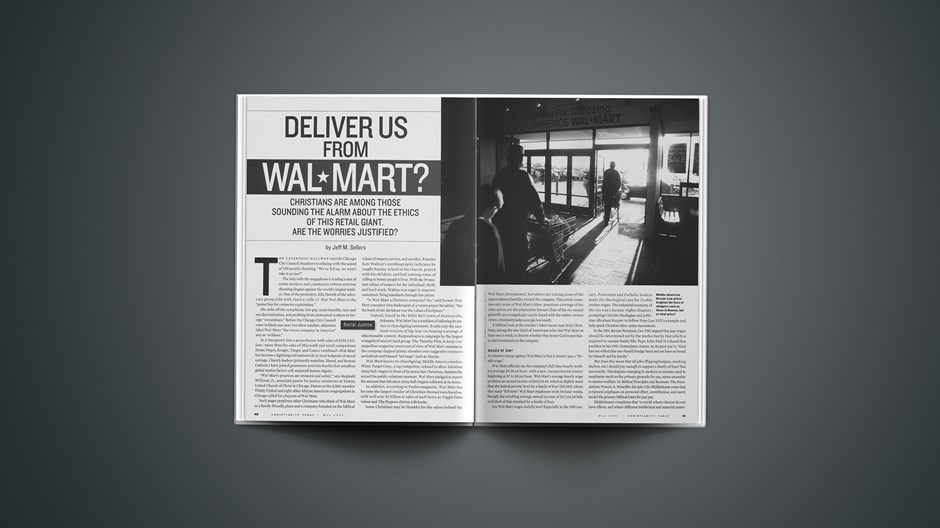
The cavernous hallway outside Chicago City Council chambers is echoing with the sound of 150 people chanting, "We're fed up, we won't take it no mo'!"
The lady with the megaphone is leading a mix of union workers and community reform activists shouting slogans against the world's largest retailer. One of the protesters, Ella Hereth of the advocacy group Jobs with Justice, tells CT that Wal-Mart is the "poster boy for corporate exploitation."
She ticks off the complaints: low pay, scant benefits, race and sex discrimination, and profiting from mistreated workers in foreign "sweatshops." Before the Chicago City Council votes to block one store but allow another, aldermen label Wal-Mart "the worst company in America" and an "evildoer."
As it has grown into a powerhouse with sales of $256.3 billion—more than the sales of Microsoft and retail competitors Home Depot, Kroger, Target, and Costco combined—Wal-Mart has become a lightning rod nationwide in local tempests of moral outrage. Church leaders (primarily mainline, liberal, and Roman Catholic) have joined grassroots activists fearful that mindless global market factors will steamroll human dignity.
"Wal-Mart's practices are immoral and unfair," says Reginald Williams Jr., associate pastor for justice ministries at Trinity United Church of Christ in Chicago. Pastors at the 8,500-member Trinity United and eight other African American congregations in Chicago called for a boycott of Wal-Mart.
Such anger perplexes other Christians who think of Wal-Mart as a family-friendly place and a company founded on the biblical values of respect, service, and sacrifice. Founder Sam Walton's autobiography indicates he taught Sunday school in his church, prayed with his children, and had a strong sense of calling to better people's lives. With the Protestant values of respect for the individual, thrift, and hard work, Walton was eager to improve customers' living standards through low prices.
"Is Wal-Mart a Christian company? No," said former Wal-Mart executive Don Soderquist at a recent prayer breakfast. "But the basis of our decisions was the values of Scripture."
Indeed, based in the Bible Belt town of Bentonville, Arkansas, Wal-Mart has a tradition of tailoring its service to churchgoing customers. It sells only the sanitized versions of hip-hop cds bearing warnings of objectionable content. Responding to a campaign by the largest evangelical mutual fund group, The Timothy Plan, to keep Cosmopolitan magazine covers out of view of Wal-Mart customers, the company slapped plastic sheathes over suggestive women's periodicals and banned "lad mags" such as Maxim.
Wal-Mart knows its churchgoing, Middle America market. When Target Corp., a top competitor, refused to allow Salvation Army bell-ringers in front of its stores last Christmas, Bentonville seized the public-relations moment. Wal-Mart pledged to match the amount that Salvation Army bell-ringers collected at its stores.
In addition, according to Forbes magazine, Wal-Mart has become the largest retailer of Christian-themed merchandise, with well over $1 billion in sales of such items as VeggieTales videos and The Purpose-Driven Life books.
Some Christians may be thankful for the values behind the Wal-Mart phenomenon, but others are voicing some of the unprecedented hostility toward the company. A biblical look at the retailer's labor issues may help Christians, among the one-third of Americans who visit Wal-Mart at least once a week, to discern whether they honor God in purchases and investments in the company.
Wages of Sin?
A common charge against Wal-Mart is that it doesn't pay a "livable wage."
Wal-Mart officials say the company's full-time hourly workers average $9.68 an hour, with a new, inexperienced worker beginning at $7 to $8 per hour. Wal-Mart's average hourly wage produces an annual income of $20,134.40, which is slightly more than the federal poverty level for a family of four ($19,350). Given that many "full-time" Wal-Mart employees work 34-hour weeks, though, the resulting average annual income of $17,114.24 falls well short of that standard for a family of four.
Are Wal-Mart wages sinfully low? Especially in the 19th century, Protestant and Catholic leaders made the theological case for livable worker wages. The industrial economy of the era was a human-rights disaster, prompting Calvinist theologian and politician Abraham Kuyper to follow Pope Leo XIII's example and help spark Christian labor union movements.
In the 1891 Rerum Novarum, Leo XIII argued that just wages should be determined not by the market but by that which is required to sustain family life. Pope John Paul II echoed that position in his 1991 Centesimus Annus. As Kuyper put it, "God has not willed that one should drudge hard and yet have no bread for himself and his family."
But does this mean that all jobs (flipping burgers, stocking shelves, etc.) should pay enough to support a family of four? Not necessarily. Theologians emerging in modern economies tend to emphasize merit as the primary grounds for pay, more amenable to market realities. In Biblical Principles and Business: The Foundations, Francis A. Schaeffer disciple Udo Middelmann notes that scriptural emphases on personal effort, contribution, and merit model the primary biblical bases for just pay.
Article continues below
Middelmann complains that "a world where choices do not have effects, and where different intellectual and material contributions lead to equal distribution of resulting wealth, is a world unknown to man."
That is, God creates all humanity equal, and we strive to provide equal opportunity to all, but Scripture does not command equal outcomes. Though Methodist theologian J. Philip Wogaman believes that human need should ultimately determine income, he says in Economics and Ethics: A Christian Inquiry (Fortress Press, 1986) that "in some respects this is a naïve doctrine, since it does not face up to the problem of how an employer could pay different workers different wages for the same kind of work."
Economist Thomas Sowell has shown that wages artificially elevated by government or unions lead to unemployment—to survive, employers simply make do with fewer workers. And theologians from liberal-leaning Miroslav Volf to the conservative Michael Novak agree that unemployment is among the gravest affronts to human dignity.
The devastating spiritual effect of unemployment is one reason the authors of Christian Ethics in the Workplace (Concordia Publishing House, 2001) argue that business owners have a moral responsibility to control expenses and to succeed. Raymond L. Hilgert, Philip H. Lochhaas, and James L. Truesdell (business professor, Lutheran minister, and businessman, respectively) add, however, that Christian ethics require employers to consider:
whether employees have options to work elsewhere (a "semblance of equal bargaining power");
whether the wage is significantly below the market for similar jobs of similar skills;
whether the employer regards workers as human beings or as tools;
whether the employer offers the employee a sense of partnership in the enterprise;
whether the employer is treating the worker according to the Golden Rule.
Historically, service jobs have not been the basis for making a living. Fully two-thirds of Wal-Mart employees, according to the company, are senior citizens, college students, or second-income providers unlikely to rely on these jobs as their only means of sustenance.
Critics say Wal-Mart is so dominant that it drives down retail wages everywhere, but service sector jobs paid low wages long before the retailer's ascent. "Front-line service sector employees have never made livable wages," says Jim Hoopes, professor of business ethics at Babson College in Wellesley, Massachusetts, "or at least they have always been among the most poorly paid." Hoopes is quick to point out that such jobs form an increasing share of the U.S. economy. But that trend is much larger than Wal-Mart.
Article continues below
Cheating Your Associates
Low wages are one thing, unpaid overtime another. In Malachi 3:5 the Lord rebukes "those who defraud laborers of their wages," and those who have "failed to pay the workmen who mowed your fields" are denounced in James 5.
A federal jury found in 2002 that Wal-Mart had forced employees in its Oregon stores to work overtime without pay. Two years later, a jury found 83 of these workers were entitled to back pay. Wal-Mart's Christi Gallagher says the Oregon verdict does not indicate widespread refusal to pay overtime, though lawsuits alleging just that are pending in at least 28 states.
"Since the plaintiffs recovered only 840 hours of the total alleged 72,000 hours," Gallagher says of the Oregon verdict, "these alleged practices are clearly not systematic, not widespread, and are highly individualized."
A class-action suit settled in 2000 accused Wal-Mart of cheating 69,000 Colorado employees of overtime pay. Wal-Mart reportedly paid $50 million to settle the case. Gallagher says that figure is "wildly inflated and inaccurate." She declined, however, to reveal the settlement amount.
A class-action suit in Massachusetts filed on behalf of 55,000 Wal-Mart employees, according to the Boston Herald, cites a computer expert alleging to have found 7,000 cases of Wal-Mart managers deleting large blocks of time from their employee payroll records. Wal-Mart officials deny the charges.
The Oregon lawsuit charged that some supervisors locked employees in after closing to force the overtime work. Wal-Mart's Gallagher declined to comment on this charge.
Wal-Mart policies forbid such "off-the-clock" practices. But David Batstone notes in Saving the Corporate Soul & (Who Knows?) Maybe Your Own (Jossey-Bass, 2003) that store managers come under such heavy pressure from Bentonville to avoid paying overtime that they see no option but to demand off-the-clock labor.
"A senior Wal-Mart payroll executive revealed under court deposition that every store has to send corporate headquarters a daily report noting whether the store had exceeded its payroll limit," Batstone writes. "Store managers who fail to minimize overtime pay can be reprimanded or fired."
Article continues below
Sticky Sweatshop Issues
The issue of "defrauding laborers" extends beyond U.S. borders. Shareholders and socially screened investment funds have long protested that the company relies on foreign factories routinely violating their countries' labor laws—"sweatshops" that employ underage workers, pay below minimum wage, or force employees to work beyond legal hours.
Sweatshop does not accurately describe many developing country factories, and activist shareholders avoid the term, especially since factory jobs are the lifeblood of the poor. Often the workers' only alternatives are unemployment or prostitution. Still, ever since Wal-Mart was embarrassed on the December 22, 1992, broadcast of Dateline NBC showing children as young as 9 years old making its private-label shirts at a factory in Saraka, Bangladesh, the issue has surfaced periodically.
Most recently, the National Labor Committee (NLC) reported in February 2004 that workers making plastic toys for Wal-Mart in Chang Ping township in Guangdong province, China, were paid less than the legal minimum and worked longer hours than local labor laws allowed. Employees worked for up to 20 hours a day, sometimes 7 days a week, for an average of 16.5 cents per hour; the legal minimum is 31 cents an hour.
Shareholders in Wal-Mart such as the United Methodist Church, whose pension fund invests in the company, have successfully pressured the company to set standards for such factories—Wal-Mart's "vendor code of conduct." Enforcing that code is another matter. The NLC reported that Chinese factory managers trained and paid workers to "correctly" answer questions they knew Wal-Mart inspectors would ask—and that inspectors played along, fully aware that the employees were lying about conditions.
Wal-Mart officials responded that the company has veteran inspectors who adhere to established standards, and that if such practices did occur they would violate its vendor code of conduct. Wal-Mart spokesman William Wertz declined to comment to CT about whether the company has investigated NLC concerns over the Chang Ping factory.
Vidette Bullock Mixon, director of corporate relations and social concern for the United Methodist Church's pension fund, has urged Wal-Mart for several years to better monitor conditions of its foreign suppliers. "I think they're finding some things, and the factories are agreeing that they will fix them," she says. "And it appears they're fixed for the moment, but then they go back to their habits of doing things that are not consistent with the code of conduct."
Article continues below
Shareholder and other groups have long pressured Wal-Mart to use independent inspectors to monitor its foreign factories. Charles Kernaghan of the NLC says only about half of the inspectors of Wal-Mart's suppliers in Guangdong province are independent—but they are for-profit auditors based in developed countries paid by the factories themselves.
Shareholder groups encourage Wal-Mart to use human-rights organizations or other nongovernmental organizations to monitor conditions. Nike, for example, relies not only on its own monitors but on inspectors from the Fair Labor Association.
Wal-Mart's policy is to work with managers of foreign factories violating its code of conduct, giving them a period of weeks to achieve compliance. If the supplier makes no progress, Wal-Mart withdraws its business. According to a report by the China-based worker-rights organization China Labor Watch, Wal-Mart has ended contracts with hundreds of Chinese suppliers because of excessive work hours. It also has blacklisted at least 72 factories for employing child labor.
Improving conditions in Chinese factories is especially urgent as the United States began phasing out quotas for Chinese textile imports in January, Kernaghan says. That is expected to lead to a dramatic increase in multinational companies relying on goods produced in China, where labor laws are essentially meaningless.
In the end, Kernaghan says "transparency"—disclosure of the locations of Wal-Mart's factories so journalists and others can verify company reports—is even more important than independent monitors. Most companies refuse to divulge the locations of foreign suppliers. Wal-Mart officials say they will not do so for competitive reasons. Kernaghan scoffs at this, saying competitors already know about each other's foreign suppliers, as several retailers often have their labels produced in the same factories.
Counting the Cost
Discerning Christians with varying social/theological priorities will differ on whether to open their wallets to Wal-Mart. Its impact on local communities and on the environment, as well its treatment of minorities and women, also must be examined. But even with this initial look at labor issues, what conclusions can we draw?
Article continues below
Because of Wal-Mart's low wages, critics accuse executives of "hoarding" wealth, the same charge leveled at unjust employers in James 5:3. But it would be hard to make this charge stick against Wal-Mart, whose gross profit margin (profit as a percentage of total revenues) of 22.5 percent equals the discount retail industry average. And Wal-Mart has long offered profit sharing and discounted stock purchase plans to employees.
Thus the savings from low wages and various cost-cutting innovations are not stockpiled for exorbitant profits or fat executive salaries. They are passed on to consumers in reduced prices (Walton's gospel). The Walton heirs occupying places four through eight on Forbes's list of richest people did not attain their fortunes from drawing salaries at Wal-Mart.
As for a livable wage, it's hard to show that markets, governments, or Christian ethics obligate businesses to pay shelf stockers enough to support a family of four. If this be evil, then it is the free market that is evil. Wal-Mart is merely the touchstone for the unwelcome macro-trend of low-paying service jobs replacing manufacturing work. As the ranks of the working poor swell, though, we do well to contemplate our complicity in the global drive toward offering—and getting—the lowest prices.
In the matter of unpaid overtime, many lawsuits are still pending and it is premature to make sweeping assertions. Still, the number of lawsuits in process suggests that Wal-Mart is struggling to follow its own policies against off-the-clock work.
Finally, the company shares responsibility with the foreign factories that supply it with dirt-cheap goods, especially since Wal-Mart routinely threatens to withdraw orders unless factories find cheaper ways to produce them. This too is a global practice involving many companies besides Wal-Mart. Wal-Mart has taken steps to improve monitoring of such abuses and has distanced itself from violators, but activists would like to see greater efforts to bring factories into compliance rather than pulling orders—which can leave hundreds of poor workers unemployed.
Sam Walton, apart from his philanthropy, had a habit of ignoring matters that didn't contribute directly to the bottom line. Wal-Mart executives have begun to see that the old ways will no longer do. There are signs that Wal-Mart is beginning to listen to criticisms, but the one thing it hears above all else is the soft rustle of wallets opening—or, even louder, the absence of them from their stores.
Benefits Blues | Spiraling health costs squeeze Wal-Mart as they do every other large company.
Women Against Wal-Mart | Sex-discrimination charges constitute the largest-ever class action lawsuit against a private employer.
Wal-Mart offers statements on a host of issues, including some discussed in this article.
CT covered Christian bookstores that have suffered from a drop in business after Wal-Mart and other big retailers began carrying Christian books.
Forbes magazine covered Wal-Mart's expansion into the Christian product business.
Christian Retailing quotes a Christian bookstore owner who says, "Wal-Mart is a canker out there that's killing our market in this country. Until the suppliers realize that and start standing up to Wal-Mart and start protecting independent stores, we're on a death trail."
PBS's Frontline ran a documentary last November about Wal-Mart. The full program is available for viewing online.
Ariah Fine is a student at Wheaton College and says in this Relevant article that shopping at Wal-Mart is wrong.
Baptist Press says a pastor was asked to stop passing out tracks at his local Wal-Mart.
Wal-Mart Facts is the public relations push the company is using to show it's environment, community, and people-friendly.
After some deliberation, Danny Duncan Collum writes in Sojourners Magazine, "Today I'm ready to join the ranks of all right-thinking people the world over in declaring Wal-Mart an outpost of hell on earth."
More Christianity Today articles on Money & Business is available from our website.
Have something to add about this? See something we missed? Share your feedback here.
Our digital archives are a work in progress. Let us know if corrections need to be made.
















 While we pray for peace, we need moral clarity about this war.
 We’ve got little information on Jesus’ appearance and personality. But that’s the way God designed it.españolFrançais
 How groups like Hillsong learned to let go of the literal in favor of creative collaboration.españolPortuguês






