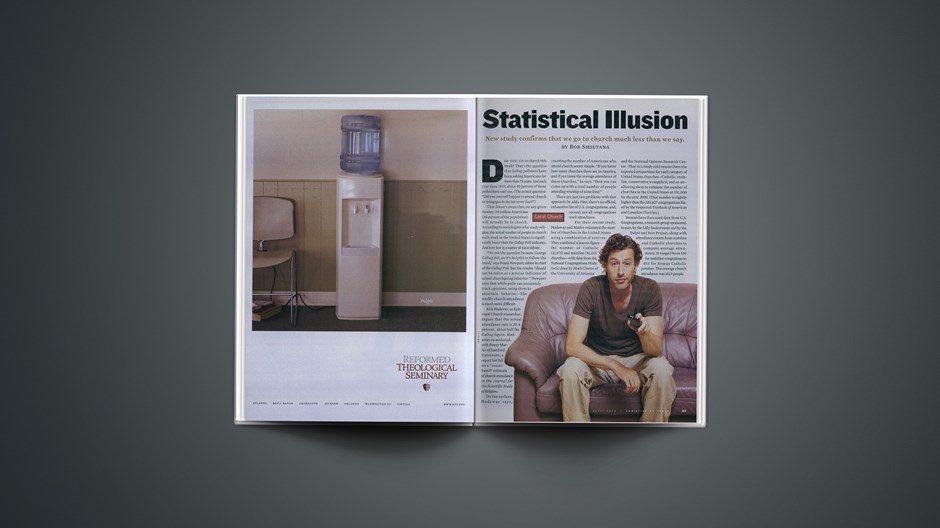
Did you go to church this week? That's the question that Gallup pollsters have been asking Americans for more than 75 years. And each year since 1939, about 40 percent of those polled have said yes. (The actual question: "Did you yourself happen to attend church or synagogue in the last seven days?")
That doesn't mean that, on any given Sunday, 118 million Americans (40 percent of the population) will actually be in church. According to sociologists who study religion, the actual number of people in church each week in the United States is significantly lower than the Gallup Poll indicates. Just how low is a matter of some debate.
"We ask the question because George Gallup did, so it's helpful to follow the trend," says Frank Newport, editor in chief of the Gallup Poll. But the results "should not be taken as a precise indicator of actual churchgoing behavior." Newport says that while polls can accurately track opinions, using them to ascertain behavior—like weekly church attendance is much more difficult.
Kirk Hadaway, an Episcopal Church researcher, argues that the actual attendance rate is 20.4 percent, about half the Gallup figure. Hadaway co-authored, with Penny Marler of Samford University, a report last fall on a "count-based" estimate of church attendance in the Journal for the Scientific Study of Religion.
On the surface, Hadaway says, counting the number of Americans who attend church seems simple. "If you know how many churches there are in America, and if you know the average attendance of those churches," he says, "then you can come up with a total number of people attending worship of some kind."
There are just two problems with that approach, he adds. First, there's no official, exhaustive list of U.S. congregations, and, second, not all congregations track attendance.
For their recent study, Hadaway and Marler estimated the number of churches in the United States using a combination of sources. They combined a known figure—the number of Catholic (21,975) and mainline (81,183) churches—with data from the National Congregations Study (NCS) done by Mark Chaves of the University of Arizona and the National Opinion Research Center. That NCS study told researchers the expected proportions for each category of United States churches—Catholic, mainline, conservative/evangelical, and so on—allowing them to estimate the number of churches in the United States at 331,000 for the year 2000. (That number is slightly higher than the 320,827 congregations listed by the respected Yearbook of American and Canadian Churches.)
Researchers then used data from U.S. Congregations, a research group sponsored, in part, by the Lilly Endowment and by the Pulpit and Pew Project, along with attendance counts from mainline and Catholic churches to compute average attendance. It ranged from 109 for mainline congrations to 853 for Roman Catholic parishes. The average church attendance was 161.9 people.
Dave Olson, director of church planting for the Evangelical Covenant Church and director of TheAmericanChurch.org, believes Hadaway and Marler's figures are accurate. Olson's research, drawing from attendance data collected from 200,000 churches, reaches a similar conclusion. He believes that Hadaway and Marler have shown that a significantly smaller number of Americans "are participating in the most basic Christian practices—the weekly gathering for worship, teaching, prayer, and fellowship."
"Christ spoke the words of life, and a church service is the most common place that people hear those words," Olson says. "When fewer people attend church, fewer people hear the words of life. Fewer people hear the gospel for the first time. Fewer take the sacraments. Fewer children hear of God's love for them. Fewer teenagers find a listening ear. Fewer broken lives are put back together. It's a matter that should concern all Christians."
Hadaway and Marler drew similar conclusions about church attendance after previous studies (in 1998 and 1993, the latter in which Chaves took part). While those studies were controversial, response to this latest study has been subdued.
"For sociologists, this is old hat," says Christian Smith, professor of sociology at the University of North Carolina at Chapel Hill. Smith says that for some time, sociologists have known that the Gallup figure is "greatly overestimated."
"I think the actual number is halfway between the Gallup figure and the Hadaway figure—around 27 to 30 percent." However, he adds, "If it came out that [Hadaway and Marler] were right and the actual figure was 20 percent, I would not be too surprised."
Robert Woodberry, a sociologist at the University of Texas, has been critical of Hadaway and Marler's work. He notes that "higher quality, face-to-face surveys" on religious life have consistently reported higher church attendance figures, usually "something lower than 40 percent and higher than 30 percent." He cautions against "making head counts the gold standard, when you have no idea how accurate they are." Woodberry notes that there's no way of second-checking attendance counts reported by churches, and no standard set of procedures for conducting attendance counts.
Article continues below
Some counts, he fears, come from attendance registers in the pews, which may reach "only 60 percent of the people there." And, he says, "You've got to make sure those counts include everyone in Sunday school and people who come in late."
Those reservations aside, Woodberry says that Hadaway and Marley have "done a great service" in demonstrating that church attendance is lower than previously thought.
"They have demonstrated that this is an issue," he says, "and that we as scholars have to pay attention to it."
Explaining the gap
Hadaway says that many church groups—especially larger ones such as Catholic, some mainline, and Southern Baptist—have developed standard procedures for counts, leading him to believe that the figures are accurate. Also, he says, when it comes to church attendance, he's more concerned that congregations are overestimating their attendance, not underestimating it.
In explaining the gap between his research and Gallup polls, Hadaway thinks that many people are answering with what they usually do, instead of what they did the last week. He also believes that people are more lenient with themselves when they miss church because of vacation or Sunday morning conflicts.
"As life has become more complicated in the last 30 years," Hadaway says, "perhaps people are inventing more excused absences than they used to."
The success of megachurches may be masking attendance struggles in smaller congregations. According to the NCS, only 10 percent of American congregations have more than 350 regular participants, yet those congregations compose nearly half of those attending religious services in the United States. Hadaway says smaller churches indeed are in decline, though the research didn't touch on that.
"You have Joel Osteen's church with 20,000 or 30,000 people worshipping on an average weekend, and it just seems like religion is going great guns," Hadaway says. "I think it is creating a false impression of what is happening in the church. There are more giant churches now than there used to be—but at the same time, the average church is quite small. The decline among these small congregations has led to the death of a lot of churches. They have declining numbers and rising costs—insurance rates, pastors' salaries, utilities—making it really tough for many churches across America."
Article continues below
Newport says that if Gallup wanted to provide a "more precise" figure for church attendance, the organization would have to approach the problem differently—using multiple surveys, having respondents keep track of actual churchgoing behavior, and doing follow-up calls. He, like Hadaway, wonders if people tell pollsters what they usually do, rather than reporting actual behavior for a given week.
"I would say that we are right in saying that 4 out of every 10 Americans represent themselves as being regular churchgoers," he says. "But that does not mean that they are in church 52 weeks a year."
Bob Smietana is features editor of The Covenant Companion.
















 While we pray for peace, we need moral clarity about this war.
 We’ve got little information on Jesus’ appearance and personality. But that’s the way God designed it.españolFrançais
 How groups like Hillsong learned to let go of the literal in favor of creative collaboration.españolPortuguês






