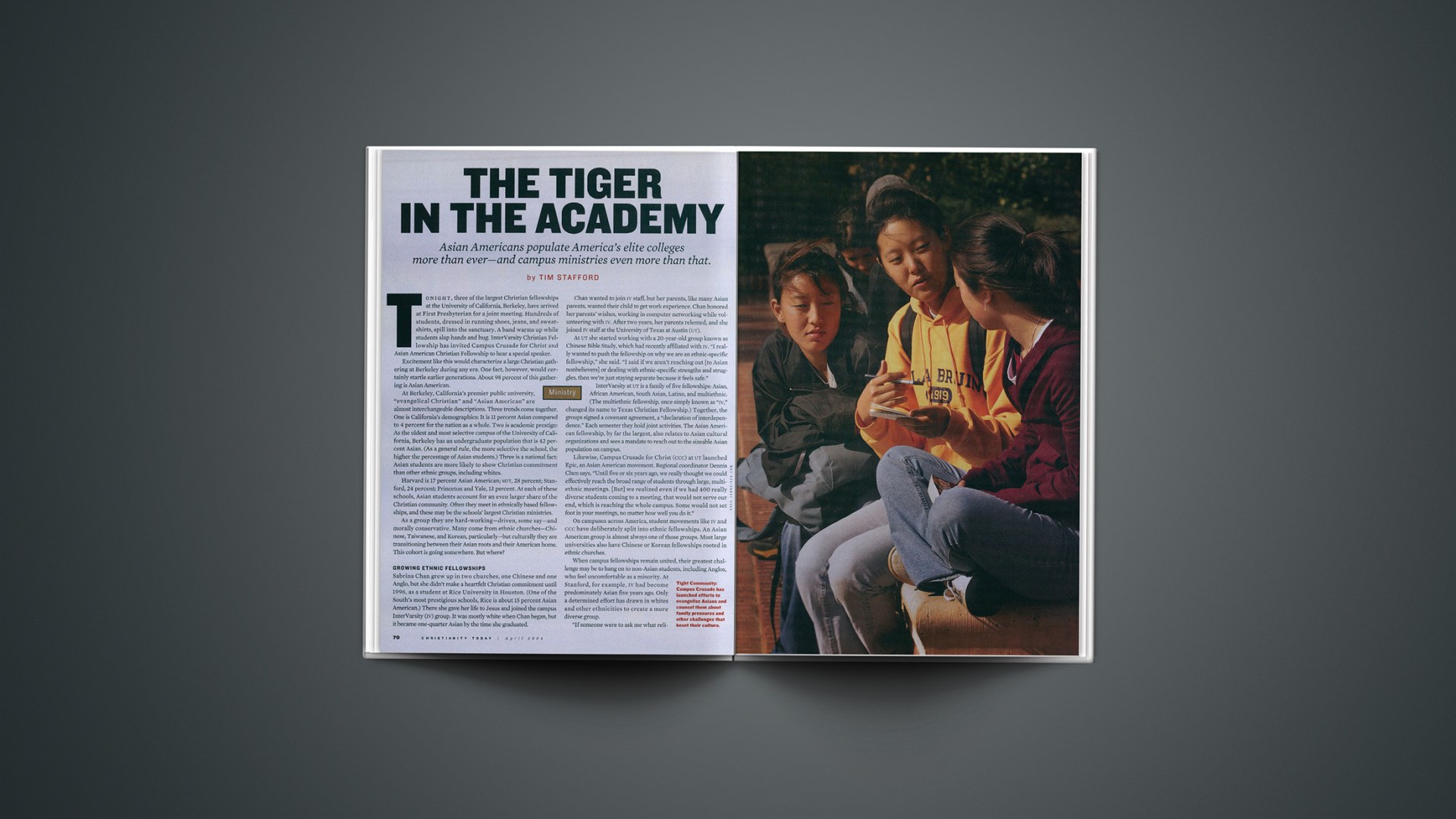

Tonight, three of the largest Christian fellowships at the University of California, Berkeley, have arrived at First Presbyterian for a joint meeting. Hundreds of students, dressed in running shoes, jeans, and sweatshirts, spill into the sanctuary. A band warms up while students slap hands and hug. InterVarsity Christian Fellowship has invited Campus Crusade for Christ and Asian American Christian Fellowship to hear a special speaker.
Excitement like this would characterize a large Christian gathering at Berkeley during any era. One fact, however, would certainly startle earlier generations. About 98 percent of this gathering is Asian American.
At Berkeley, California’s premier public university, “evangelical Christian” and “Asian American” are almost interchangeable descriptions. Three trends come together. One is California’s demographics: It is 11 percent Asian compared to 4 percent for the nation as a whole. Two is academic prestige: As the oldest and most selective campus of the University of California, Berkeley has an undergraduate population that is 42 percent Asian. (As a general rule, the more selective the school, the higher the percentage of Asian students.) Three is a national fact: Asian students are more likely to show Christian commitment than other ethnic groups, including whites.
Harvard is 17 percent Asian American; mit, 28 percent; Stanford, 24 percent; Princeton and Yale, 13 percent. At each of these schools, Asian students account for an even larger share of the Christian community. Often they meet in ethnically based fellowships, and these may be the schools’ largest Christian ministries.
As a group they are hard-working—driven, some say—and morally conservative. Many come from ethnic churches—Chinese, Taiwanese, and Korean, particularly—but culturally they are transitioning between their Asian roots and their American home. This cohort is going somewhere. But where?
Growing Ethnic Fellowships
Sabrina Chan grew up in two churches, one Chinese and one Anglo, but she didn’t make a heartfelt Christian commitment until 1996, as a student at Rice University in Houston. (One of the South’s most prestigious schools, Rice is about 15 percent Asian American.) There she gave her life to Jesus and joined the campus InterVarsity (IV) group. It was mostly white when Chan began, but it became one-quarter Asian by the time she graduated.
Chan wanted to join IV staff, but her parents, like many Asian parents, wanted their child to get work experience. Chan honored her parents’ wishes, working in computer networking while volunteering with IV. After two years, her parents relented, and she joined IV staff at the University of Texas at Austin (UT).
At UT she started working with a 20-year-old group known as Chinese Bible Study, which had recently affiliated with IV. “I really wanted to push the fellowship on why we are an ethnic-specific fellowship,” she said. “I said if we aren’t reaching out [to Asian nonbelievers] or dealing with ethnic-specific strengths and struggles, then we’re just staying separate because it feels safe.”
InterVarsity at UT is a family of five fellowships: Asian, African American, South Asian, Latino, and multiethnic. (The multiethnic fellowship, once simply known as “IV,” changed its name to Texas Christian Fellowship.) Together, the groups signed a covenant agreement, a “declaration of interdependence.” Each semester they hold joint activities. The Asian American fellowship, by far the largest, also relates to Asian cultural organizations and sees a mandate to reach out to the sizeable Asian population on campus.
Likewise, Campus Crusade for Christ (CCC) at UT launched Epic, an Asian American movement. Regional coordinator Dennis Chen says, “Until five or six years ago, we really thought we could effectively reach the broad range of students through large, multiethnic meetings. [But] we realized even if we had 400 really diverse students coming to a meeting, that would not serve our end, which is reaching the whole campus. Some would not set foot in your meetings, no matter how well you do it.”
On campuses across America, student movements like IV and CCC have deliberately split into ethnic fellowships. An Asian American group is almost always one of those groups. Most large universities also have Chinese or Korean fellowships rooted in ethnic churches.
When campus fellowships remain united, their greatest challenge may be to hang on to non-Asian students, including Anglos, who feel uncomfortable as a minority. At Stanford, for example, IV had become predominately Asian five years ago. Only a determined effort has drawn in whites and other ethnicities to create a more diverse group.
“If someone were to ask me what religion is practiced by Chinese immigrants, I would say money,” says Steven Chin, pastor of a large Chinese church in Boston that ministers to many college students. “This is what they live for and dream about. They want financial security. This is why they want education—not just any kind of education, but an education that will make money. They were taught that if you have enough money, you will be happy, that money will provide the answers for you. As people got money and began to live well in nice homes, young people felt that something was missing. The next generation of Asian Americans is looking for purpose that money cannot fulfill. Many are looking to God. It’s not the influence of Christian parents [that leads so many young Asians to Christianity]. These are non-Christians who are searching.”
Tom Lin, a former Harvard IV staff worker now serving in Asia, adds: “Before Asian students arrive in elite schools, they’ve spent almost their whole lifetime for the purpose of getting that acceptance letter. But once they actually arrive and begin, the search for meaning and what’s next comes around.”
It would be hard to exaggerate the significance of family for Asian American students. American parents raise their children to become independent and free; the Confucian heritage of most Asian families values lifelong subservience. Many Asian parents expect to guide their children’s decisions at least until they marry. Immigrant parents who came out of poverty advise, “Work hard, study hard, get a good job.” One pastor says that he felt deep shame going to Tufts University; his parents had hoped for Harvard.
Consequently, says Rebecca Kim, a sociology professor at Pepperdine, “The picture of Jesus, who offers unconditional love, forgiveness, and strength, [is] especially inviting to many Asian American college students.”
In the book Following Jesus Without Dishonoring Your Parents, Greg Jao describes a friend pulled between her parents’ culture and that of her new, non-Asian friends. “My non-Asian friends tell me I need to do what is right for me. And they tell me that I need to love Jesus more than I love my family. But the youth pastor at my home church says that the Bible tells me to honor and obey my parents.” Jao explains that doing something “because I should” or “because it is expected” signals maturity in Asian cultures, while doing something “because it feels right or honest to me” suggests maturity in modern Western cultures.
Paul Tokunaga, national coordinator for Asian American ministries at IV, described a moment at a triennial conference for Asian American staff. Those who wanted prayer regarding family issues were invited to come forward. “I have never felt or seen anything like it,” Tokunaga says. “It seemed as though half the room poured forward, weeping and sobbing because the pain was so great.”
This helps explain why Asian American students prefer their own fellowships. Who else would truly understand them? In addition, many Asians believe that Anglo Christians welcome Asians but don’t give them leadership opportunities. Kim quotes an Asian American ministry staff member: “If Asians start their own organizations, they are more able to take on leadership positions.”
A Serious, Committed Blessing
“This generation of Asians is the most blessed of all Asians in history,” says pastor David Hsu of the West Houston Chinese Church. “The opportunity to learn, to interact, to have freedom is unparalleled. They have unprecedented opportunities and material blessings. But you either become a channel of blessing, or it will be taken away from you and given to others.”
Asian campus fellowships have unique opportunities for evangelism. The close community draws in non-Christian Asians, who are not likely to find a comparable sense of belonging anywhere on campus. Rarely is another Asian group so large and friendly. Christians so dominate the Korean American student world that one Stanford student posted a lengthy online lament. As a non-Christian, he said, he stood a much-diminished chance of finding a Korean wife. “The challenge for Asian Americans in an ethnic fellowship is to use it as a base for evangelism,” Tokunaga says, “not just to stick with people they are comfortable with.”
When it comes to world missions, “These students are poised for accessing the 10/40 window like we have never seen,” says Tommy Dyo of the Asian American Christian Fellowship. “They are highly trained and culturally sensitive; they have experienced some marginalization themselves.” Notably, Asians have made up one-quarter of the students attending IV’s Urbana mission convention in recent years.
“I think God is doing something special,” Hsu says. “Their desire and interest in spiritual things seem heightened compared to other groups at this time. My guess is that God is raising up a new generation of his people, maybe to reach their homelands, maybe to reach other parts of the world.” Pastor Chin notes a natural interest in China. Though his church tries to enlarge their vision to include the whole world, he says, “Many purposely choose careers that allow them to work in China.”
Another area of potential is leadership. “I believe that the Lord may be preparing a great harvest of Asian graduates from elite institutions,” Lin says, “to be released into Christian leadership, to influence the future American church.”
While reading the management bestseller Good to Great, Tokunaga was struck by the description of “level 5 leaders,” those with strong drive yet deep humility. He thought, That describes some of my Asian American staff. Contrary to some American leadership styles, “a lot of our Asian American staff are reflective,” says Tokunaga. “They are more hierarchical and submissive. They don’t challenge authority figures. So they’re not getting noticed.” Tokunaga is trying to influence IV’s institutional culture so that Asian leaders don’t hit a glass ceiling.
Seminary attendance is one sign of Asian interest in leadership. Western Seminary, for example, has three campuses; Portland and Sacramento are 11 percent Asian, while San Jose is 40 percent. Fuller Theological Seminary reports that 1,100 out of its 5,000 students are either Asian citizens or Americans of Asian descent. Asians account for 25 percent of the students at Talbot School of Theology. In the Midwest, Trinity Evangelical Divinity School (TEDS) reports an almost 9 percent Asian population.
The opportunities for Asians to use leadership gifts are expanding. Professor Peter Cha says that when he graduated from TEDS in 1985, along with about 20 other Korean American students, their only choices were to minister in ethnic churches or to launch their own churches. Now, he says, some Asian students find open doors to minister in majority-white settings.
But some cultural challenges remain. Family expectations can get in the way of service. “The reality of duty to family, regardless of what Asian culture you come from or what your economic status is, is a huge, inescapable reality,” Chen says. “In some cases, it is spiritual bondage. A number of Asian American students I have been in contact with over the years have felt called to fulltime ministry, but because their parents didn’t approve, they went a different path. That happens so often.”
Russell Jeung, professor of sociology at San Francisco State University, sums up well the strengths Asian Americans bring to the larger Christian community: “They have so much fervor and dedication, partly because of their Confucian background.” For example, Asian Christians often set an example to other believers on campus by their seriousness and commitment. It’s not unusual for Korean students to inspire a whole campus to pray more seriously.
“We [Asians] have a stronger sense of obligation and responsibility to give back to God,” says Jeung. “We understand sacrifice, because our parents have sacrificed for us. We understand that Christ’s sacrifice for us can’t be repaid, but that it demands a great response. Confucianism is a pretty good background for responsibility, sacrifice, and grace.”
Tim Stafford is a CT senior writer.
Copyright © 2006 Christianity Today. Click for reprint information.
Related Elsewhere:
InterVarsity Christian Fellowship has more information about its multiethnic ministries.
Following Jesus Without Dishonoring Your Parents is available from Christianbook.com and other book retailers.
The Harvard-Radcliffe Asian American Christian Fellowship has information about its ministry.
More Christianity Today articles on campus ministry include:
The Holy and the Ivy | Intellectual skepticism persists in the Ivy League. Thankfully, so does a vibrant Christian faith. (Sept. 1, 2005)
Campus Collisions | Why InterVarsity Christian Fellowship was “derecognized” at some of America’s leading universities. (Oct. 3, 2003)