Evangelical Protestants are the happiest people in America. Or at least that’s what they say.
Evangelicals are 26 percent more likely to describe themselves as “very happy” than Americans as a whole, according to a Pew Research Center survey released last month. Almost half—43 percent—of evangelical Protestants described themselves that way, compared to only 34 percent of Americans.
Christian Smith, a sociologist at University of North Carolina, said there are many possible reasons why evangelical Protestants rate higher than others on happiness surveys.
Religion, especially Christianity, emphasizes forgiveness, reduction of anxiety through prayer, gratitude, and other virtues, Smith said. In addition to this, evangelical churches provide various tools, teachings, beliefs, and practices that tend to increase happiness.
Evangelical Christianity, he said,”gives a perspective that’s more thankful, and that makes one more happy and appreciative than a perspective that asks, ‘Why didn’t I get what I deserve?'”
Many Americans probably define happiness in “a consumerist, superficial sense of I’m feeling good,” Smith said. “There’s a part of me that thinks evangelicals are kind of superficial” as well, he said. “But if it’s well-defined, happiness is good.”
It’s probably not well-defined by most evangelicals surveyed, said Ruth Tucker, a missions professor at Calvin Theological Seminary who wrote about happiness in her recent book Walking Away from Faith. The Pew poll, she says, simply shows that evangelicals are expected to be happy.
“We all know the song ‘If You’re Happy and You Know It.’ There are a number of little jingles like that about happiness in children’s choruses,” Tucker said. “Happiness is kind of a mark for an evangelical. We make it important in our choruses, in our megachurches, and in evangelism.”
Tucker said she doesn’t think happiness is necessarily biblical, but it is preached from church pulpits as a Christian calling.
“There’s very little room in megachurches for lament and grief and expressing one’s deep sadness,” Tucker said. “If you feel deep depression or sadness and are going through a rough time, you are told to stay home from church.”
The contemporary church’s pursuit of happiness is markedly different from historical Christianity’s, said Florida State University professor Darrin McMahon, author of Happiness: A History. Christians in the early church, he said, did not expect to have happiness before death. Much of Augustine’s City of God, he notes, criticizes those who seek perfect happiness in this world. Original sin, Augustine wrote, made earthly happiness impossible.
“It’s only relatively recently, since the 18th century, that people expected religion to make them happy,” McMahon said. “In a way, it’s a perverse affirmation of the Enlightenment.”
Belief or practice? As a whole, evangelicals are 30 percent happier than mainline Protestants. Only one of three mainline Protestants told pollsters they were very happy. But the differences between evangelical and mainline Protestants disappear after taking religious attendance into account, said Cary Funk, senior project director at Pew Research Center.
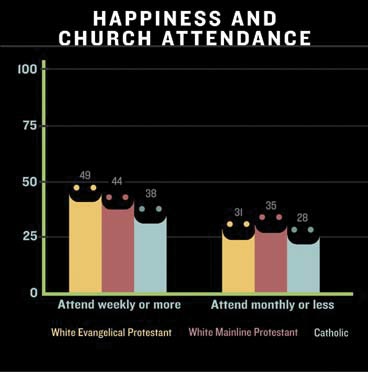
In fact, of Protestants who do not attend church at least weekly, mainline Protestants are more likely than evangelicals to say they are very happy.
“It’s more about frequent church attendance than it is about particular sets of beliefs,” Funk said. “This asks, ‘How different are they?’ and suggests maybe they’re not that different.”
David Myers, a psychology professor at Hope College and author of The Pursuit of Happiness, said people who attend church regularly tend to be happier partly because church provides social support.
“Humans have a need to belong, to be connected in close, caring relationships, and North America’s 350,000 congregations are a significant venue for social support,” Myers said. “If something bad happens, like a devastating sickness, you stand a good chance of getting love-bombed by your faith community if you are an active member of it.”
The study also found that the happiness achieved by attending church could be modified by personal income. In some ways, the survey found, money can seem to buy happiness. Half of those who attended church weekly and had an income of $50,000 or more said they were very happy. But only 37 percent of weekly attendees earning less than $50,000 reported they were very happy.
As with many public opinion surveys, the Pew Research Center’s definition of evangelical and mainline are open to some debate. Respondents were given a choice of religious preferences to identify with. Those who answered Protestant were asked if they would describe themselves as born-again or evangelical. Mainliners are those who answered no. Evangelicals are those who answered yes. However, black and Hispanic Protestants were measured differently, so the numbers given above for evangelical and mainline Protestants only reflect those of white Protestants. Whites and Hispanics overall tended to be happier than blacks, the survey said.
Copyright © 2006 Christianity Today. Click for reprint information.
Related Elsewhere:
The full survey, “Are We Happy Yet?” is available at the Pew Research Center site.
A 2003 survey from Barna Research also found that evangelicals were more likely to describe themselves as happy.
In a 2002 interview, Myers talked about whether money makes people happier.
“We must fight the temptation to treat our faith the way we treat our careers—as a source of entertainment, fulfillment, and happiness,” said Chuck Colson and Anne Morse in a 2004 Christianity Today column. “Remember the warning of C. S. Lewis: If you’re seeking happiness, don’t choose Christianity, choose port wine.” Colson also talked about the subject in a 2005 column: “Evangelicals must rely on more than cheerful tunes, easy answers, and happy smiles.”