Alejandro Iñ árritu, director of Babel, says his films are about families—parents and children, of course, but also the global family … and the consequences of trying to live without God.
Alejandro González Iñ árritu has a lot of stories to tell. He packs several of them into each film that he makes. In three critically acclaimed features—Amores Perros, 21 Grams, and the latest, Babel—he and screenwriter Guillermo Arriaga have told at least nine, depending on how you unravel his complex tapestries of narrative.
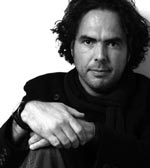
Alejandro Gonzalez Innaritu
All three films bear the distinct style and perspective of storytellers who are unafraid to portray characters in states of depravity, desperation, and despair. There is a burdensome weight to these pictures, giving us the sense that the world is getting very dark indeed. Hope is not lost, but it only glimmers in the occasional traces of compassion and care.
Born in Mexico City in 1963, Iñ árritu has had quite a colorful journey already. He began his creative career as a radio DJ, then began composing music for films. Studying film in the U.S., he eventually crafted Amores Perros, the feature film that would earn him raves and awards around the world, including a Best Foreign Film nomination at the Oscars, and catapult him into the top tier of directors working today. 21 Grams earned nominations for Benicio Del Toro and Naomi Watts.
And now, Babel may earn him his first Best Picture nomination. Babel features unforgettable performances by Brad Pitt and Cate Blanchett, even as it introduces American audiences to a diverse, international cast. Filmed in Mexico, the U.S., Morocco, and Japan, it carries us around the globe into various crises of violence, loneliness, and communication breakdown. It's almost overwhelming, but we come away thinking about the power of compassion and the need to slow down and pay attention to our neighbors and their needs.
Christianity Today Movies visited Iñ árritu during a publicity stop in Seattle to talk with him about his art, the challenges of filming such an international project, and his curious preoccupation with the importance of family.
Films about foreign cultures with wide release in America often feel like postcards—simplistic, often with insulting stereotypes. But Babel feels authentic. What was your approach to capturing each distinct culture?
Alejandro Iñ árritu: I spent one year [trying] to really assimilate, absorb, and be very respectful with every culture. I tried to not judge them, or portray them as stereotypes or cartoonish—you know, the misbehaving Muslims, or the lazy Mexicans, or the selfish Americans. Compassion is the word for this film.
You take us into intimate contact with these characters, so we get a visceral grasp of their broken hearts. And while they're from different cultures, your storytelling suggests there is a commonality to their experience. Is that what you intended?
Iñ árritu: I started out making a film about what really separates us. But during the process I was transformed—and my films are extensions of myself. I ended up doing a film about what unites us.
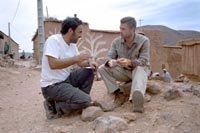
On the 'Babel' set with co-star Brad Pitt
I want the audiences to forget that they are watching a foreign-language film, about a foreign culture, and realize that they are just watching human beings. I want Brad Pitt to [blend in] with humanity, so he's not Brad Pitt anymore. It's not about celebrities. It's not about movement and explosions. I want the people to really feel the weight of the dead. I want the people to feel the weight of pain.
These many characters never get together on screen; they're not completely connected. But what connects them is not happiness but pain, and the process that they go through to … break down walls and connect to the ones they need and love. These people don't have the ability to express love, or to receive love.
This film, for me, is about compassion. And it's about borders—not specifically the ones that are built physically, but those that are built within ourselves … through prejudice; through stereotypes; through branding people, cultures, ideas, or even ideologies. … I think the only way that we can break down those walls is through compassion. Every time that we judge, or every time that we criticize, we have lost that element. And without that element, we are losing our humanity, I think.
What appeals to you about doing these very complex webs of story?
Iñ árritu: I'm very curious, I guess, as a human being. Every time that I'm shooting a film— even when I'm going to the set, I see some people in the window in the car and I find them more interesting than the ones that I'm talking about. [laughs]
As a Third World citizen, I always feel that I need to express my point of view. Sometimes the points of view of Third World countries are never expressed. We don't have that possibility, sometimes, to spread what we feel and how we see things.
For me, it is important that every character in every film has some words, has some way to express themselves, to be more democratic about the angles [of perspective on] the subject matter, to understand that when somebody does something, they have a reason [for it.]
Article continues below
I've read that you take your family with you when you work. Is it true that you took your wife and kids to Morocco and Japan for a whole year?
Iñ árritu: We went to Morocco, to Tijuana, to Japan. Not the whole year around, but many [trips], yes. The most beautiful thing that I learned, I learned from my kids. They were eight and ten—and they were playing with Moroccan kids in these humble villages, and they were playing with the Japanese kids … because they haven't built those walls that we have as adults. They are basically pure, and they understand each other with their eyes. That's how we are born, but we unfortunately have been poisoned when we become adults. That's a sad thing.
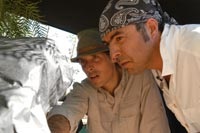
Innaritu (right) and cinematographer Rodrigo Prieto
In all of your stories, no matter what the culture, you seem intensely interested in communicating the importance of family relationships.
Iñ árritu: Completely. I think that my films are basically family stories, beyond the fact that they are global and have political and social commentary. At the core of it, Babel is basically four stories of parents and children.
I think we are defined as human beings through our families, no matter what kind of family—through our relationships with parents, brothers and sisters. [You look back to] the first people of the world, and there is Cain killing Abel. In families you can find the source of every human drama. It is interesting because the cell of a society, the cell of a country, the cell of humanity—everything lies in the family.
For me, the most important thing that I have to accomplish, is to be a good father. That's the most difficult challenge of my life. That's the most important thing for me, more than films.
I have dedicated all my films to my family. … The first one I dedicated to the son that my wife and I lost. And then the second one I dedicated to my wife. This one I've dedicated to my kids who are alive. They were part of the process, and I want them to be close to my process, to know who I am, what I do.
The title of the film is a reference to a story in the Book of Genesis, when God punished human pride by confusing our languages. Did you mean for the film to suggest anything about our relationship with God?
Iñ árritu: For me, Babel is about human beings left alone with each other. There's an absence of God. In a way, we have been dealing with the consequences of our own greed, our own selfishness. We punish ourselves with the way we act [toward each other.]
Article continues below
God made very clear what we need to do. And we are the ones that haven't followed those rules. We always complain and get angry at institutions and religions. But it is not religion or institutions—it is us. The problem is us. We destroy everything that we touch. We destroy marriages, parent-child relationships, governments. Before, it was the monarchy that failed. Then, the czars failed. Then, communism failed. Globalization and capitalism are failing. There's corruption in every institution. It is not the fault of God. It is us. This film clearly shows that man is trying to survive, lonely, without God.
Watching your films, I often glimpse Catholic iconography. That seems important to you. Did you grow up in a religious family?
Iñ árritu: I have been raised in a Catholic family. My mother is a practicing Catholic. I went to a Catholic college. So, I always have been close [to Catholicism], and I always feel that [when] people criticize Catholicism, [the problem] is not really Catholicism, but the people in Catholicism.
We're all messed up. It seems like an excuse, to ignore religion because people are bad. It seems like a cop-out to me.
I respect every religion. For me, it is especially important to maintain my interior life. My spirituality, my connectedness. That is the way I think. That is the way I deal with life and tough moments. I keep in touch with something bigger than me. And I connect with people who have an interior life—a connection with something bigger than them. They realize there's a supernatural existence, something we can't understand.
To think that we can understand everything is such stupidity because our senses are so limited. We are so limited that to feel that we can understand the creation scientifically is a little bit naïve. It's very childish.
So, now that you've completed three of these ambitious, complicated films, what's next?
Iñ árritu: I'm developing a [project] that will take me a couple of years more. I like to explore things that I haven't done. I like the possibility of failure. I don't want to be in a comfortable zone.












 While we pray for peace, we need moral clarity about this war.
 We’ve got little information on Jesus’ appearance and personality. But that’s the way God designed it.españolFrançais
 How groups like Hillsong learned to let go of the literal in favor of creative collaboration.españolPortuguês