That's how director Darren Aronofsky describes the central theme of his new film The Fountain, the story of a young married couple and their struggles as the wife is dying of cancer.
In Darren Aronofsky's ambitious, unusual science fiction film The Fountain (opening Friday), a husband must come to terms with his wife's mortality. As Tom watches Izzy suffer the debilitating effects of a growing brain tumor, he leads a frantic scientific endeavor to find a cure. But she responds differently, chronicling her feelings in a historical novel about the queen of Spain.
Both their daily reality and the novel reflect humankind's longing for the Tree of Life, the source of eternal life described in Genesis. And their varying responses reveal humankind's tendency to respond to death in fear and panic, rather than seeking a spiritual path to peace.
For Aronofsky, the project was deeply personal, a passion that led him to multiple attempts to get the film made. But he made it, and cast his own true love—Rachel Weisz—in the role of Izzy, opposite Hugh Jackman as Tom. The project is unique in its depiction of a passionate marriage and a spiritual struggle. And it reveals an artist who is deeply dismayed at the direction the world is going, and who wants us to come to a deeper understanding of the ties that bind us, and our responsibility to the world we've been given.
Some filmmakers portray marriage as bondage, but The Fountain shows us an admirable marriage. Tom and Izzy are really in love, they're faithful, and they support each other through hard times.
DarrenAronofsky: We definitely have gotten disconnected from what a relationship between two people can mean. That's because of all the temptations that are out there. Everything's a little all out of whack. But, The Fountain, to me, is a very, very romantic film. Romantic with a big capital "R."
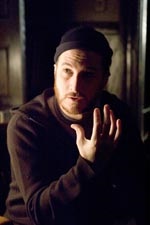
Director Darren Aronofsky
It's about two people who love each other deeply, and yet a terrible thing is happening to one of them—or, actually, to both of them—because one is dying at such a tragic young age.
What led you to focus on the mysteries of death so intently?
Aronofsky: I started working on it when I turned thirty. I think when you turn thirty, it's the first time that your mortality comes into any sort of focus. When you're in your twenties, you're still sort of carefree. When you turn thirty, there's something about that number. You suddenly realize, one day I will be forty-five, and one day I will be seventy-five.
At the same time, both of my parents faced a fight with cancer. They were diagnosed within a month of each other, with different cancers. To suddenly be their caretaker in a certain way, and to be concerned about losing them, it really shook me up a bit. They've both been healthy now, for three or four years.
Both Hugh Jackman and Rachel Weisz had to perform some intense, emotional scenes, as Izzy and Tom deal with her brain tumor. How did they prepare for that?
Aronofsky: Rachel did a lot of research. She went to a lot of hospices, met people who were dying at a tragically young age, and talked to a lot of doctors. I think it got to her in a way that she didn't necessarily share with me. That's part of her [acting] process. I think she was really thinking about what Izzy was going through, and that's a heavy place for a healthy young woman to go.
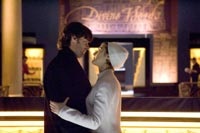
Hugh Jackman and Rachel Weisz play a happily married couple
What did Rachel, and the rest of you, learn from that research?
Aronofsky: When Rachel, Hugh, and I started to go out and meet young people who were dying, we talked to some of their doctors and caregivers. And what we found was just mind-blowing. A lot of these caregivers told us that they had started to have a spiritual [experience]. Death was happening in front of them, and they started to change.
Unfortunately, our culture doesn't have a way to understand and accept death as a spiritual act. We basically have no vocabulary or language to help anyone understand what is happening to them [when they die]. The families of these dying people would completely turn the opposite direction and start fighting it, basically telling their loved ones "You gotta fight! You gotta keep going!" Then, their hope became something that actually started to hurt the relationship. And the result was that a lot of these young people who were actually finding grace ended up dying even more alone because their families became so detached.
That tragedy, to me, became the core emotional story of The Fountain, because I found it so sad and so tragic.
So, The Fountain is a story about learning to accept death as "a spiritual act"?
Aronofsky: I think it has to do with the sanctity of life. The Bible says that the Creator sent Adam and Eve out of the Garden [and they could not] eat from the Tree of Life. The question is, what would have happened if they ate from the Tree of Life? Mortality is part of our humanity; it's what makes us beautiful. And unfortunately we've lost touch with what it means to be mortal.
In many ways it's about science versus art, and religion versus spirituality. You have these [scientific and religious] dogmas that are the languages of a certain type of discovery, but beneath that you have a certain type of acceptance and truth.
Article continues below
Izzy's character is leaning more toward acceptance [of death] … and Tom's character is using the scientific method to fight it. At times, these two methods rub against each other. I think the story is about Tom learning to accept, learning to live in the moment, and learning to accept life and death to the fullest.
But you're not saying it's a bad thing, or a futile pursuit, to employ science for the purpose of prolonging life and fighting disease, are you? Can Tom be both a medical researcher and enlightened?
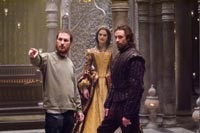
Aronofsky with Weisz and Jackman on the set
Aronofsky: I think it's about balance. Clearly science and technology have done amazing things. They prolong life, and they prolong the quality of life. We have people in their seventies and eighties living such a full life that it's inspirational. But, I think there comes a certain disconnect at a certain point. Because of the success of science, there's this hubris that we can fix everything. But we can't, because death is a certainty. Without death, we're not really human.
I had a 93-year-old grandmother who had a heart attack, and they tried to resuscitate her three times. I think there's a certain brutality to that. It's like they don't want anybody to die on their watch, or something like that.
All three of your films are about characters striving to escape suffering and reach some higher plane, whether through drugs or mathematics or science. Do you think audiences are ready for something this ambitious?
Aronofsky: It's a very spiritual movie, and I think that there'd be a lot of people in all religious communities that could have reaction to it— especially in the Christian community, because there's a major Judeo-Christian foundation to the film.
What was interesting to me was this: At the core of so many different religions is the spiritual truth which unites us all. It's just amazing when you look at the Judeo-Christian/Islamic foundation in Genesis about the two trees in the Garden of Eden—the Tree of Knowledge and the Tree of Life—and man and woman ate from the Tree of Knowledge and were basically banned from Eden. They could no longer eat from the Tree of Life.
You think about that, and then you go to the Mayan tradition. Think about how separate the Jews were from the Mayans! They were separated by, who knows, thousands of years—and yet, the Mayans tell a story about "a first father," an Adam, who had to make a sacrifice for the Tree of Life.
To me, that's amazing that there's this unity of spiritual sense between many of the faiths. I think that there is something that makes us all human. From all our different faiths and beliefs, there is something that connects us.
Article continues below
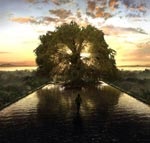
The Tree of Life
There seems to be a theme in many films right now, from Code Unknown to Crash to Babel—an increasing focus on the idea that some kind of fundamental connection has been broken.
Aronofsky: I buy it. I think we live in a very critical time. Every plastic bottle of drinking water that we've produced is going to be around for 10,000 years, at the minimum. We've basically poisoned our oceans and ripped down our forests. We've taken a huge chunk out of the planet. And we're still playing the same old game of killing each other, and being the only species on the planet that just basically wipes each other out off the planet.
We know that there's 16,000 different species that are on the endangered list, and that's all because of human pressure. We're basically destroying our Creator's, uh, Eden. All of us believe that there's something amazing and something beautiful about this creation, yet here we are just totally shredding it and destroying it. It's really, really mixed up and messed up. We've really lost our way.
As far as I can see, we're just continuing down this path. And now, as a new father, I look at my son and I think about my grandchildren, and I know they're gonna look back on my generation and say, "What were you people thinking?" They'll just have incredible disdain for what we did in the twentieth century to the planet and to each other.
So, as a filmmaker and a storyteller, I've got to try and tell stories that reconnect us to each other and to the planet.
So, in view of that human tendency to destroy, what is The Fountain showing us?
Aronofsky: The big message of The Fountain is a message of recycling.
It's called The Fountain because a fountain basically sucks out from below, shoots it up on the air, it goes back into the earth, and goes around in a cycle. Even a tree is very much a fountain that moves extremely slowly: It grows up and up out of the earth, the leaves come out, the leaves die and fall down, they go back into the soil, and the tree comes back alive again.
And, for me, that circle, that rotating circle of energy and matter, is endless. It stretches all the way back to the beginning of time.
The whole "Big Bang," the scientific theory of how we've evolved, and the question of whether or not there is a Creator—it doesn't matter to me. I think The Fountain is open to all of that. All of our energy and all of our matter comes from something before us. It's the old "ashes to ashes, dust to dust," idea that we go back to the earth and then something else comes out of it. I don't think it affects how you look at Heaven or Hell, or reincarnation, or whichever religious belief you come from. I worked really hard in The Fountain not to get in the way of that. I just wanted people to see that we're part of this long, lasting cycle stretching back all the way to the Big Bang.












 While we pray for peace, we need moral clarity about this war.
 As my doubts about his teachings grew, so did a secret fascination with Jesus.
 The plan would organize UMC churches in four global regions, with each given more leeway around same-sex marriage and other theological issues.