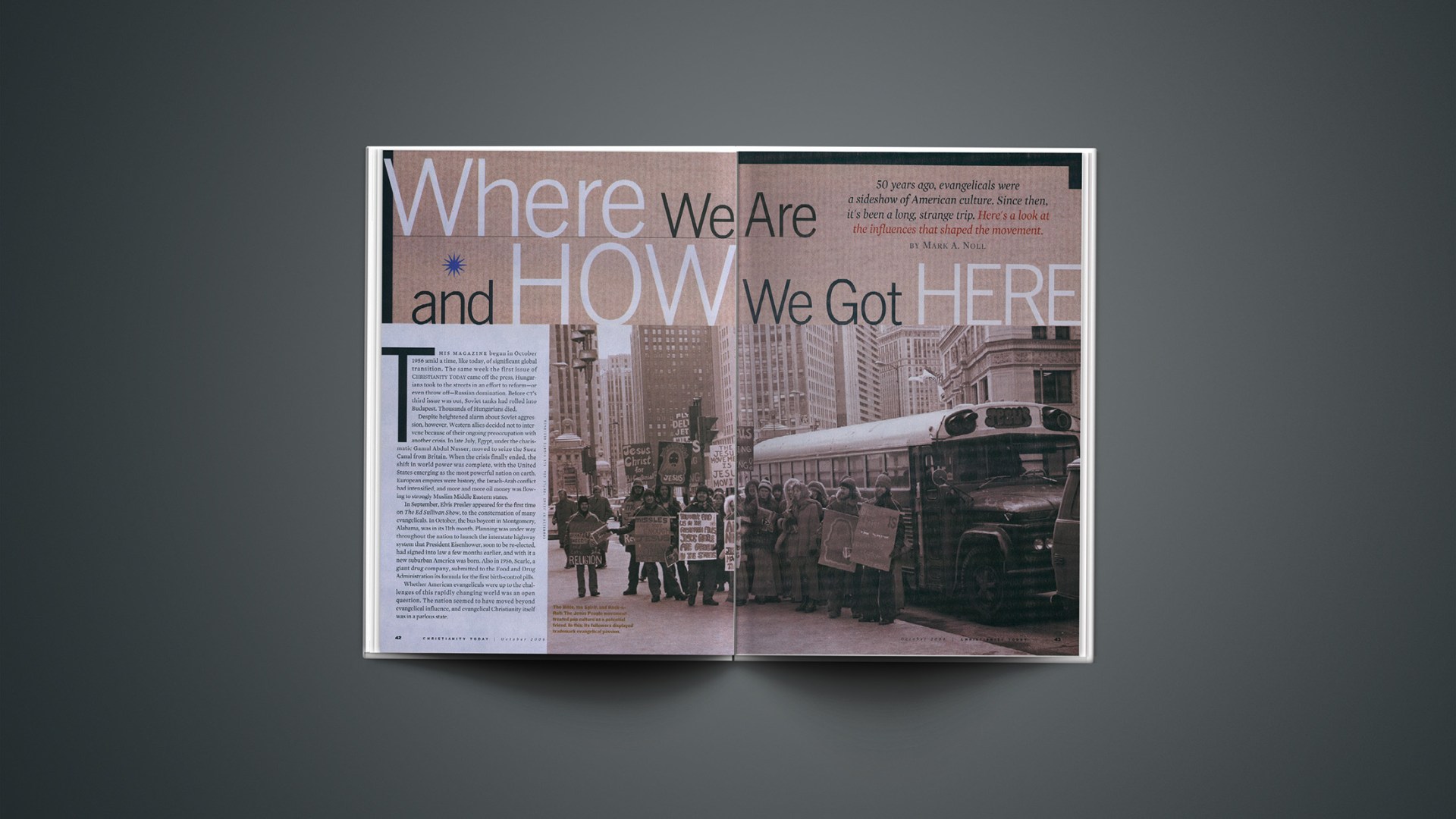

This magazine began in October 1956 amid a time, like today, of significant global transition. The same week the first issue of Christianity Today came off the press, Hungarians took to the streets in an effort to reform—or even throw off—Russian domination. Before CT's third issue was out, Soviet tanks had rolled into Budapest. Thousands of Hungarians died.
Despite heightened alarm about Soviet aggression, however, Western allies decided not to intervene because of their ongoing preoccupation with another crisis. In late July, Egypt, under the charismatic Gamal Abdul Nasser, moved to seize the Suez Canal from Britain. When the crisis finally ended, the shift in world power was complete, with the United States emerging as the most powerful nation on earth. European empires were history, the Israeli-Arab conflict had intensified, and more and more oil money was flowing to strongly Muslim Middle Eastern states.
In September, Elvis Presley appeared for the first time on The Ed Sullivan Show, to the consternation of many evangelicals. In October, the bus boycott in Montgomery, Alabama, was in its 11th month. Planning was under way throughout the nation to launch the interstate highway system that President Eisenhower, soon to be re-elected, had signed into law a few months earlier, and with it a new suburban America was born. Also in 1956, Searle, a giant drug company, submitted to the Food and Drug Administration its formula for the first birth-control pills.
Whether American evangelicals were up to the challenges of this rapidly changing world was an open question. The nation seemed to have moved beyond evangelical influence, and evangelical Christianity itself was in a parlous state.
Greatly Weakened Protestantism
In retrospect, it is clear that the fundamentalist-modernist controversies of the early 20th century had greatly weakened American Protestantism, leading to an intellectual collapse. By the 1950s, specific Christian influence of any sort was rare in the nation's leading universities or in first-level discussions of public policy. Fundamentalists had lost the battles against evolution and the higher criticism of Scripture. So they had angrily opted out of mainstream academic life. Modernists had made their peace with the dominant paradigms of the secular university, but were left with little to offer that was explicitly Christian.
Popular culture was similarly devoid of Protestant influence. With apologies to radio stalwarts like Aimee Semple McPherson, Charles Fuller, and the Moody network, the popular media (especially cinema) were controlled by forces hostile or indifferent to evangelical concerns. Television was growing fast, but it was even more untouched by Christianity.
To be sure, World War II, by galvanizing the nation morally as well as militarily, had prompted an upsurge of religion. But this religion was mostly a patriotic theism rather than a sharply focused particular faith. As Will Herberg argued in his 1955 book Protestant, Catholic, Jew, a generic religion of "Judeo-Christian values" could become as much a substitute for individual faiths as an extension of them.
The number of evangelical adherents was actually quite large nationwide. Catholics, Jews, and Protestants of all sorts were expanding in step with the postwar economic boom. Evangelicals were in the vanguard of these advances, but the churches that were expanding most rapidly (Southern Baptists, Seventh-day Adventists, Churches of God in Christ, Nazarenes, Assemblies of God, and independents) were also the least visible in the national consciousness.
Theological conservatives had lost control of the historic Northern denominations that once played such a large role as arbiters of the nation's public life. Strong evangelical outposts did remain in several ecclesiastical traditions. These included mainline churches; fundamentalist associations and individual congregations; burgeoning Pentecostal networks; ethnic Mennonites, Lutherans, and Christian Reformed; a variety of African American church families; even a few Hispanic American and Asian American bodies. But the outposts were largely unconnected. South of the Mason-Dixon Line, evangelicals in rich variety dominated the landscape, but the region's institutionalized racism undermined its religious influence nationally.
While large numbers of evangelicals could still be found, their general impact was considerably less than the sum of the parts. Politics offers a good example. Apart from nearly universal support for the nation's stand against Communism, a burst of interest in the new state of Israel (driven more by apocalyptic speculation than on-site analysis), and simmering agitation against the liquor trade, evangelicals—in sharp contrast to their predecessors of earlier eras—were politically inert.
Sadly, evangelical political passivity extended to the nation's greatest enduring moral problem—race. In 1956, far more than half of the nation's African Americans were still prevented by law or custom from voting, and the nation's armed forces had been recently integrated only because Russian propagandists made capital out of the plight of segregated blacks in the supposed "land of the free." Congress was again considering civil rights legislation in 1956, as it had annually since the landmark Supreme Court decision of 1954, Brown v. Board of Education. But as if to underscore how difficult it would be to alter the racial habits of three centuries, in mid-year, 96 white congressmen from the 11 states of the former Confederacy issued a widely noticed manifesto that defended segregation, criticized non-Southerners for their own racial hypocrisy, and defied federal efforts at altering Southern race traditions.
Individual white evangelicals could be found working to pass a civil rights bill and contributing to the Southern manifesto. But without an evangelical consensus, there was no national mobilization. Nor was there even much awareness that coercive discrimination against African Americans contradicted evangelical moral norms as much as it did American ideals.
Evangelicalism was by no means dead. But its capacity to shape national mores or to influence national agendas in politics, the media, and intellectual life seemed spent. One could not wonder if perceptive observers at the time predicted increasing irrelevance for America's evangelicals. Some might have anticipated selected outposts of evangelical strength fueled (especially in the race-divided South) by resistance to the secularizing trends of national life. Few, however, could have predicted the resurgence that actually occurred.
New Neighbors
Why did this resurgence happen? It is possible to sketch some of the important forces at work, even if assessments of cause and effect and judgments about theological merit remain hotly debated, especially among evangelicals themselves. Here I briefly highlight two specific developments and three diffuse movements. I then consider one overarching characteristic of recent evangelical history that may explain a great deal about these unexpected happenings.
The two specific developments are ones that evangelicals did not seek and that some actively opposed. First was the ethnic transformation of the United States following the Immigration and Nationality Act of 1965. Second was the successful implementation, through federal legislation and the courts, of civil rights.
1. Immigration reform. Since the loosening of immigration restrictions in 1965, the United States has once again become the most ethnically diverse nation on the planet. Conventional wisdom understands that the dramatically increased presence of Hindus, Buddhists, Muslims, and adherents of other faiths has created unprecedented religious pluralism. But as sociologist R. Stephen Warner has pointed out, the new immigration is surprisingly—even overwhelmingly—Christian. Warner has called the outcome of recent immigration "the de-Europeanization of American Christianity." Because so many of the Hispanic, Korean, Nigerian, Chinese, Eastern European, Filipino, Ghanaian, and Brazilian newcomers are evangelicals, often of a Pentecostal cast, the result has also contributed to the re-evangelization of America.
2. Civil Rights. The civil rights revolution began in African American churches during the 1930s and 1940s when more and more black Americans began to explore applications of biblical faith in an all-righteous God, which had sustained them through slavery and segregation, to the nation's structural racial injustices. After Brown v. Board of Education in 1954, white evangelicals mostly remained ambivalent. They could recognize strong biblical convictions in the black church folk who were driving the revolution. But they were frightened by elements like Gandhi's pacifism and the socialism of A. Philip Randolph.
Without much white evangelical support, the civil rights movement nonetheless moved ahead with passage of a federal civil rights bill in 1957. Then came the landmark legislation of the mid-1960s: civil rights (1964), voting rights (1965), and open housing (1968). By this time white evangelicals, even in the South, were beginning to accept the inevitability of civil rights for blacks, and a few intrepid evangelicals, such as Frank Gaebelein of Stony Brook School (and a CT co-editor), actively joined in the struggle (though, it must be acknowledged, with significant internal opposition at CT). It was, however, President Lyndon Johnson, Martin Luther King Jr., and a host of African American leaders and followers who pushed the revolution through.
The spinoffs for American evangelicals were immense. First, evangelical acceptance of civil rights did not mean that evangelicals accepted the means used to secure them—federal power, which soon expanded well beyond civil rights. Sociologists Robert Wuthnow and Steve Bruce have demonstrated how resentment against intruding national authority—especially on sexuality, the family, and public schools—fueled evangelical attachment to the Republican Party, as putatively the party of small government.
But once legally enforced racism was gone, the great impediment that had restricted the influence of Southern religion was also gone. Stripped of racist overtones, Southern evangelical religion—the preaching, the piety, the sensibilities, and above all the music—became much easier to export throughout the country. Billy Graham had earlier shown how attractive a non-racist form of affective Southern evangelicalism could be. As historians Grant Wacker and Darren Dochuk have demonstrated, evangelical sons and daughters of the South (Pat Robertson, D. James Kennedy, Jerry Falwell, Anita Bryant, even Jimmy Carter) found it much easier to export the gospel sensibilities of their region once the battle for civil rights was won.
For reviving and defining American evangelicalism as a whole, the infusion of new adherents from overseas and the expansion of Southern influence to the nation have been pivotal.
People Movements
The three more diffuse movements were tightly interwoven with broader developments, but each still deserves brief attention on its own.
1. A new wave of voluntary organization. The formation of the American Board of Commissioners for Foreign Missions, the American Bible Society, and similar foundations had revived evangelicalism in an earlier period. Now came a new effervescence of evangelical entrepreneurialism. It began in the fundamentalist era, but then really took off in the postwar boom of wealth, higher education, and upward mobility. Without denominational identification, without sanction from the universities, and usually without carefully constructed organizational charts, this new wave nonetheless was driven by the gospel. And it was brimful of energy. A partial listing of the new agencies and institutions includes InterVarsity Christian Fellowship (1938), the Summer Institute of Linguistics (1934) and Wycliffe Bible Translators (1942), Young Life (1941), the National Association of Evangelicals (1942), the Navigators (incorporated 1943), Youth for Christ (1944), Fuller Theological Seminary (1947), Campus Crusade for Christ (1951), World Vision (1953), and the Fellowship of Christian Athletes (1954). These new organizations were purebred evangelical in their commitment to traditional Christian faith. But they were also purebred evangelical in expressing those commitments independently, focused on need, and with organizational creativity. They have reconstructed the infrastructure of contemporary American evangelicalism.
2. The charismatic movement. The charismatic movement, which can be traced back to the 1950s, but which burst into prominence in the following decade, offered a different kind of reinvigoration. It promoted emphases of classical Pentecostalism, but in typical American fashion—as a spiritual smorgasbord to sample as individuals chose. Charismatic emphases on personal conversion, physical healing, speaking in tongues, participation in small group fellowships, and freshly written songs offered a range of open possibilities rather than formal ecclesiastical requirements.
Effects of the movement included greater concern for specific acts of the Holy Spirit, but even more a general turn toward subjective spirituality, especially in churches where Pentecostal teachings were alien. In a postwar world of increasing mobility, rapid population growth, suburban sprawl, and an accelerated pace of life, teaching about the presence of the Spirit—as Comforter, Guide, Counselor—found real traction.
In the week-to-week life of congregations, the influence of the charismatic movement was most visible in the great changes in church music that began to take place in the 1960s. Almost all these changes were related to the charismatic movement, the expanding influence of Southern evangelicalism, or both.
3. The Jesus People movement. The Jesus People of the late 1960s and early 1970s offered a particularly visible instance of voluntary and charismatic vitality. They foreswore suits and ties. They penned lyrics beyond number to be sung with guitar and drums. They enlisted new vocabularies from pop culture to connect with young people disillusioned by the corporate rat race or the Vietnam War. They cooperated with energetic young pastors, such as Chuck Smith of Calvary Chapel, who were committed to becoming all things to all restless youth that by all means they might save some.
The short-lived prominence of the Jesus People should not blind us to their wide-ranging significance. From the 1920s to the 1950s, American evangelicals had tended to view popular culture as an enemy—to keep the gospel it was necessary to flee the world. In the late 1960s, the Jesus People treated popular culture as a potential friend—to spread the gospel it was necessary to use what the world offered. The fact that leaders of the movement displayed a firm commitment to scriptural values while rejecting the licentious practices of the counterculture reassured the broader evangelical world that, strange as they might seem, these Jesus Folk were okay. As historian Larry Eskridge has shown, the Jesus People found a potent antidote to sex, drugs, and rock-n-roll in the Bible, the Spirit, and rock-n-roll.
Cultural Creativity
These movements illustrated an overarching and multifaceted characteristic of American evangelicalism from the early 1950s to the present. That characteristic was a willingness—whether expressed consciously or simply taken for granted—to embrace broader currents of American culture.
Since the movement's beginning in the revivals of the 18th century, evangelicals have combined traditional religion with cultural adaptability. Evangelicalism has been at its best when continuity with doctrinal tradition has balanced sensitive response to surrounding circumstances. For instance, John Wesley, himself a politically conservative Anglican, nonetheless sensed the need for new forms of organization and new modes of religious expression to respond to what historians have called "the invention of the individual." The result? Small groups, a more lively and personal hymnody, and extensive lay recruitment that made Methodism the fastest growing Christian movement of the century. Methodism positively influenced the whole world of English-speaking Protestantism, including those who disagreed with Wesley's theology.
During the fundamentalist era, evangelicals had in fact shown considerable cultural creativity—by setting up publishing networks outside the denominations, producing radio programs with broad appeal, and organizing youth activities in the public square. But a defensive mentality that deployed doctrine and requirements of lifestyle piety to fend off threats from the world was dominant. In the mid-20th century, evangelicals once again began to run on the two tracks of tradition and innovation. From every point on the compass, evangelicals re-engaged with main currents of American life.
This re-engagement took a spectacular turn early in 1956, when five young missionaries who had ventured deep into the Amazonian jungle were slain by the Waodani tribespeople they were trying to evangelize. Such attacks had taken place before—indeed, quite regularly—in the history of evangelical missions. This time, however, the after-effects were startling. The story of the missionaries' sacrifice was featured not only in the pulpits and pages of the Christian world, but also by American secular media. First came photos in Life magazine, followed soon thereafter by an article in Reader's Digest, then a segment on television's This Is Your Life, and finally the publication of a bestselling book, Through Gates of Splendor, by Harper, a major New York press.
Historian Kathryn Long has pointed out that nothing like this positive attention to evangelicals had occurred in American mainstream media for more than a generation. Such evangelical skill at engaging and exploiting the mainstream media had not been witnessed since the heady days of D. L. Moody 60 years before. The missionaries had died attempting to spread the old, old story of Jesus and his love. Their testimony, however, was being communicated through the most up-to-date media that America had to offer.
Significantly, Elisabeth Elliot, widow of one of the missionary martyrs, wrote Through Gates of Splendor. It was the first in a remarkable series of books that came to include other missionary memoirs, novels, devotional reflections, and social commentaries. With Rachel Saint, sister of another of the missionaries, Elliot returned to the Waodani. Aided by Dayuma, a formidable Waodani woman, the missionaries began to translate the Scriptures and establish a beachhead for the gospel, only short years after the killings took place. Elisabeth Elliot, Rachel Saint, and Dayuma were not feminists. But they were exercising the kind of public "agency" for which modern feminists appealed, and they were showing the way for an evangelical female activism that would come to include a bulging roster of influential public figures such as Beverly LaHaye, Diane Knippers, Nancy Hardesty, Letha Scanzoni, and (as outsiders heeded by evangelicals) Phyllis Schlafly and Frederica Mathewes-Green. Their activity was geared to contemporary realities, using contemporary media.
Old Message, New Language
When the first Christianity Today appeared in October 1956, the Billy Graham Evangelistic Association (BGEA) was already deep into planning for a major evangelistic effort in New York City. Both the magazine and the campaign represented watersheds. Graham's plans for New York City were his most ambitious project yet. The meetings drew tremendous crowds, including one gathering of 92,000 at Yankee Stadium. There were also many life-changing decisions for Christ. But this campaign solidified a decisive break with the past. In New York City, Graham clarified a strategy he had been developing for some time: He would cooperate with whoever would cooperate with him, including mainline Protestants, whom many evangelicals considered dangerously liberal. When fundamentalist critics challenged this strategy, Graham stood firm.
The result, which many others besides the BGEA supported, was a clear distinction between separatistic and intentionally narrow fundamentalism and more open, intentionally outgoing evangelicalism. While outsiders have not always recognized the distinction, it has been crucial. It draws a straight line from Graham to Bill Hybels, Rick Warren, and Tim Keller. Fundamentalists would seek to protect the gospel by separating from the world. Evangelicals, by contrast, would promote it by engaging the world—and using whatever means modern America made available.
Another evangelical innovator was Kenneth Taylor. During his daily commute by train to Moody Press in Chicago, Taylor began in 1956 to paraphrase passages from the King James Version of the Bible. His family had complained about difficulties in understanding the KJV. Taylor, with characteristic evangelical initiative, did something about it. His efforts led eventually to the immensely popular Living Bible, which was the bestselling book in the United States in 1972, 1973, and 1974.
Taylor, with his devotion to the Bible, exemplified a classic evangelical commitment. Just as classically evangelical was his willingness to launch out on his own without waiting for someone else's approval. The same goes for his creation of a major new organization (Tyndale House Publishers) to institutionalize creativity. Also with his disregard for traditional church structures. (Many evangelicals had rejected the Revised Standard Version of 1952 precisely because the National Council of Churches sponsored it.)
The course pursued by the missionary families, Billy Graham, CT, and Kenneth Taylor anticipated the major evangelical developments of the next 50 years. Traditional evangelical convictions were central—missionary proclamation of the gospel abroad, committed evangelization of the lost at home, passionate fidelity to the Bible, and (in the case of CT) careful exposition of classical Christian teaching alongside principled Christian assessment of current events.
But also central was a deliberate adaptation to the norms of contemporary American culture. These evangelicals embraced the modern media, instead of treating them as evil. They set theological battles of former eras aside to communicate with as many contemporaries as possible. They considered women fully capable of active public service. They forsook traditional theological language and traditional versions of the Bible to spread Scripture with new language. They set out boldly—as in Washington, where CT was based in its early years—to engage contemporary world affairs, politics, culture, and the arts with the historical truths of the Christian faith.
Unforeseen Developments
In the decades since 1956, significant events, influential new leaders, and unanticipated developments have shaped evangelical history. A number would certainly have surprised, and probably disconcerted, the evangelical leaders of half a century ago. Few could have predicted that in many evangelical churches worship in 2006 would look and sound more like Elvis Presley on The Ed Sullivan Show than the Sunday services attended by evangelicals who were so alarmed by Elvis in 1956. Few could have foreseen the rise of megachurches attuned to the suburban landscapes created by Eisenhower's interstate highways and the startling expansion of American wealth. Few could have imagined that an appeal to reengage with American public life would lead to "culture wars" or the transformation of Caucasian evangelicalism into "the Republican Party at prayer." Yet the seeds of all these things were planted or growing in 1956.
A long list of significant events has also decisively influenced more recent evangelical history.
- Roe v. Wade (1973) legalized abortion on demand across the 50 states—and accelerated evangelical political engagement.
- The International Congress on World Evangelization (1974), which produced the influential Lausanne Covenant, highlighted revolutionary changes in the world map of Christian faith.
- The conservative victory in the Southern Baptist Convention (beginning in 1979) not only redirected the course of that denomination but also brought it into much closer contact with evangelicals outside the South.
- The first Evangelicals and Catholics Together document (1994) publicized a new era of theological dialogue and cooperation.
- The fall of the Berlin Wall (1989) and the attacks of September 11, 2001, forced evangelicals to refocus their concerns for the world at large.
Similarly, a lengthy roster of influential leaders (and influential voices from outside the United States, or from beyond the evangelical world) have played key roles in shaping evangelicalism between 1956 and today. A few of these leaders, such as Oral Roberts, John Stott, and J. I. Packer, have been active during the whole period. Most came into prominence later, including (as a sample of evangelicalism's extraordinary diversity): Francis Schaeffer, C. S. Lewis, Hal Lindsey, James Dobson, John Perkins, Gordon MacDonald, Roberta Hestenes, Richard John Neuhaus, Anne Graham Lotz, Bruce Wilkinson, Joel Osteen, and John Piper.
The interests and activities of such leaders have moved in many different, sometimes contradictory, directions. They are, however, linked by their deep involvement in the contemporary world, an involvement exemplified by the figures of the early 1950s who were present at the creation of modern American evangelicalism.
Theology and Culture
The resurgence of American evangelical Christianity over these 50 years has amounted to a cultural revival. As in earlier periods of British and American history, evangelicals have once again won converts, brokered alliances, and gained social influence.
Also as in earlier periods, cultural resurgence has been manifest in, as well as fueled by, political revival. Once again, as in the days when controversy over the morality of slavery dominated public debate, so now moral issues of interest to evangelicals have come front and center in American life, largely because evangelicals have advanced them.
In turn, the political and cultural revivals have been supported by a demographic resurgence. Rather than fading away, evangelicals have stormed back with recruitment strategies adapted to a secular America strongly shaped by television, with a strong impetus from immigrant churches, and with effective ministries to the various groups into which American society is now divided.
It is exceedingly difficult to know whether cultural, political, and demographic revival also means spiritual revival. Historically, evangelicalism has had integrity when it maintains the substance of classical Christian faith; it has exerted influence and enjoyed a broad appeal when it responds effectively to impulses within its host cultures. When evangelicals think only about honoring their heritage, they easily lose sight of the gospel imperative to evangelize and to be salt and light in the world. Conversely, when they think only about effective witness and responding to urgent psychological needs, they easily lose sight of the gospel imperative to preserve the truth in righteousness.
In some earlier eras, the balance of theological integrity and cultural sensitivity moved mountains. At other times, loyalty to traditions led to separatistic stagnation, or lust for cultural relevance perverted the gospel into Christianity-lite.
During the first half of the 20th century, the stress had shifted toward preserving traditions. At the middle of the 20th century, evangelicals began to move back toward a balance.
But have evangelicals today moved too far? Has an overemphasis on preserving tradition been replaced by an overemphasis on connecting to the culture? For such supremely important questions, it is, of course, too early for a historical assessment. When the balance shifts too strongly to one without the other, it is merely sounding brass and a tinkling cymbal. But an evangelical resurgence that balances traditional faith and cultural relevance sounds a trumpet of salvation to the world.
Mark A. Noll is the Francis A. McAnaney Professor of History at the University of Notre Dame and the author of numerous books, including The Civil War as a Theological Crisis (University of North Carolina).
Copyright © 2006 Christianity Today. Click for reprint information.
Related Elsewhere:
See also the sidebar to this story: "'Truth from the Evangelical Viewpoint'" | What Christianity Today meant to the movement 50 years ago.
More on Christianity Today International's 50th anniversary is available at our anniversary site.