Evangelicals apparently have so much political clout that they are poised to install a theocracy, according to some commentators. Such critics don't notice there is little distinctively evangelical about the evangelical approach to politics. The evangelical emphases—on conversion, the Cross, the Bible, and activism—do not themselves amount to a full, independent theological system. Nor do they take us far in understanding politics, which requires at least some grasp of history, government, law, justice, freedom, rights, mercy, violence, and war. Thoughtful evangelicals trying to understand politics often draw on the wider resources of Calvinist, Anabaptist, Anglican, Lutheran, or Catholic teaching.
Still, venerable publications like The New Republic go overboard when they claim that evangelicals merely march to the drumbeat of Catholic thinkers like Richard Neuhaus, Michael Novak, and George Weigel. Yes, evangelical distinctives can be compatible with a range of other doctrines. Hence, we can speak easily of evangelical Anglicans or Lutherans, even of evangelical Orthodox or Catholics. The Economist plausibly took Sen. Sam Brownback, a recent convert to Catholicism, to symbolize growing evangelical international activism on religious freedom, sex trafficking, AIDS, Sudan, and North Korea.
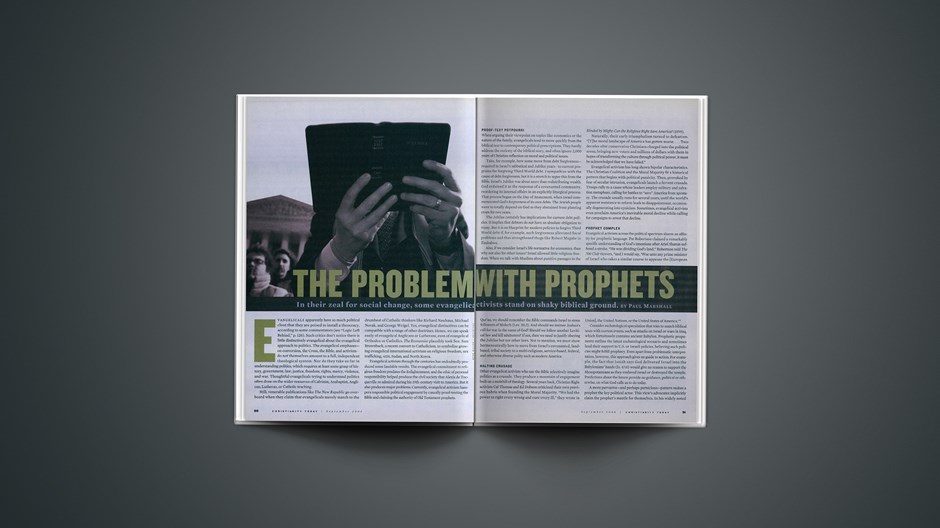
Evangelical activism through the centuries has undoubtedly produced some laudable results. The evangelical commitment to religious freedom predates the Enlightenment, and the ethic of personal responsibility helped produce the civil society that Alexis de Tocqueville so admired during his 19th-century visit to America. But it also produces major problems. Currently, evangelical activism hampers responsible political engagement by casually proof-texting the Bible and claiming the authority of Old Testament prophets.
Proof-Text Potpourri
When arguing their viewpoint on topics like economics or the nature of the family, evangelicals tend to move quickly from the biblical text to contemporary political prescriptions. They hardly address the entirety of the biblical story, and often ignore 2,000 years of Christian reflection on moral and political issues.
Take, for example, how some move from debt forgiveness—required in Israel's sabbatical and Jubilee years—to current programs for forgiving Third World debt. I sympathize with the cause of debt forgiveness, but it is a stretch to argue this from the Bible. Israel's Jubilee was about more than redistributing wealth. God ordained it as the response of a covenanted community, reordering its internal affairs in an explicitly liturgical process. That process began on the Day of Atonement, when Israel commemorated God's forgiveness of its own debts. The Jewish people were to totally depend on God as they abstained from planting crops for two years.
The Jubilee certainly has implications for current debt policies. It implies that debtors do not have an absolute obligation to repay. But it is no blueprint for modern policies to forgive Third World debt if, for example, such forgiveness alleviated fiscal problems and thus strengthened thugs like Robert Mugabe in Zimbabwe.
Also, if we consider Israel's life normative for economics, then why not also for other issues? Israel allowed little religious freedom. When we talk with Muslims about punitive passages in the Qur'an, we should remember the Bible commands Israel to stone followers of Molech (Lev. 20:2). And should we imitate Joshua's call for war in the name of God? Should we follow another Levitical law and kill adulterers? If not, then we need to justify obeying the Jubilee but not other laws. Not to mention, we must show hermeneutically how to move from Israel's covenanted, land-based, tribal society to a multi-religious, service-based, federal, and otherwise diverse polity such as modern America.
Halting Crusade
Other evangelical activists who use the Bible selectively imagine politics as a crusade. They produce a mountain of engagement built on a molehill of theology. Several years back, Christian Right activists Cal Thomas and Ed Dobson criticized their own previous hubris when founding the Moral Majority. "We had the power to right every wrong and cure every ill," they wrote in Blinded by Might: Can the Religious Right Save America? (1999).
Naturally, their early triumphalism turned to defeatism. "[T]he moral landscape of America has gotten worse. … Two decades after conservative Christians charged into the political arena, bringing new voters and millions of dollars with them in hopes of transforming the culture through political power, it must be acknowledged that we have failed."
Evangelical activism has long shown bipolar characteristics. The Christian Coalition and the Moral Majority fit a historical pattern that begins with political passivity. Then, provoked by fear of secular intrusion, evangelicals launch a fervent crusade. Troops rally to a cause whose leaders employ military and salvation metaphors, calling for battles to "save" America from apostasy. The crusade usually runs for several years, until the world's apparent resistance to reform leads to disappointment, occasionally degenerating into cynicism. Sometimes, evangelical activists even proclaim America's inevitable moral decline while calling for campaigns to arrest that decline.
Article continues below
Prophet Complex
Evangelical activism across the political spectrum shares an affinity for prophetic language. Pat Robertson claimed a remarkably specific understanding of God's intentions after Ariel Sharon suffered a stroke. "He was dividing God's land," Robertson told The 700 Club viewers, "and I would say, 'Woe unto any prime minister of Israel who takes a similar course to appease the [European Union], the United Nations, or the United States of America.'"
Consider eschatological speculation that tries to match biblical texts with current events, such as attacks on Israel or wars in Iraq, which fortuitously contains ancient Babylon. Prophetic proponents outline the latest eschatological scenario and sometimes lend their support to U.S. or Israeli policies, believing such policies might fulfill prophecy. Even apart from problematic interpretation, however, this approach gives no guide to action. For example, the fact that Isaiah says God delivered Israel into the Babylonians' hands (Is. 47:6) would give no reason to support the Mesopotamians as they enslaved Israel or destroyed the temple. Predictions about the future provide no guidance, political or otherwise, on what God calls us to do today.
A more pervasive—and perhaps pernicious—pattern makes a prophet the key political actor. This view's advocates implicitly claim the prophet's mantle for themselves. In his widely noted God's Politics, Jim Wallis writes, "The place to begin to understand the politics of God is with the Prophets." Wallis does not bother to justify this unusual contention. The Bible itself does not begin with the Prophets, but with Genesis, as does most Christian reflection on politics throughout history. Nor does Wallis relate the Prophets to the Torah. They challenged rulers on the basis of God's law, not on their own feelings of injustice.
The prophet's vital role cannot substitute for understanding the actual burdens of legal and political responsibility. If we take the Prophets as our political model, then we stress this critical outsider's role. Renowned sociologist Max Weber suggested the Prophets might well be understood as forerunners of a free press. But journalism is no substitute for government. Washington's leaders regard such modern-day prophets as betraying their limited political experience when they complain from a distance about what everyone else is doing wrong and offer no realistic alternative policies.
Article continues below
These "prophets" disregard the real, day-to-day problems faced by actual politicians. They present utopian societies to achieve, rather than guidance for governing the varied and brawling people politicians govern. It's as if parents received advice on rearing their children by hearing someone describe an ideal child. They might respond, "I know what kids are supposed to be, but that tells me nothing. What I need is advice on what, today, I should do with the little monsters I have."
The Politics of Yoder
The prophetic model, influenced by John Howard Yoder's writings, has blended with the Anabaptist tradition. This tradition's great virtues include emphasis on the church's communal role in addressing social problems, commitment to the poor, and a historical suspicion of government. Yet its current appropriation by the Left is fraught with contradictions.
Historically, Anabaptist theology has portrayed the state as "Caesar," a realm separate from Christ and inextricably intertwined with the threat of force. Hence, Anabaptists have avoided the government when possible and addressed it prophetically from the fringes. But left-wing politicians, while suspicious of military and police power, frequently call for an expansive government to redistribute income, reform welfare, and provide medical care, among many other social causes. Thus the realm of coercion, "Caesar," is urged to take over ever-larger swaths of society.
The prophetic model also does not help Christians inside the political arena. Wallis discusses the end of apartheid in South Africa and focuses on the worthy role of Archbishop Desmond Tutu, who won a Nobel Peace Prize. But for Christians in governance, better role models would have been two other Christians who won the Nobel Peace Prize, Nelson Mandela and F. W. de Klerk. Not only did they reject apartheid, but they also took up the staggeringly difficult task of leading a bitterly divided country through the transfer of power. Mandela even led the country through its fractious early years. Other Christian leaders worthy of note include Martin Lee, leader of Hong Kong's democratic opposition. Or Kim Dae-Jung, another Nobel Peace Prize winner and the first democratically elected leader of South Korea. We could reach back further into history and applaud Jacques Maritain and Charles Malik, who helped shape the Universal Declaration of Human Rights.
Article continues below
Tempered but not Trivial
This side of eternity there will be no "revolution" that can change the human condition. The world will remain full of hope and sin, success and failure. We will win a few political debates and lose a few. Perhaps one day we'll lose many, and faithful people will be dragged to their deaths, as they are now around the world.
With time, evangelicals will grow wiser about the political arena just as parents do—through lived, practical experience. That experience will deliver a dose of reality about what politics can and cannot accomplish. Political action will not deliver utopia, conquer sin, or change human nature. But it can make a difference between rampant crime and safe neighborhoods, between hungry families and economic security, between victory and defeat in war. And only those who have never been mugged, never been hungry, or never been at war will think these differences trivial.
Paul Marshall has written and edited 20 books on religion and politics, including God and the Constitution. He is senior fellow at Freedom House's Center for Religious Freedom.















 While we pray for peace, we need moral clarity about this war.
 As my doubts about his teachings grew, so did a secret fascination with Jesus.
 The plan would organize UMC churches in four global regions, with each given more leeway around same-sex marriage and other theological issues.






