If the gospel is to make a difference in our culture, surely it will come as a surprise, rather than simply echoing entrenched political positions. Few Christian ethicists today are better at surprising their readers, and the wider world, than Amy Laura Hall, the director of the doctor of theology program at Duke Divinity School. She has been willing to challenge utilitarian forms of medical research that undergird the modern university's power and prestige. Her arguments against embryonic stem-cell research have found a wide hearing, partly because she combines a fierce commitment to the dignity of the least human being with a keen feminist awareness of the implications of runaway medical hubris for women and families.
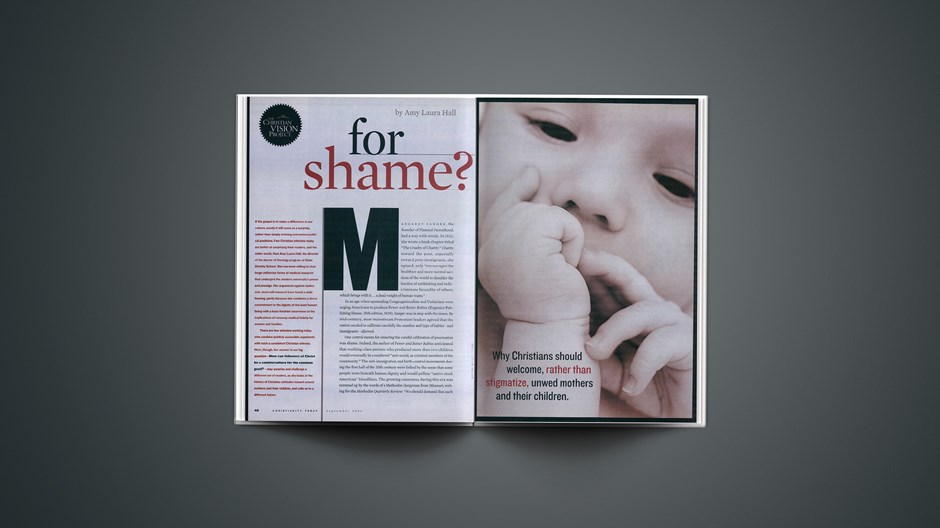
There are few ethicists working today who combine publicly accessible arguments with such a consistent Christian witness. Here, though, her answer to our big question—How can followers of Christ be a counterculture for the common good?—may surprise and challenge a different set of readers, as she looks at the history of Christian attitudes toward unwed mothers and their children, and calls us to a different future.
Margaret Sanger, the founder of Planned Parenthood, had a way with words. In 1922, she wrote a book chapter titled "The Cruelty of Charity." Charity toward the poor, especially toward poor immigrants, she opined, only "encourages the healthier and more normal sections of the world to shoulder the burden of unthinking and indiscriminate fecundity of others, which brings with it … a dead weight of human waste."
In an age when upstanding Congregationalists and Unitarians were urging Americans to produce Fewer and Better Babies (Eugenics Publishing House, 35th edition, 1929), Sanger was in step with the times. By mid-century, most mainstream Protestant leaders agreed that the nation needed to calibrate carefully the number and type of babies—and immigrants—allowed.
One central means for ensuring the careful calibration of procreation was shame. Indeed, the author of Fewer and Better Babies anticipated that working-class parents who produced more than two children would eventually be considered "anti-social, as criminal members of the community." The anti-immigration and birth-control movements during the first half of the 20th century were linked by the sense that some people were beneath human dignity and would pollute "native stock American" bloodlines. The growing consensus during this era was summed up by the words of a Methodist clergyman from Missouri, writing for the Methodist Quarterly Review: "We should demand that each child born is worthy of a place in our midst."
Yet the most blatant use of shame I have found in my work on the history of reproduction and domesticity in the U.S. does not come from the eugenicists of 60 years ago. It comes from the National Campaign to Prevent Teen Pregnancy, a 21st-century effort. Pictures posted in high schools and featured in teen magazines show a Latina girl with "CHEAP" emblazoned across her body. The African American girl is labeled "REJECT," the Asian girl "DIRTY," and the working-class white girl "NOBODY." The very fine print places these labels in a different context—recommending "cheap" condoms, for example. But the overwhelming effect of the design is bold-print humiliation, suggesting that teenage mothers are cheap, dirty nobodies, social rejects with no future and with little hope for their children. The stark photos are reminiscent of social-hygiene posters from the eugenic era, cultivating a potent combination of disdain and fear.
Possibly the most troubling of the posters features a white boy whose sexual activity resulted in an unexpected pregnancy. He is labeled "USELESS," and the fine print reads: "My scholarship is USELESS. Now I need a job to support my baby." Taken together, the posters convey a deeply problematic message. The college boy who leaves behind his scholarship to take care of the CHEAP REJECT's baby is USELESS.
The board of directors for the National Campaign to Prevent Teen Pregnancy includes CEOs from major corporations and leaders from both political parties, representing a broad consensus across the United States, as well as leading members of the black and Hispanic communities. The urgency of eliminating teenage pregnancy is one of the few matters on which conservatives and liberals agree, and the stakes are deemed sufficiently high to warrant the use of brute shame.
Sexy Doublespeak
Another national campaign to prevent teen pregnancy is sponsored by the Candie's Foundation, linked to a trendy line of handbags, sunglasses, bikinis, and sandals. The foundation's website speaks a predictable, nonsensical language of free-flowing, responsible sex appeal. "Think of what you can achieve if you don't conceive"—this runs as a refrain as various celebrities vogue for the camera. Candie's encourages viewers to "be sexy" (no doubt with the aid of Candie's accessories), but not to have sex. This directive is always followed with a caveat: If you do have sex, use birth control, or else you will suffer "the devastating consequences."
Article continues below
One public service announcement produced by Candie's makes it clear that the consequence that can render sex devastating is, in fact, a human life. With a young couple about to "do this" in the back seat of a car, former Playboy model Jenny McCarthy arrives to deliver a crying baby into the girl's arms. The boy exits the car in a hurry. Jenny leaves, too, sneering at the girl with knowing disgust. "Welcome to reality," are her departing words. The girl is left holding the crying baby, alone, clearly frightened, in the back seat of the car.
Is this truly reality—a world where teenage mothers who conceive are abandoned to "devastating consequences"? Perhaps. I sometimes think so when I hear stories of evangelical families who cannot bear the shame of an unplanned pregnancy, as I read thinly veiled warnings in the media about the growing number of young, Latina mothers in the U.S., and as I dig through the archives of meticulously planned reproduction as marketed to mid-20th-century Americans. Throughout that history of planning and parenthood, the word illegitimate bears multiple layers of stigma and shame.
But I have come to believe that Christians are called to be a counterculture for the common good in no small part by refusing to declare any life in our midst illegitimate.
Risky Commitment
Christians are called to a very different kind of double-speak from Candie's bikini-chastity chic. We are called to encourage sexual discipline outside and inside of marriage, while also affirming, in the very same breath, that no pregnancy is outside of God's reach.
This does not mean that Christians cannot say it would have been preferable had this young woman not shared herself intimately with a boy who hardly knew how to appreciate the intricate beauty of her body and the vulnerability of her love. Christians are surely called to teach girls and young women that their bodies are not primarily "in waiting" for sex with a man, but rather actively in service today for the work of the Holy Spirit. But as we affirm the blessings of holy chastity, we must also consider the incipient life embedded inside an image-bearer of God as within the purview of God's providence. A young couple's coupling in the backseat is morally barren (even if ultimately procreative), because it is outside the sacramental gift of marriage. Yet the pregnancy conceived by such a couple in the backseat (even if it is ill-conceived) is well within the reach of God's profligate grace.
Article continues below
During the last century in the United States, many mainline Protestant leaders, committed to the eugenics movement, deemed it their business to determine which births were with the grain of God's plan for the evolving progress of human history and which births were a drag on the movement forward. Christians are called to more humility and more confidence than that—more humility about the grievous harm that has been done in the name of social progress, and more confidence in God's ability to turn even regrettable human choices to good.
Happily, many Christian churches are already offering a different "welcome to reality" than the one offered by Jenny McCarthy. These congregations, neighborhoods, and kinship networks name the girls in the poster shame-campaign to be children of promise, worthy recipients of hands-on care and communal sacrifice. They refuse the calculus of life that draws a distinction between accidental and providential babies, between the right sorts of people and those sorts of people with teenage mothers.
There are such congregations, but I believe that, in answer to God's call, there could be many more.
Such advocacy, born of holy double-speak, is a stretch for many in my cohort of Christianity. But it is not so much a stretch for many African American congregations and Latino Catholic communities. It is my prayer that more mainstream evangelicals, in both "red" America and "blue" America, will cross over into risky solidarity with a third color of Americans.
We could do so by advocating for and working within alternative high schools where pregnant girls may continue their education. We could work for maternity leave and flexible schedules at all levels of education and enterprise, especially at institutions overtly committed to Christian witness. To be a people committed to the incalculable gift of life may mean myriad commitments that interrupt our plans for our own families. It may mean that a young couple without children find themselves babysitting a child not their blood kin several evenings a week, rather than watching their favorite science fiction series on DVD. A single man may find himself fixing a young single mother's clogged sink on a lunch break or building her toddler a swing set during a holiday weekend. For many mothers and fathers, it may mean adapting their entire life and career to care daily for an unexpected grandchild. And by my own political reckoning, witnessing for the common good not only means hands-on local action, but also advocating for systematic acts of mercy through a matrix of services to offer single mothers a safety net of care.
Article continues below
After hearing me give a talk on abortion, eugenics, and teenage pregnancy, my oldest daughter, with whom I had not yet initiated a talk about birds and bees, looked up at me and said frankly, "Mom, if God gives me a baby before I am married, I won't worry. I know that you and Dad would take care of it so that I could stay in school."
After taking a deep breath and squeezing back tears of sheer parental terror, I agreed that she was right, that we would help her and her baby no matter what. I pray that the situation will not arise, but I also pray that should it arise, her father and I, as well as the congregation into which she has been baptized, will be worthy of her confidence, for to fail her would be contrary to who we hope to be. To fail her would be the true shame.
















 While we pray for peace, we need moral clarity about this war.
 As my doubts about his teachings grew, so did a secret fascination with Jesus.
 Beyoncé’s right. Whether listening to Cowboy Carter or reading theology, diversity is a good thing.






