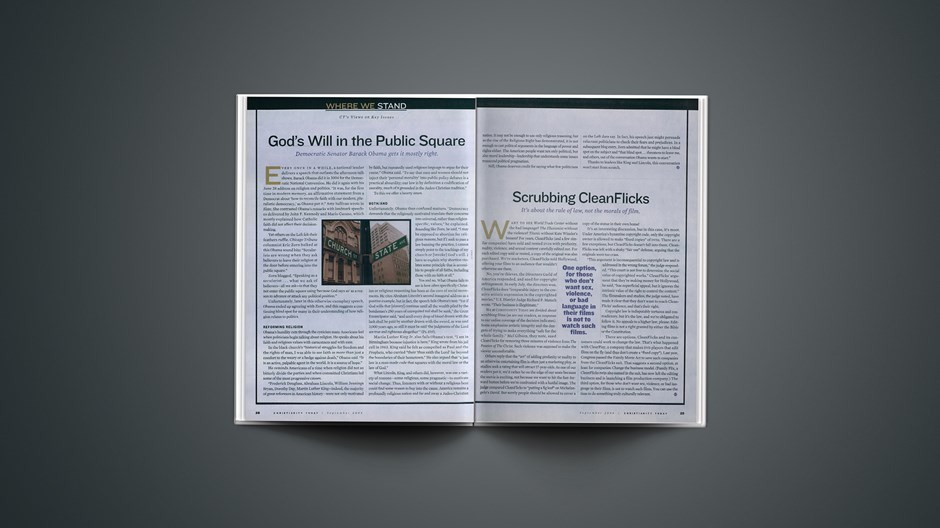
Every once in a while, a national leader delivers a speech that outlasts the afternoon talk shows. Barack Obama did it in 2004 for the Democratic National Convention. He did it again with his June 28 address on religion and politics. "It was, for the first time in modern memory, an affirmative statement from a Democrat about 'how to reconcile faith with our modern, pluralistic democracy,' as Obama put it," Amy Sullivan wrote in Slate. She contrasted Obama's remarks with landmark speeches delivered by John F. Kennedy and Mario Cuomo, which mostly explained how Catholic faith did not affect their decision-making.
Yet others on the Left felt their feathers ruffle. Chicago Tribune columnist Eric Zorn balked at this Obama sound bite: "Secularists are wrong when they ask believers to leave their religion at the door before entering into the public square."
Zorn blogged, "Speaking as a secularist … what we ask of believers—all we ask—is that they not enter the public square using 'because God says so' as a reason to advance or attack any political position."
Unfortunately, later in this otherwise exemplary speech, Obama ended up agreeing with Zorn, and this suggests a continuing blind spot for many in their understanding of how religion relates to politics.
Reforming Religion
Obama's humility cuts through the cynicism many Americans feel when politicians begin talking about religion. He speaks about his faith and religious values with earnestness and with ease.
In the black church's "historical struggles for freedom and the rights of man, I was able to see faith as more than just a comfort to the weary or a hedge against death," Obama said. "It is an active, palpable agent in the world. It is a source of hope."
He reminds Americans of a time when religion did not so bitterly divide the parties and when committed Christians led some of the most progressive causes.
"Frederick Douglass, Abraham Lincoln, William Jennings Bryan, Dorothy Day, Martin Luther King—indeed, the majority of great reformers in American history—were not only motivated by faith, but repeatedly used religious language to argue for their cause," Obama said. "To say that men and women should not inject their 'personal morality' into public policy debates is a practical absurdity; our law is by definition a codification of morality, much of it grounded in the Judeo-Christian tradition."
To this we offer a hearty amen.
Both/And
Unfortunately, Obama then confused matters. "Democracy demands that the religiously motivated translate their concerns into universal, rather than religion-specific, values," he explained. Sounding like Zorn, he said, "I may be opposed to abortion for religious reasons, but if I seek to pass a law banning the practice, I cannot simply point to the teachings of my church or [invoke] God's will. I have to explain why abortion violates some principle that is accessible to people of all faiths, including those with no faith at all."
Yes and no. What Obama fails to see is how often specifically Christian or religious reasoning has been at the core of social movements. He cites Abraham Lincoln's second inaugural address as a positive example, but in fact, the speech fails Obama's test: "Yet if God wills that [this war] continue until all the wealth piled by the bondsman's 250 years of unrequited toil shall be sunk," the Great Emancipator said, "and until every drop of blood drawn with the lash shall be paid by another drawn with the sword, as was said 3,000 years ago, so still it must be said 'the judgments of the Lord are true and righteous altogether'" (Ps. 19:9).
Martin Luther King Jr. also fails Obama's test. "I am in Birmingham because injustice is here," King wrote from his jail cell in 1963. King said he felt as compelled as Paul and the Prophets, who carried "their 'thus saith the Lord' far beyond the boundaries of their hometown." He also argued that "a just law is a man-made code that squares with the moral law or the law of God."
What Lincoln, King, and others did, however, was use a variety of reasons—some religious, some pragmatic—to motivate social change. Thus, listeners with or without a religious bent could find some reason to buy into the cause. America remains a profoundly religious nation and far and away a Judeo-Christian nation. It may not be enough to use only religious reasoning, but as the rise of the Religious Right has demonstrated, it is not enough to cast political arguments in the language of power and rights either. The American people want not only political, but also moral leadership—leadership that understands some issues transcend political pragmatism.
Still, Obama deserves credit for saying what few politicians on the Left dare say. In fact, his speech just might persuade reluctant politicians to check their fears and prejudices. In a subsequent blog entry, Zorn admitted that he might have a blind spot on the subject and "that blind spot … threatens to leave me, and others, out of the conversation Obama wants to start."
Article continues below
Thanks to leaders like King and Lincoln, this conversation won't start from scratch.
The Chicago Tribune's Eric Zorn's comments are available on his blog.
More commentary includes:
What's the Matter With Barack Obama? | Unfortunately, Obama's rhetoric ends up reinforcing Republican myths about liberal Godlessness instead of challenging them. (Michelle Goldberg, Huffington Post, July 30, 2006)
Obama Works to Win Evangelicals Back for Democrats | Illinois Sen. Barack Obama talks with Renee Montagne about his call for Democrats to reach out to evangelical Christians. (Morning Edition, NPR, July 14, 2006)
In Good Faith | The real meaning of Barack Obama's speech on religion and politics. (Amy Sullivan, Slate, July 3, 2006)
More Christianity Today editorials on Politics includes:
Worship as Higher Politics | Political priorities for citizens of the kingdom. A Christianity Today editorial (June 23, 2005)
How Serious Are Democrats? | Making abortion rare will take more than words. A Christianity Today editorial (March 16, 2005)
Same Song, Second Term | It is a unique political moment for Christian conservatives—or is it? A Christianity Today editorial (Jan. 10, 2005)
For Whom Would Jesus Vote? | Single-issue politics is neither necessary nor wise. A Christianity Today editorial (Oct. 27, 2004)
Have something to add about this? See something we missed? Share your feedback here.
Our digital archives are a work in progress. Let us know if corrections need to be made.















 While we pray for peace, we need moral clarity about this war.
 We’ve got little information on Jesus’ appearance and personality. But that’s the way God designed it.españolFrançais
 The rage of the mob is a poor substitute for real community.






