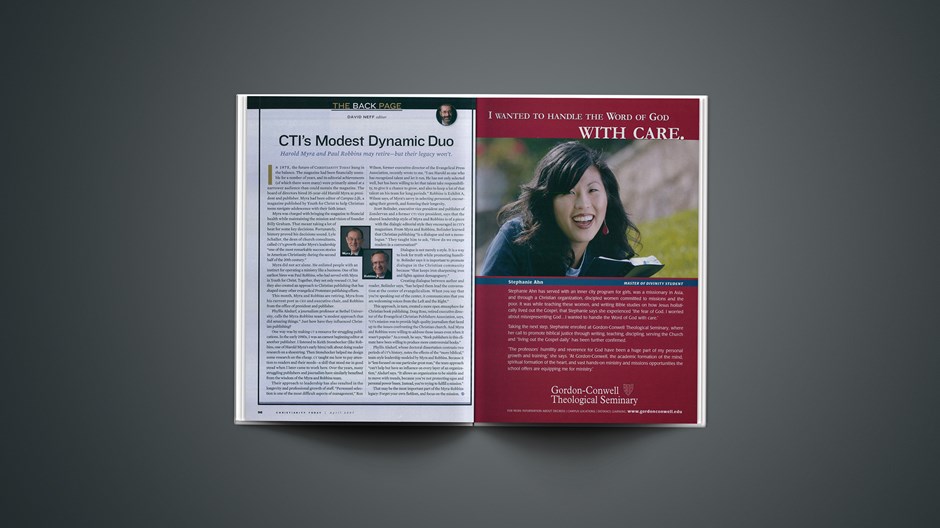
In 1975, the future of Christianity Today hung in the balance. The magazine had been financially unstable for a number of years, and its editorial achievements (of which there were many) were primarily aimed at a narrower audience than could sustain the magazine. The board of directors hired 35-year-old Harold Myra as president and publisher. Myra had been editor of Campus Life, a magazine published by Youth for Christ to help Christian teens navigate adolescence with their faith intact.
Myra was charged with bringing the magazine to financial health while maintaining the mission and vision of founder Billy Graham. That meant taking a lot of heat for some key decisions. Fortunately, history proved his decisions sound. Lyle Schaller, the dean of church consultants, called CT's growth under Myra's leadership "one of the most remarkable success stories in American Christianity during the second half of the 20th century."
Myra did not act alone. He enlisted people with an instinct for operating a ministry like a business. One of his earliest hires was Paul Robbins, who had served with Myra in Youth for Christ. Together, they not only rescued CT, but they also created an approach to Christian publishing that has shaped many other evangelical Protestant publishing efforts.
This month, Myra and Robbins are retiring, Myra from his current post as CEO and executive chair, and Robbins from the office of president and publisher.
Phyllis Alsdurf, a journalism professor at Bethel University, calls the Myra-Robbins team "a modest approach that did amazing things." Just how have they influenced Christian publishing?
One way was by making CT a resource for struggling publications. In the early 1980s, I was an earnest beginning editor at another publisher. I listened to Keith Stonehocker (like Robbins, one of Harold Myra's early hires) talk about doing reader research on a shoestring. Then Stonehocker helped me design some research on the cheap. CT taught me how to pay attention to readers and their needs—a skill that stood me in good stead when I later came to work here. Over the years, many struggling publishers and journalists have similarly benefited from the wisdom of the Myra and Robbins team.
Their approach to leadership has also resulted in the longevity and professional growth of staff. "Personnel selection is one of the most difficult aspects of management," Ron Wilson, former executive director of the Evangelical Press Association, recently wrote to me. "I see Harold as one who has recognized talent and let it run. He has not only selected well, but has been willing to let that talent take responsibility, to give it a chance to grow, and also to keep a lot of that talent on his team for long periods." Robbins is Exhibit A, Wilson says, of Myra's savvy in selecting personnel, encouraging their growth, and fostering their longevity.
Scott Bolinder, executive vice president and publisher of Zondervan and a former CTI vice president, says that the shared leadership style of Myra and Robbins is of a piece with the dialogic editorial style they encouraged in CTI's magazines. From Myra and Robbins, Bolinder learned that Christian publishing "is a dialogue and not a monologue." They taught him to ask, "How do we engage readers in a conversation?"
Dialogue is not merely a style. It is a way to look for truth while promoting humility. Bolinder says it is important to promote dialogue in the Christian community because "that keeps iron sharpening iron and fights against demagoguery."
Creating dialogue between author and reader, Bolinder says, "has helped them lead the conversation at the center of evangelicalism. When you say that you're speaking out of the center, it communicates that you are welcoming voices from the Left and the Right."
This approach, in turn, created a more open atmosphere for Christian book publishing. Doug Ross, retired executive director of the Evangelical Christian Publishers Association, says, "CT's mission was to provide high-quality journalism that faced up to the issues confronting the Christian church. And Myra and Robbins were willing to address those issues even when it wasn't popular." As a result, he says, "Book publishers in this climate have been willing to produce more controversial books."
Phyllis Alsdurf, whose doctoral dissertation contrasts two periods of CT's history, notes the effects of the "more biblical," team-style leadership modeled by Myra and Robbins. Because it is "less focused on one particular great man," the team approach "can't help but have an influence on every layer of an organization," Alsdurf says. "It allows an organization to be nimble and to move with trends, because you're not protecting egos and personal power bases. Instead, you're trying to fulfill a mission."
That may be the most important part of the Myra-Robbins legacy: Forget your own fiefdom, and focus on the mission.


















 While we pray for peace, we need moral clarity about this war.
 Church movements need magnetic leaders. But the best leaders need more than charm.
 Ethan Hawke has made a movie as scandalous as one of the writer’s short stories.