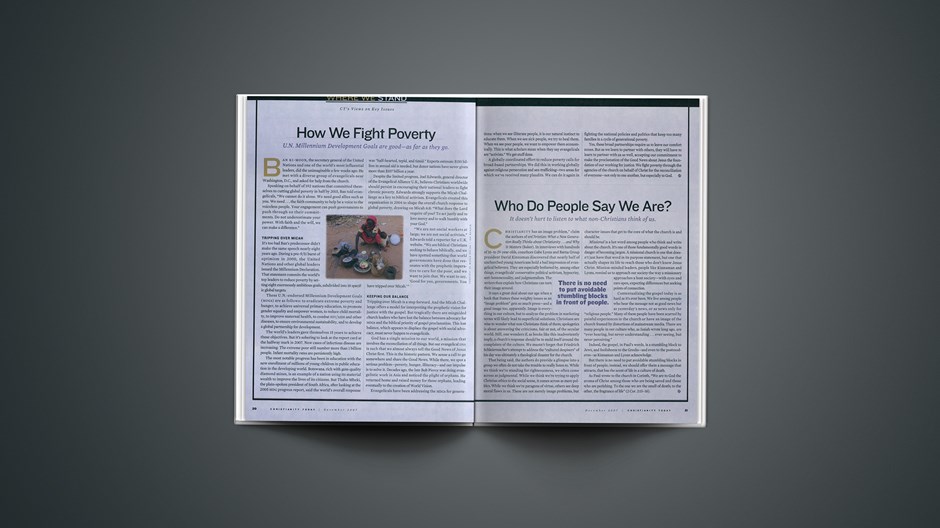
Ban Ki-Moon, the secretary general of the United Nations and one of the world's most influential leaders, did the unimaginable a few weeks ago: He met with a diverse group of evangelicals near Washington, D.C., and asked for help from the church.
Speaking on behalf of 192 nations that committed themselves to cutting global poverty in half by 2015, Ban told evangelicals, "We cannot do it alone. We need good allies such as you. We need … the faith community to help be a voice to the voiceless people. Your engagement can push governments to push through on their commitments. Do not underestimate your power. With faith and the will, we can make a difference."
Tripping Over Micah
It's too bad Ban's predecessor didn't make the same speech nearly eight years ago. During a pre-9/11 burst of optimism in 2000, the United Nations and other global leaders issued the Millennium Declaration. That statement commits the world's top leaders to reduce poverty by setting eight enormously ambitious goals, subdivided into 18 specific global targets.
These U.N.-endorsed Millennium Development Goals (MDGs) are as follows: to eradicate extreme poverty and hunger, to achieve universal primary education, to promote gender equality and empower women, to reduce child mortality, to improve maternal health, to combat HIV/AIDS and other diseases, to ensure environmental sustainability, and to develop a global partnership for development.
The world's leaders gave themselves 15 years to achieve these objectives. But it's sobering to look at the report card at the halfway mark in 2007. New cases of infectious disease are increasing. The extreme poor still number more than 1 billion people. Infant mortality rates are persistently high.
The most notable progress has been in education with the new enrollment of millions of young children in public education in the developing world. Botswana, rich with gem-quality diamond mines, is an example of a nation using its material wealth to improve the lives of its citizens. But Thabo Mbeki, the plain-spoken president of South Africa, after looking at the 2005 MDG progress report, said the world's overall response was "half-hearted, tepid, and timid." Experts estimate $150 billion in annual aid is needed, but donor nations have never given more than $107 billion a year.
Despite the limited progress, Joel Edwards, general director of the Evangelical Alliance U.K., believes Christians worldwide should persist in encouraging their national leaders to fight chronic poverty. Edwards strongly supports the Micah Challenge as a key to biblical activism. Evangelicals created this organization in 2004 to shape the overall church response to global poverty, drawing on Micah 6:8: "What does the Lord require of you? To act justly and to love mercy and to walk humbly with your God."
"We are not social workers at large; we are not social activists," Edwards told a reporter for a U.K. website. "We are biblical Christians seeking to behave biblically, and we have spotted something that world governments have done that resonates with the prophetic imperative to care for the poor, and we want to join that. We want to say, 'Good for you, governments. You have tripped over Micah.'"
Keeping Our Balance
Tripping over Micah is a step forward. And the Micah Challenge offers a model for interpreting the prophetic vision for justice with the gospel. But tragically there are misguided church leaders who have lost the balance between advocacy for MDGs and the biblical priority of gospel proclamation. This lost balance, which appears to displace the gospel with social advocacy, must never happen to evangelicals.
God has a single mission to our world, a mission that involves the reconciliation of all things. But our evangelical dna is such that we almost always tell the Good News of Jesus Christ first. This is the historic pattern. We sense a call to go somewhere and share the Good News. While there, we spot a serious problem—poverty, hunger, illiteracy—and our impulse is to solve it. Decades ago, the late Bob Pierce was doing evangelistic work in Asia and noticed the plight of orphans. He returned home and raised money for those orphans, leading eventually to the creation of World Vision.
Evangelicals have been addressing the MDGs for generations: when we see illiterate people, it is our natural instinct to educate them. When we see sick people, we try to heal them. When we see poor people, we want to empower them economically. This is what scholars mean when they say evangelicals are "activists." We get stuff done.
A globally coordinated effort to reduce poverty calls for broad-based partnerships. We did this in working globally against religious persecution and sex-trafficking—two areas for which we've received many plaudits. We can do it again in fighting the national policies and politics that keep too many families in a cycle of generational poverty.
Yes, these broad partnerships require us to leave our comfort zones. But as we learn to partner with others, they will have to learn to partner with us as well, accepting our commitment to make the proclamation of the Good News about Jesus the foundation of our working for justice. We fight poverty through the agencies of the church on behalf of Christ for the reconciliation of everyone—not only to one another, but especially to God.















 While we pray for peace, we need moral clarity about this war.
 As my doubts about his teachings grew, so did a secret fascination with Jesus.
 The plan would organize UMC churches in four global regions, with each given more leeway around same-sex marriage and other theological issues.






