


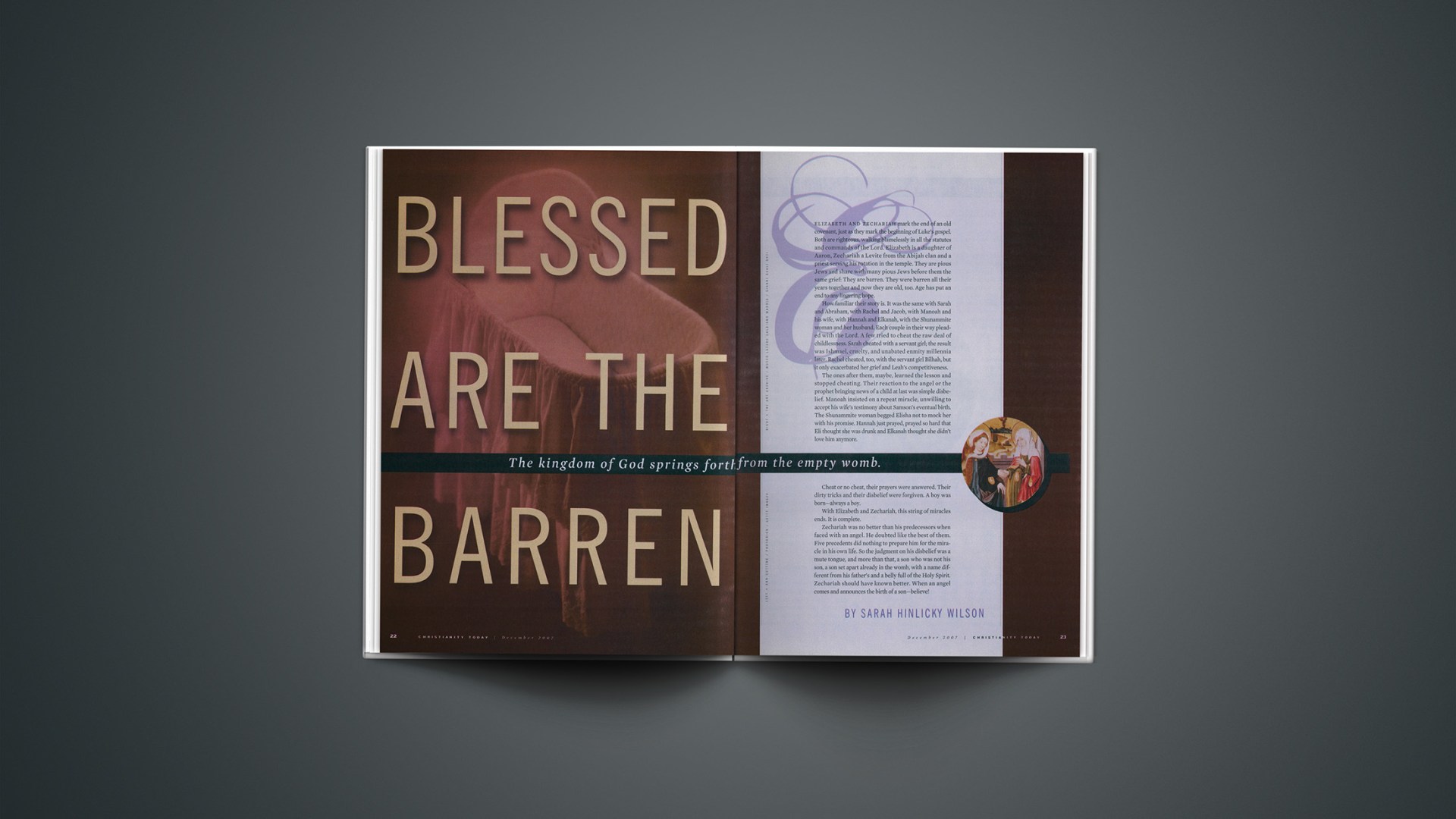

Elizabeth and Zechariah mark the end of an old covenant, just as they mark the beginning of Luke’s gospel. Both are righteous, walking blamelessly in all the statutes and commands of the Lord. Elizabeth is a daughter of Aaron, Zechariah a Levite from the Abijah clan and a priest serving his rotation in the temple. They are pious Jews and share with many pious Jews before them the same grief: They are barren. They were barren all their years together and now they are old, too. Age has put an end to any lingering hope.
How familiar their story is. It was the same with Sarah and Abraham, with Rachel and Jacob, with Manoah and his wife, with Hannah and Elkanah, with the Shunammite woman and her husband. Each couple in their way pleaded with the Lord. A few tried to cheat the raw deal of childlessness. Sarah cheated with a servant girl; the result was Ishmael, cruelty, and unabated enmity millennia later. Rachel cheated, too, with the servant girl Bilhah, but it only exacerbated her grief and Leah’s competitiveness.
The ones after them, maybe, learned the lesson and stopped cheating. Their reaction to the angel or the prophet bringing news of a child at last was simple disbelief. Manoah insisted on a repeat miracle, unwilling to accept his wife’s testimony about Samson’s eventual birth. The Shunammite woman begged Elisha not to mock her with his promise. Hannah just prayed, prayed so hard that Eli thought she was drunk and Elkanah thought she didn’t love him anymore.
Cheat or no cheat, their prayers were answered. Their dirty tricks and their disbelief were forgiven. A boy was born—always a boy.
With Elizabeth and Zechariah, this string of miracles ends. It is complete.
Zechariah was no better than his predecessors when faced with an angel. He doubted like the best of them. Five precedents did nothing to prepare him for the miracle in his own life. So the judgment on his disbelief was a mute tongue, and more than that, a son who was not his son, a son set apart already in the womb, with a name different from his father’s and a belly full of the Holy Spirit. Zechariah should have known better. When an angel comes and announces the birth of a son—believe!
No one need learn from Zechariah’s mistake now. Angels do not announce impossible births anymore. These miracles are done with. God has spoken his piece and shown the strength of his arm. John the Baptist completes the Lord’s work of bringing something from nothing in the womb of a barren wife. God’s next miracle after this boy is a greater one, so great that he gladly permits the surprise and even the modest challenge of the mother. She is a virgin, not a wife; she is young, not old; she has no precedent before her. The child will take his flesh from her and yet not be hers, for he is begotten of the Father and conceived by the power of the Holy Spirit. His name will be Jesus.
Jesus’ cousin, John, the last son born to the childless, prepares the way. He is the prophet of the Most High. But John, whose praise his father sings, is a son to break your heart. He goes to the desert, eats locusts and wild honey, wears camel hair, never comes home, angers everyone, points to the Messiah, decreases, and loses his head to the wicked king. Elizabeth and Zechariah deliver their long-awaited son to the world, and are never heard from again. They begin the gospel, and in so doing they end the old covenant of sons for the barren.
When love does not bear fruit
My husband and I are barren.
Some people, on hearing the news, want to know which of us is to blame. There is precedent for the question. The Scriptures always identify who is at fault. Sarah is too old, the Shunammite woman’s husband is too old, too; Rachel and Hannah and Manoah’s wife are simply cursed with closed wombs. One person of the pair is always responsible.
But we challenge Scripture with Scripture. Genesis 2 declares husband and wife to be one flesh. It takes two people, a man and a woman, joined in one flesh, to make a baby. Asking which of us is “responsible” for the barrenness suggests that one of us could procure a baby by a method not involving the other—requiring first divorce or death. The implied rupture in the one flesh of our marriage renders the question meaningless. We cannot have a baby. No other marriage is under discussion here.
We learned of our barrenness, not from time and dying hope, but from doctors. Doctors do not think of marriages as one flesh. They do not look at our bodies as we look at each other’s. We see beloved skin and muscles and eyes, we see tenderness and protection and desire. Doctors look at our bodies as problems to solve. They started trying to solve our problem before we even absorbed the horrible truth that there was a problem. Tests were planned, minor surgeries, hormone counts and chemical ratings, all to solve the problem. The problem was ultimately to be solved by a conception in which we would be nowhere near each other. We were to be harvested, fruitful cells gleaned from our unpromising fields. None of the doctors asked if we even wanted to be harvested. We had to read between the lines, decipher the code language, blurt out in plain speech what was shrouded in bland indifference.
Then we said no. We were regarded as weird. “Do you have a moral objection to conception taking place outside the human body?” one doctor asked.
Forget the moral objection for the moment. How about this: Does it matter if a baby comes from sex? We were looked upon as technological prudes for shunning the test tubes. I think they were the prudes for considering sex so unnecessary.
Here is the plain truth. I do want a child of my own flesh and blood. But I want the child to come from my love for my husband. Not love in the abstract; love in the flesh, for a child in the flesh. The fertile cannot grasp how profound is the cosmic insult in learning that your love cannot bear fruit. That is what love is for; babies are one of the many fruits that love bears; and yet ours just isn’t enough.
We are a big mistake. We are an abomination in nature—we exist pointlessly because we cannot make more of our species. We are an abomination according to the charge of Genesis, because we cannot be fruitful and multiply and fill the earth. Our love does not bear fruit.
Blessed are the empty wombs
Twenty-three chapters later, John is dead, and Jesus is on his way to being dead. He has fed the five thousand, healed the sick, stilled the waters, and most miraculously of all, taught with authority. His words are God’s words.
The Pharisees and scribes rage at these words. But the crowds throng Jesus and beg for more. He gives them more. In her enthusiasm at his words, a woman in the crowd cries out a blessing. “Blessed is the womb that bore you, and the breasts at which you nursed!” Happy the woman who is your mother. Sad that there could be only one of her.
But Jesus turns the blessing aside. He redirects it. “Blessed rather,” he says, “are those who hear the Word of God and keep it.” His mother is not exempt from the blessing so long as she hears the Word of God. Her womb and breasts are no guarantee— not even for the mother of the Lord.
This is not the first time Jesus has distanced himself from his mother. She and his brothers tried to reach him once before, unable to pierce through the crowds, unable to make their claim on him. A kindly messenger conveys the word that they are waiting for him. But Jesus does not rush to see his mother. He is a heartbreaking son just like his cousin, John. “My mother and brothers are those who hear the word of God and do it,” he says.
Twice Jesus turns aside the family. Twice he finds his mother among the hearers of the Word of God.
Perhaps Elizabeth, mourning her decapitated son, prepared Mary for her son’s death. In Luke’s account, Mary is not one of the women at the cross. Perhaps the redirected blessings and the grief overcame her. Luke will not show her to us again until after the resurrection, in the temple, awaiting the outpouring of the Spirit at Pentecost.
But now Jesus is pursuing the road to the cross with just a few hearers of the Word of God to keep him company. At his footsteps follow the mourning women. They have run out of blessings to bestow on him and on his mother’s womb and breasts. So Jesus turns and bestows blessings of his own. He says:
Daughters of Jerusalem,
do not weep for me,
but weep for yourselves
and for your children. For the days
are surely coming when they will say:
Blessed are the barren
and the wombs that never bore
and the breasts that never nursed!
Then they will begin to say to the mountains, Fall on us,
and to the hills, Cover us.
For if they do this
when the wood is green,
what will happen when it is dry?
Luke 23: 28-31, New Revised Standard Version
Barrenness is a curse on creation. It is a violation, a defiance of the Creator’s original charge and desire for his creatures. It shushes the Deuteronomist’s assurance: The Lord will make you abound in prosperity, in the fruit of your womb and in the fruit of your livestock and in the fruit of your ground. Barrenness challenges creation, opposes it in battle, pins it down and defeats it. A fruitless love is the Devil’s mockery of the Creator’s gift.
Yet Jesus, whose own cousin put an end to the covenant of children for the childless, lays a blessing on the barren. He blesses the barren as barren for the first time. He takes their curse away. But not in granting a child—that blessing is not to be given anymore. Jesus’ blessing is a hard blessing; it is a divine blessing, for it kills as it makes alive. It does not answer the deepest longing of husbands and wives to make babies together. It does not even dignify the grief and honor the curse. It casts away the curse, and the cure to the curse, the one with the other, and instantiates a new blessing altogether. Blessed are the barren, blessed are the empty wombs, blessed are the dry breasts.
This is not a blessing to live everyday life by. It is not a blessing for the now. It a blessing for the end. It is an apocalyptic blessing intruding on the present and on the desire of the present for family, children, hearth, home. It is a blessing for a time when falling mountains and crumbling hills are preferable to the horrors at hand, to the rampage of the crucifiers and the blasphemers and the falling bombs. It is bad enough when the wood is green. This blessing is for when the wood is dry, smoldering, kindling, bursting into flame.
But the blessing does not wait for the dry wood, the collapsing hillsides, the final battle. The blessing comes now in lands of green wood, in the middle of towns and cities full of families, striking with the randomness of lightning. Some couples are cursed by creation and singled out for the apocalyptic blessing of barrenness. They are forced to live the eschaton during the in-between times.
‘Here’s your son.’
Before I knew about my husband and me, I did not think about barrenness much at all. I had no reason to. Children were on the lifetime agenda. On the rare occasions I heard of people who were involuntarily without child, I turned aside, averted my eyes. Such a horror. Now I get averted eyes myself. Friends and family cannot hide that their sorrow is mingled with guilt, guilt that the ordinary blessings of creation were given to them, but not to us. Some have found it difficult to tell us they were pregnant, as if it were a smack in the face. Yet who knows better than we do what a gift a child is?
There was a period of uncertainty, for a few months, when we didn’t know how absolute the medical judgment was. While we were waiting to find out, the desire for a child pressed on us more and more. We loved each other too much. We knew we’d drive each other to distraction if there were never another common object for our love. We remembered—with relief and a strange sense of providence—how, long before we married, we said to each other that we wanted to adopt someday. It was not enough for us to say we were pro-life or anti-abortion or however you want to put it. You affirm the sanctity of life in the womb by welcoming the child when her mother cannot. We thought, as many people do, of rejected baby girls in China. Maybe when we’re forty, wealthy, and stable.
But we were nowhere near forty, or wealth, or stability. We were poor students ripped off of the one free source of family assets. One night we invited to dinner a family with one biological child and one adopted child, and asked them for their story and the name of their agency. A week later we went to the agency. That night two countries were featured, China and Guatemala. My husband has traveled in Latin America, he speaks Spanish, his doctoral work is on colonial Latin America. He could teach the child Spanish, he could get a teaching job south of the border, he could bridge the racial and cultural gap better with a Guatemalan child than with a Chinese one.
For my part, I’d thought about Latin Americans as little as I’d thought about barrenness. I didn’t even understand what the term Hispanic meant. I hadn’t realized how many more of the indigenous people survived in South and Central America as compared to North. Race to me was white, black, and Asian. I was considering becoming the mother of a child whom I wouldn’t even have been capable of seeing a month before.
We thought about it a few weeks. We still didn’t know the biological answer. One Sunday on the way home from church I said, I don’t want it to be either-or. I want conception and adoption both to be ways of having children. I want to be trying them both. I want to start adopting now.
And my husband, without a moment’s hesitation, said okay.
Having a child by adoption is not nearly as much fun as having a baby by conception. There is certainly a lot more paperwork involved. There are blurry photos of a little fat blob who is in some theoretical but increasingly legal way your own. There is a flight, a hotel room, and suddenly someone puts this kid in your arms and says, “Here’s your son.” I don’t know what the delivery room is like, but I suspect that seeing a baby squirt out of your own body isn’t even quite as surreal as collecting your baby in a hotel lobby, no fanfare, no blood, no labor, no kicking, no sonograms, nothing to signal the cosmic sensibleness of the child in your arms being yours. Adoptive parents do not believe in coincidence; they can’t afford to.
The new family
Luke cares who Jesus’ mother is. Paul does not. He mentions her once, not by name, emphasizing the Father and not the mother; when the fullness of time had come, God sent forth his Son, born of a woman, born under the law, to redeem those who were under the law.
The birth of Jesus does not matter to Paul because Paul does not care about birth. He does not care about family. Paul is a Jew who had to walk away from the claims of law and family alike. He excelled beyond all those of his age and station; his credentials were impeccable; his own birth set him up from the start, a child of Benjamin, circumcised on the eighth day. To Paul, all the facts of his birth are rubbish. Birth does not matter anymore; adoption does.
When Paul tells us that Jesus was born of a woman, he does so only to lead us to the far more critical point: Jesus was born of a woman that we might become adopted sons of God. When we are adopted, we have the Spirit of the Son, and the Son cries for us in our hearts, “Abba! Father!” Before adoption, children of our own birth, we were only slaves. Now, after adoption, we are sons, and heirs. There is no more rejoicing over the birth of a promised son as in the old covenant, because now there is the adoption of sons in the new. In the old covenant, no daughter was wanted, or given. In the new covenant, there is not only no Greek or Jew; there is also no male or female. “Sons” means “daughters,” too. Together they will prophesy, as Joel predicted and Peter proclaimed on the day of Pentecost, when the Spirit of adoption arrived. In this new covenant we live not by blood but by promise. We live by faith and not by works of the law. When Paul gives his critical proof of justification by faith, a reality that arises not only in the New Testament but spans the Old and New alike, he turns to Abraham. Abraham believed and God reckoned it to him as righteousness. And what did Abraham believe? He believed the promise of a son. He heard the words, “I will make you the father of many nations,” and he believed. He heard the words, “Your descendants shall be like the stars of the sky,” and he believed. In hope he believed against hope. He did not regard his own body as good as dead; he did not regard Sarah’s ninety years of barrenness. It was God’s ability to overcome even barrenness, the worst of curses, that inspired Abraham’s justifying faith.
And so Isaiah sang, and Paul quoted, “Rejoice, O barren one who does not bear; break forth and cry aloud, you who are not in labor! For the children of the desolate one will be more than those of the one who has a husband.”
At last Abraham received his son of the flesh, his Isaac, so dearly loved that God had to put Abraham to the test and demand the boy’s life back again. Abraham’s faith held out even the second time.
But what of the many nations? What of the stars in the sky? Paul the Jew is faced with the same grief as a childless father. His love for Christ is not bearing fruit. The Jews do not believe. They are turning away even as the Gentiles are grafted in. Many children are adopted, but the children of the flesh turn away. Abraham, father of Isaac, never imagined how God would keep his promise. For Abraham’s family grows not from Isaac’s offspring, in the end, but from the nations, the uncircumcised. It grows from adoption, not from birth.
Jesus gave fair warning. He warned against those who valued his mother’s breasts and womb over her hearing the Word of God and keeping it. He warned his followers to call no man their father, for their only true father is the adoptive Father in heaven. He warned that he would turn fathers against sons, and mothers against daughters, and mothers-in-law against daughters-in-law. He warned the Pharisees and scribes that he could raise up children of Abraham from the very stones. There is no safety in flesh and blood. The only hope against hope is adoption in the Spirit.
And so all this time, hidden behind the covenant of sons for the childless, another story has played itself out. It is the story of the three great prophets, Moses, Samuel, and Jesus—all adopted.
Moses, the hope of Israel enslaved in Egypt, was not raised in the heart of the community. He was pulled out, set aside, raised among people not his own, a son to Pharaoh’s daughter. This adopted child was the one to lead the way from bondage to freedom. And the boy who was the answer to barren Hannah’s prayers left his mother’s arms to be raised by Eli, whose own sons of the flesh ran wild and faithless. Samuel was the prophet called from his childhood to anoint Israel’s kings.
Jesus, the new Moses, is the natural-born, only-begotten Son of God, but he is not the natural-born son of Joseph. Yet he must be Joseph’s adoptive son. Two Gospels trace at great length Jesus’ genealogy through Joseph, even while they both insist that Joseph played no part in Jesus’ conception. Matthew starts with Abraham, moves fourteen generations to David, another fourteen to Jeconiah, and a final fourteen to Joseph, the husband of Mary, of whom Jesus was born, who is called Christ. Luke moves in the opposite direction, starting with Jesus at the age of thirty, “being the son (as was supposed) of Joseph,” through many sons and fathers, until the end when we reach “Seth, the son of Adam, the son of God.” Through adoption Jesus is the son of David and heir to the kingdom. The genealogies are pointless unless adoption matters; unless it is real; unless the ingrafting really happens.
And Paul discovers it to be so. The baptized Gentiles really do belong to Israel. They belong so completely that they cannot be compelled to keep the law. They cannot be forced into circumcision as if it were the true source of the relationship. The Spirit of the Son calling on the Father alone makes the adoption efficacious. And so the church cannot be a family based on blood. And the church must be more important that any family based on blood. Family is not family anymore. Church is family instead.
Living in the end times
We have a photograph of our son’s mother. Not me; the mother who carried him in her womb and gave birth to him. He is four months old, but she hadn’t seen him since he was four days old. The government made her return for a photograph and a DNA test, to make sure he was really hers, to make sure she wasn’t selling someone else’s baby. He gurgles and smiles, ignorant of the drama around him. She presses her cheek into his head, holds him tight, and looks at the camera with a pain that I will never know. The child I lost is only the child of my imagination: too perfect, or rather too much an imprint of myself, to be real. The child she lost is flesh. He calls someone else mama.
Adoption always begins with at least one tragedy and sometimes two. The parents who can have the child don’t want or can’t keep the child. The child always loses them. The parents who do want a child often can’t have a child. The child they end up raising is not theirs alone. Their joy comes from someone else’s grief. Adoptive parents are in the strange position of having to wish their own family not to be necessary, not dependent on someone else’s destitution. For who could have expected to love the child of another’s womb so much? Who could have expected that her child would become my child, so completely, so certainly? There is no doubt that adoption is a matter of bringing good from evil; the danger is in consequently justifying the evil, rather than overcoming it.
The truth is, adoptive families are born from pain, just as the church family was born from the pain of the cross. Pharaoh’s daughter and Eli and Joseph are not the only adoptive parents of the Bible. So is the most praised “biological” mother of all, Mary, the lady of sorrows, who had to relinquish the son of her flesh, her boy Jesus, to his death on the cross. She loses this son, but she gains, she adopts, another—the disciple whom Jesus loved. And in so doing she is only mirroring the act of the Father in heaven, who gave his only Son to Mary in the first place, so that the sons and daughters of this world might not perish, but have eternal life, and become the church of his adopted children.
So an adoptive family looks more like the church than a biologically formed one. It is not a private circle of blood, but a mixed bag of unrelated persons living together. The ecclesia domestica uplifted by teachers of the church from John Chrysostom to Luther is most realized in the unrelatedness of adoption. We are not only different sexes but different families, ethnicities, races.
More pointedly, and painfully, adoptive families are symbols of the conflict between creation and redemption. This conflict ought not be; our God is both Creator and Redeemer; and yet our sin puts the two at odds. The whole earth groans in labor pains. Creation itself needs deliverance. We are tempted to keep our minds on things below instead of things above. The good things of the earth, food and sex and riches, all too often point us not toward God but away from him. Blood and race and family compete for our loyalties; they threaten to take precedent over baptism. We must learn to be in the world but not of it, not conformed to it but transformed. These bodies must die and be raised again imperishable.
And so the barren, and the adopted, and the adoptive, live in the middle of an apocalyptic blessing. It is an uneasy way to live before the end has come. There is always something of a reproach in it, to ourselves and to others. It constantly asks us whether we believe in the resurrection of the dead. In the old covenant, children were immortality. Childlessness was not only sorrow for the moment, but everlasting death. As the barren of the new covenant, my husband and I are cut off from the immortality of the bloodline. Our adopted children will likely bear children of their own, just as our parents bore us, but there is a circle drawn around the two of us and our barren marriage, excising us from the rising up and passing away of generations. We are related only to other barren couples through our mutual unrelatedness. We together mark the end of the line and the end of time.
Barrenness inspires fear. How shall we live on when we are dead? We cannot hide our disbelief behind our children, or behind the inanimate children of fame and fortune and names spoken centuries into the future. We know, in a way biological parents do not, that our children are not our own.
And yet, in knowing that, our disbelief is exposed, and we are drawn back to faith again. We will live on after death because we will rise like Christ, the firstfruits and pioneer. We do not see the reality now. It is hidden from us. It is a promise to be fulfilled in the eschaton. To many the eschaton is far away. But my husband and I are living in it.
Blessed are the barren.
Sarah Hinlicky Wilson is the pastor at St. John Lutheran Church in Trenton, New Jersey, and the editor of Lutheran Forum.
Copyright © 2007 Christianity Today. Click for reprint information.
Related Elsewhere:
Sarah Hinlicky Wilson also wrote about learning to like Mary.
Our other articles on Advent and Christmas are available in our special section.
Raymond C. Van Leeuwen asked whether ‘be fruitful and multiply’ was a command, or a blessing.