Birth: wonder … astonishment … adoration. There can't be very many of us for whom the sheer fact of existence hasn't rocked us back on our heels. We take off our sandals before the burning bush. We catch our breath at the sight of a plummeting hawk. "Thank you, God." We find ourselves in a lavish existence in which we feel a deep sense of kinship—we belong here; we say thanks with our lives to Life. And not just “Thanks” or “Thank It,” but “Thank You.”
Most of the people who have lived on this planet Earth have identified this You with God or gods. This is not just a matter of learning our manners, the way children are taught to say thank you as a social grace. It is the cultivation of adequateness within ourselves to the nature of reality, developing the capacity to sustain an adequate response to the overwhelming gift and goodness of life.
Wonder is the only adequate launching pad for exploring this fullness, this wholeness, of human life. Once a year, each Christmas, for a few days at least, we and millions of our neighbors turn aside from our preoccupations with life reduced to biology or economics or psychology and join together in a community of wonder. The wonder keeps us open-eyed, expectant, alive to life that is always more than we can account for, that always exceeds our calculations, that is always beyond anything we can make.
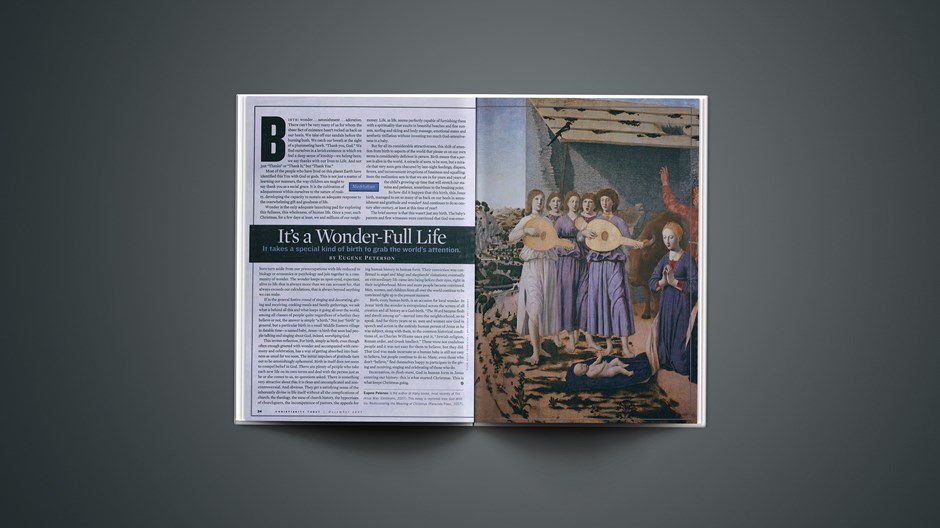
If in the general festive round of singing and decorating, giving and receiving, cooking meals and family gatherings, we ask what is behind all this and what keeps it going all over the world, among all classes of people quite regardless of whether they believe or not, the answer is simply "a birth." Not just "birth" in general, but a particular birth in a small Middle Eastern village in datable time—a named baby, Jesus—a birth that soon had people talking and singing about God, indeed, worshiping God.
This invites reflection. For birth, simply as birth, even though often enough greeted with wonder and accompanied with ceremony and celebration, has a way of getting absorbed into business as usual far too soon. The initial impulses of gratitude turn out to be astonishingly ephemeral. Birth in itself does not seem to compel belief in God. There are plenty of people who take each new life on its own terms and deal with the person just as he or she comes to us, no questions asked. There is something very attractive about this; it is clean and uncomplicated and noncontroversial. And obvious. They get a satisfying sense of the inherently divine in life itself without all the complications of church: the theology, the mess of church history, the hypocrisies of churchgoers, the incompetence of pastors, the appeals for money. Life, as life, seems perfectly capable of furnishing them with a spirituality that exults in beautiful beaches and fine sunsets, surfing and skiing and body massage, emotional states and aesthetic titillation without investing too much God-attentiveness in a baby.
But for all its considerable attractiveness, this shift of attention from birth to aspects of the world that please us on our own terms is considerably deficient in person. Birth means that a person is alive in the world. A miracle of sorts, to be sure, but a miracle that very soon gets obscured by late-night feedings, diapers, fevers, and inconvenient irruptions of fussiness and squalling. Soon the realization sets in that we are in for years and years of the child's growing-up time that will stretch our stamina and patience, sometimes to the breaking point.
So how did it happen that this birth, this Jesus birth, managed to set so many of us back on our heels in astonishment and gratitude and wonder? And continues to do so century after century, at least at this time of year?
The brief answer is that this wasn't just any birth. The baby's parents and first witnesses were convinced that God was entering human history in human form. Their conviction was confirmed in angel and Magi and shepherds' visitations; eventually an extraordinary life came into being before their eyes, right in their neighborhood. More and more people became convinced. Men, women, and children from all over the world continue to be convinced right up to the present moment.
Birth, every human birth, is an occasion for local wonder. In Jesus' birth the wonder is extrapolated across the screen of all creation and all history as a God-birth. "The Word became flesh and dwelt among us"—moved into the neighborhood, so to speak. And for thirty years or so, men and women saw God in speech and action in the entirely human person of Jesus as he was subject, along with them, to the common historical conditions of, as Charles Williams once put it, "Jewish religion, Roman order, and Greek intellect." These were not credulous people and it was not easy for them to believe, but they did. That God was made incarnate as a human baby is still not easy to believe, but people continue to do so. Many, even those who don't "believe," find themselves happy to participate in the giving and receiving, singing and celebrating of those who do.
Article continues below
Incarnation, in-flesh-ment, God in human form in Jesus entering our history: this is what started Christmas. This is what keeps Christmas going.
Eugene Peterson is the author of many books, most recently of The Jesus Way (Eerdmans, 2007). This essay is reprinted from God With Us: Rediscovering the Meaning of Christmas (Paraclete Press, 2007).















 While we pray for peace, we need moral clarity about this war.
 But let’s not mistake it for calling.
 After this week’s UMC votes on LGBTQ issues, African Methodists should join American conservatives in the new Global Methodist denomination.