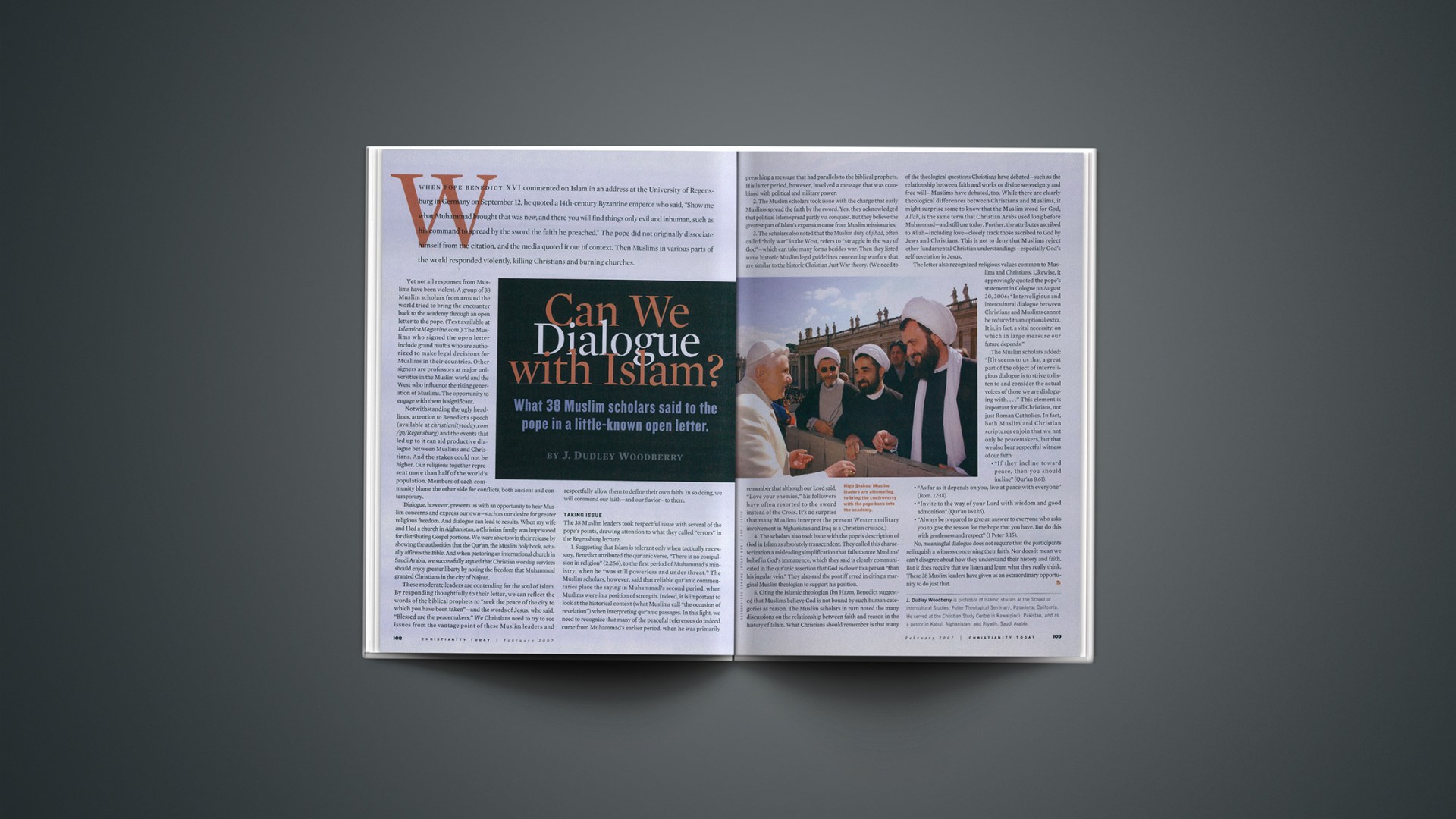

When Pope Benedict XVI commented on Islam in an address at the University of Regensburg in Germany on September 12, he quoted a 14th-century Byzantine emperor who said, “Show me what Muhammad brought that was new, and there you will find things only evil and inhuman, such as his command to spread by the sword the faith he preached.” The pope did not originally dissociate himself from the citation, and the media quoted it out of context. Then Muslims in various parts of the world responded violently, killing Christians and burning churches.
Yet not all responses from Muslims have been violent. A group of 38 Muslim scholars from around the world tried to bring the encounter back to the academy through an open letter to the pope. (Text available at IslamicaMagazine.com.) The Muslims who signed the open letter include grand muftis who are authorized to make legal decisions for Muslims in their countries. Other signers are professors at major universities in the Muslim world and the West who influence the rising generation of Muslims. The opportunity to engage with them is significant.
Notwithstanding the ugly headlines, attention to Benedict’s speech and the events that led up to it can aid productive dialogue between Muslims and Christians. And the stakes could not be higher. Our religions together represent more than half of the world’s population. Members of each community blame the other side for conflicts, both ancient and contemporary.
Dialogue, however, presents us with an opportunity to hear Muslim concerns and express our own—such as our desire for greater religious freedom. And dialogue can lead to results. When my wife and I led a church in Afghanistan, a Christian family was imprisoned for distributing Gospel portions. We were able to win their release by showing the authorities that the Qur’an, the Muslim holy book, actually affirms the Bible. And when pastoring an international church in Saudi Arabia, we successfully argued that Christian worship services should enjoy greater liberty by noting the freedom that Muhammad granted Christians in the city of Najran.
These moderate leaders are contending for the soul of Islam. By responding thoughtfully to their letter, we can reflect the words of the biblical prophets to “seek the peace of the city to which you have been taken”—and the words of Jesus, who said, “Blessed are the peacemakers.” We Christians need to try to see issues from the vantage point of these Muslim leaders and respectfully allow them to define their own faith. In so doing, we will commend our faith—and our Savior—to them.
Taking Issue
The 38 Muslim leaders took respectful issue with several of the pope’s points, drawing attention to what they called “errors” in the Regensburg lecture.
1. Suggesting that Islam is tolerant only when tactically necessary, Benedict attributed the qur’anic verse, “There is no compulsion in religion” (2:256), to the first period of Muhammad’s ministry, when he “was still powerless and under threat.” The Muslim scholars, however, said that reliable qur’anic commentaries place the saying in Muhammad’s second period, when Muslims were in a position of strength. Indeed, it is important to look at the historical context (what Muslims call “the occasion of revelation”) when interpreting qur’anic passages. In this light, we need to recognize that many of the peaceful references do indeed come from Muhammad’s earlier period, when he was primarily preaching a message that had parallels to the biblical prophets. His latter period, however, involved a message that was combined with political and military power.
2. The Muslim scholars took issue with the charge that early Muslims spread the faith by the sword. Yes, they acknowledged that political Islam spread partly via conquest. But they believe the greatest part of Islam’s expansion came from Muslim missionaries.
3. The scholars also noted that the Muslim duty of jihad, often called “holy war” in the West, refers to “struggle in the way of God”—which can take many forms besides war. Then they listed some historic Muslim legal guidelines concerning warfare that are similar to the historic Christian Just War theory. (We need to remember that although our Lord said, “Love your enemies,” his followers have often resorted to the sword instead of the Cross. It’s no surprise that many Muslims interpret the present Western military involvement in Afghanistan and Iraq as a Christian crusade.)
4. The scholars also took issue with the pope’s description of God in Islam as absolutely transcendent. They called this characterization a misleading simplification that fails to note Muslims’ belief in God’s immanence, which they said is clearly communicated in the qur’anic assertion that God is closer to a person “than his jugular vein.” They also said the pontiff erred in citing a marginal Muslim theologian to support his position.
5. Citing the Islamic theologian Ibn Hazm, Benedict suggested that Muslims believe God is not bound by such human categories as reason. The Muslim scholars in turn noted the many discussions on the relationship between faith and reason in the history of Islam. What Christians should remember is that many of the theological questions Christians have debated—such as the relationship between faith and works or divine sovereignty and free will—Muslims have debated, too. While there are clearly theological differences between Christians and Muslims, it might surprise some to know that the Muslim word for God, Allah, is the same term that Christian Arabs used long before Muhammad—and still use today. Further, the attributes ascribed to Allah—including love—closely track those ascribed to God by Jews and Christians. This is not to deny that Muslims reject other fundamental Christian understandings—especially God’s self-revelation in Jesus.
The letter also recognized religious values common to Muslims and Christians. Likewise, it approvingly quoted the pope’s statement in Cologne on August 20, 2006: “Interreligious and intercultural dialogue between Christians and Muslims cannot be reduced to an optional extra. It is, in fact, a vital necessity, on which in large measure our future depends.”
The Muslim scholars added: “[I]t seems to us that a great part of the object of interreligious dialogue is to strive to listen to and consider the actual voices of those we are dialoguing with. …” This element is important for all Christians, not just Roman Catholics. In fact, both Muslim and Christian scriptures enjoin that we not only be peacemakers, but that we also bear respectful witness of our faith:
• “If they incline toward peace, then you should incline” (Qur’an 8:61).
• “As far as it depends on you, live at peace with everyone” (Rom. 12:18).
• “Invite to the way of your Lord with wisdom and good admonition” (Qur’an 16:125).
• “Always be prepared to give an answer to everyone who asks you to give the reason for the hope that you have. But do this with gentleness and respect” (1 Peter 3:15).
No, meaningful dialogue does not require that the participants relinquish a witness concerning their faith. Nor does it mean we can’t disagree about how they understand their history and faith. But it does require that we listen and learn what they really think. These 38 Muslim leaders have given us an extraordinary opportunity to do just that.
J. Dudley Woodberry is professor of Islamic studies at the School of Intercultural Studies, Fuller Theological Seminary, Pasadena, California. He served at the Christian Study Centre in Rawalpindi, Pakistan, and as a pastor in Kabul, Afghanistan, and Riyadh, Saudi Arabia.
Copyright © 2007 Christianity Today. Click for reprint information.
Related Elsewhere:
The Vatican website has posted Pope Benedict XVI’s Regensburg lecture and an explanation (translated into English about halfway down the page) of his comments on Islam.
The clerics’ open letter is available in translation to English from Islamica Magazine.
Christianity Today‘s collected articles on Islam are on our site.
Christian History & Biography interviewed J. Dudley Woodberry for the issue on Christians and Muslims.
He also wrote a review of Why the Rest Hates the West.