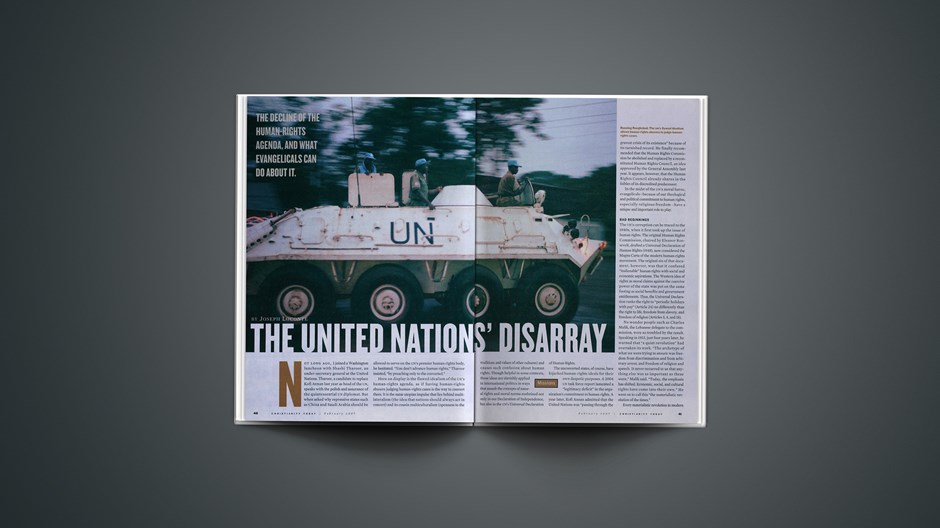
Not long ago, I joined a Washington luncheon with Shashi Tharoor, an under-secretary general at the United Nations. Tharoor, a candidate to replace Kofi Annan last year as head of the UN, speaks with the polish and assurance of the quintessential UN diplomat. But when asked why repressive states such as China and Saudi Arabia should be allowed to serve on the UN's premier human-rights body, he hesitated. "You don't advance human rights," Tharoor insisted, "by preaching only to the converted."
Here on display is the flawed idealism of the UN's human-rights agenda, as if having human-rights abusers judging human-rights cases is the way to convert them. It is the same utopian impulse that lies behind multilateralism (the idea that nations should always act in concert) and its cousin multiculturalism (openness to the traditions and values of other cultures) and causes such confusion about human rights. Though helpful in some contexts, these ideas are slavishly applied in international politics in ways that assault the concepts of natural rights and moral norms enshrined not only in our Declaration of Independence, but also in the UN's Universal Declaration of Human Rights.
The unconverted states, of course, have hijacked human-rights ideals for their own despotic purposes. A 2004 UN task force report lamented a "legitimacy deficit" in the organization's commitment to human rights. A year later, Kofi Annan admitted that the United Nations was "passing through the gravest crisis of its existence" because of its tarnished record. He finally recommended that the Human Rights Commission be abolished and replaced by a reconstituted Human Rights Council, an idea approved by the General Assembly last year. It appears, however, that the Human Rights Council already shares in the foibles of its discredited predecessor.
In the midst of the UN's moral havoc, evangelicals—because of our theological and political commitment to human rights, especially religious freedom—have a unique and important role to play.
Bad beginnings
The UN's corruption can be traced to the 1940s, when it first took up the issue of human rights. The original Human Rights Commission, chaired by Eleanor Roosevelt, drafted a Universal Declaration of Human Rights (1948), now considered the Magna Carta of the modern human-rights movement. The original sin of that document, however, was that it confused "inalienable" human rights with social and economic aspirations. The Western idea of rights as moral claims against the coercive power of the state was put on the same footing as social benefits and government entitlements. Thus, the Universal Declaration ranks the right to "periodic holidays with pay" (Article 24) no differently than the right to life, freedom from slavery, and freedom of religion (Articles 3, 4, and 18).
No wonder people such as Charles Malik, the Lebanese delegate to the commission, were so troubled by the result. Speaking in 1952, just four years later, he warned that "a quiet revolution" had overtaken its work. "The archetype of what we were trying to ensure was freedom from discrimination and from arbitrary arrest, and freedom of religion and speech. It never occurred to us that anything else was as important as these were," Malik said. "Today, the emphasis has shifted. Economic, social, and cultural rights have come into their own." He went on to call this "the materialistic revolution of the times."
Every materialistic revolution in modern times—socialism, communism, fascism—has held a utopian vision. By definition, utopians deny the deep sinfulness of human nature. At the same time, they lose sight of the sacred basis for human dignity, the imago Dei. The result is a confusion (and ultimately a denial) of inalienable human rights. The UN version of this revolution is no different: Its multicultural creed has produced a torrent of treaties and conventions, with ever-expanding categories of rights. Nations even claim an "inalienable right" to nuclear technology (see the Nuclear Non-Proliferation Treaty, Article IV). When human rights are confused with social or economic goals, human dignity is debased—and basic rights become more politically tenuous.
Hug-a-Thug Mentality
This helps explain why the UN General Assembly, five years after the attacks of 9/11, lacks the moral clarity to even agree on a definition of terrorism. It is why the Security Council, despite its lofty rhetoric, cannot rise above narrow political interests to stop the genocidal violence in Sudan. Finally, this utopianism has nurtured a human-rights regime that rewards the world's most repressive governments with membership and voting privileges.
Of the 53 member states of the old Human Rights Commission, for example, at least 25 percent were considered "not free" by leading human-rights organizations. (At the nadir of its corruption, the commission nominated Libya as its chair and re-elected Sudan amid reports of ethnic cleansing.) During the last two decades, attempts to produce resolutions critical of human-rights violators routinely died in their crib—blocked in backroom maneuvers.
Article continues below
It's doubtful that any of this will change under the new regime. The General Assembly failed to set any criteria for membership in the Human Rights Council. Governments need only a simple majority of General Assembly votes to join. Thus, the proportion of autocratic states in the body (scaled down to 47 members) remains about the same. Iran did not make the cut, but China, Cuba, Russia, and Saudi Arabia easily pocketed enough votes. The Islamic Conference, with 56 nations, can effectively block United States admission.
Moreover, the council appears to have the same hug-a-thug mentality: At the conclusion of its first and second meetings last year, members failed to produce a resolution on behalf of the victims in Sudan and singled out only one country among 192 UN member states for special criticism: Israel. "Most of the world's abuses were ignored," reported UN Watch, the Geneva-based human-rights group. Peggy Hicks, global advocacy director of Human Rights Watch, agreed: "In the face of atrocities in Sudan, attacks on civilians in Sri Lanka, and impunity for mass murder in Uzbekistan, this council was largely silent."
Unfortunately, this moral chauvinism is not limited to the UN bureaucracy and its affiliates. Two years ago, for example, Amnesty International noisily condemned the U.S. war on terror as "the most sustained attack on human rights and international law in 50 years." To be sure, the abuse of prisoners at Abu Ghraib (the catalyst for Amnesty's condemnation) is a despicable episode in U.S. foreign policy. But think of it: There was no mention of the atrocities under Stalin, Mao, Pol Pot, or Saddam Hussein. No reference to the killing fields of Darfur, the child soldiers of Africa, the women sold into sexual slavery in Eastern Europe, or the hundreds of thousands of dissidents languishing in Chinese prisons.
Religious progressives echo the partisan cant of their secular counterparts. Just as the humanitarian crisis in Darfur hit a fever pitch, the World Council of Churches lambasted the United States in its "Decade to Overcome Violence." The Christian Century ran articles calling for a "season of repentance" for U.S. actions in Iraq and elsewhere. No other nation, it seemed, had anything to repent of. A 2005 study by the Institute on Religion and Democracy found that of 197 human-rights criticisms by mainline churches from 2000 to 2003, nearly 70 percent were aimed at America and Israel—but none at China, Libya, Syria, or North Korea. Few at the UN spoke up last year when Venezuelan dictator Hugo Chavez called George W. Bush the devil.
Article continues below
The 'Clean Hands' Canard
Why this selective indignation? Because many human-rights groups and denominational elites are heavily invested in the UN as a "parliament of humanity." They kept quiet last year, for example, as foreign ambassadors blasted the United States for its plan to reform the Human Rights Commission. UN apologists were shocked—yes, shocked!—at the proposition that states under UN sanction for human-rights abuses be kept off the new Human Rights Council. Ijaz Hussein, a Pakistani educator and political analyst, captured the mood perfectly: "There is a general feeling that the U.S. is hypocritical," he wrote, "because whereas it fulminates against the election of human-rights abusers, its own hands are not clean."
The "clean hands" charge is repeated everywhere nowadays—as a ploy to divert attention from thuggish regimes. We've heard the argument before. Apologists and appeasers of the 1930s used it to divert attention from Nazi brutalities. To many progressives, Britain and the United States were equally to blame, as corrupt democracies driven by craven economic interests.
Protestant thinkers such as Reinhold Niebuhr knew better. A leading American critic of Hitler's Germany, Niebuhr called it "sheer moral perversity" to equate the failings of democratic states with the atrocities of fascist dictatorships. The "clean hands" argument, he said, was a sop to evade political responsibility. "As if any one ever came to any significant issue in history with 'clean hands'! As if any nation which enforces peace within its boundaries had clean hands!" he wrote. The "simple moralism" of the equivocators, Niebuhr argued, was a symptom of their "utopian illusions" about social and political life.
Then and now, false hopes about human nature and human societies fail to advance the cause of human rights. Under the new rules for the Human Rights Council, for example, not even genocidal regimes may be categorically denied membership. The editorial page of The New York Times called the latest UN plan a "shameful charade" that will not change the corrupted status quo. "John Bolton is right; Secretary General Kofi Annan is wrong," announced The Times. "And leading international human rights groups have unwisely put their preference for multilateral consensus ahead of their duty to fight for the strongest possible human rights protection."
Article continues below
Charles Malik, who assumed leadership of the old Human Rights Commission after Eleanor Roosevelt, anticipated this result. An Arab Christian and political philosopher, Malik saw a spiritual problem at work: the rejection of belief in God and love for God as the surest foundation for defending those made in his image. Malik said that human beings possessed moral and spiritual capacities that deserved unique political safeguards—a direct challenge to Marxist materialism. "Unless man's proper nature, unless his mind and spirit are brought out, set apart, protected, and promoted, the struggle for human rights is a sham and a mockery."
We need a different kind of revolution in human-rights thinking. Neither the utopians nor the cynics are up to the task. We need a heavy dose of realism—not realpolitik, but the Christian realism of statesmen and religious leaders who anchor human rights in a transcendent view of the human person.
Evangelical Engagement
What might this mean in terms of engagement by evangelicals, whom The New York Times columnist Nicholas Kristof calls "the new internationalists"? First, we must help redefine human rights for the broader political community. We can remind decision makers that democratic rights owe a great debt to the Judeo-Christian conception of human dignity. We can explain why the fundamental rights of life, liberty, and freedom of worship are essential to our God-given nature.
Second, evangelical leaders and activists should endorse the idea of an alliance of democracies to work inside and outside the UN system to advance this vision of human rights. Congress has already approved a Democracy Caucus, to function as a voting bloc within the United Nations. But the organization has failed to push aggressively for democratic reforms. Evangelicals, mobilized around several key human-rights issues, could help catalyze the Democracy Caucus into effective action.
Third, evangelicals could lobby for the creation of a U.S. Commission on Human Rights, in the same way they rallied in the 1990s for a U.S. Commission on International Religious Freedom. A U.S. Commission on Human Rights would not function alone, however, but would join with other national groups to offer an alternative to the United Nations. It would focus on the world's most serious rights violations: state-sanctioned torture, sexual slavery, ethnic cleansing, and genocide.
Article continues below
If we hope to advance the cause of human rights, we need to recover their moral and spiritual bedrock. We must work, philosophically and politically, to reconnect human dignity to a biblical view of the human person. "There is already in the great American tradition," Malik said, "grounded in Christian freedom and charity and in faith in the infinite worth of the individual human soul, the necessary elements for a satisfactory solution."
The American tradition of which Malik spoke has taken a beating in world opinion. Cynicism about our commitment to human rights is widespread. Nevertheless, by any rational measure, the American vision remains the most powerful force for human rights and democratic freedom in the world today. St ill, there remains much work to be done in the task of reform and renewal, once again rooted in Christian freedom and Christian charity.
For those whose human rights hang daily in the balance—in prisons, refugee camps, and the world's war zones—the sooner more of us begin this noble work of faith, the better.
Joseph Loconte is a senior fellow at the Ethics and Public Policy Center and a distinguished visiting professor at Pepperdine University's School of Public Policy. He served as a human-rights expert on the Congressional Task Force on the United Nations and has testified before Congress on reforming the UN's human-rights agenda.
Other Christianity Today articles on the United Nations include:
De-Demonizing the UN | While bloated and badly in need of reform, the UN fills a necessary role that Christians should support. By Robert A. Seiple (December 11, 1995)
The UN's Antifamily Manifesto | The Beijing platform downplays the family, while exalting the autonomous individual. (August 1, 1995)















 While we pray for peace, we need moral clarity about this war.
 As my doubts about his teachings grew, so did a secret fascination with Jesus.
 How groups like Hillsong learned to let go of the literal in favor of creative collaboration.españolPortuguês






