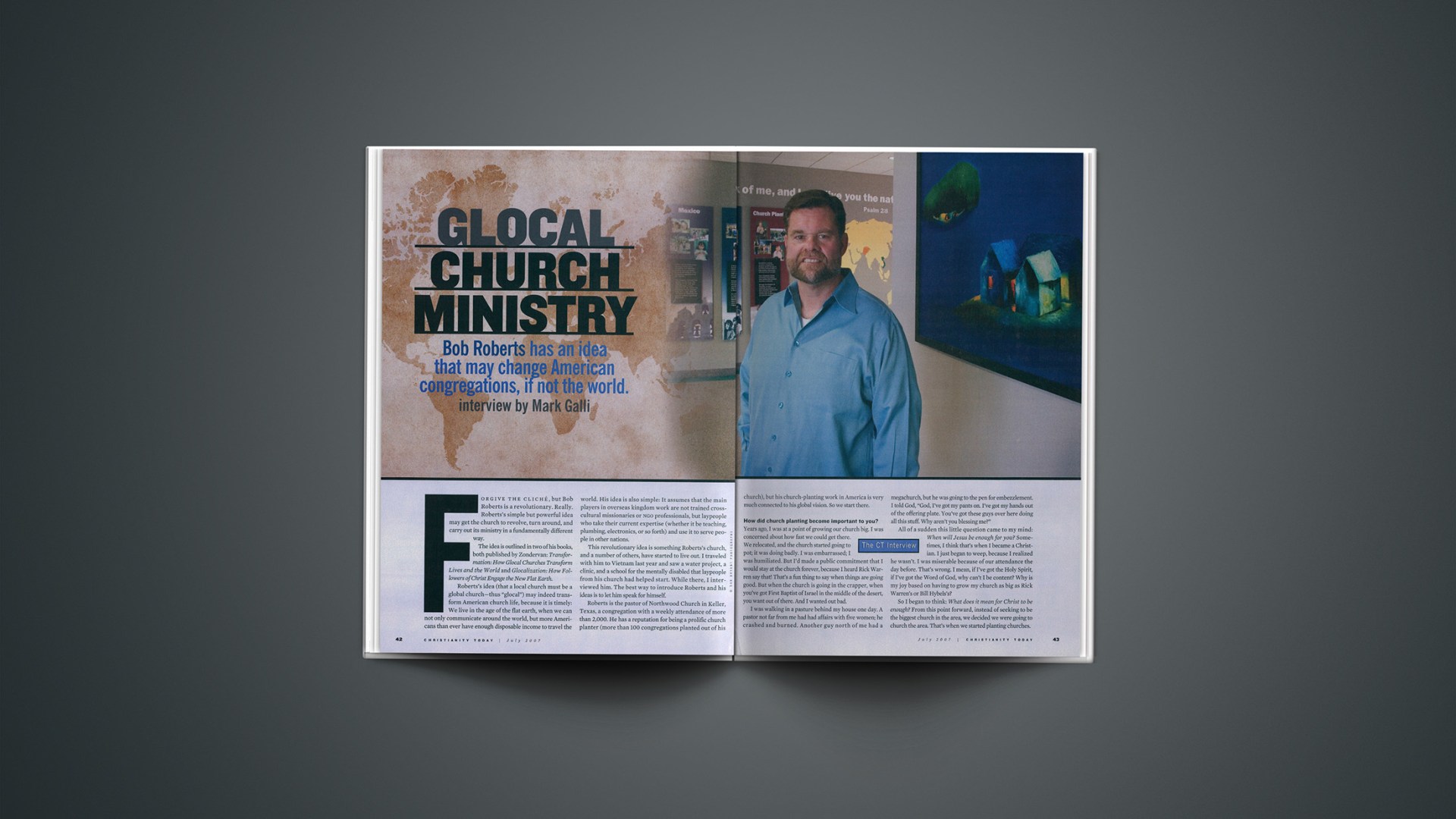

Forgive the cliché, but Bob Roberts is a revolutionary. Really. Roberts’s simple but powerful idea may get the church to revolve, turn around, and carry out its ministry in a fundamentally different way.
The idea is outlined in two of his books, both published by Zondervan: Transformation: How Glocal Churches Transform Lives and the World and Glocalization: How Followers of Christ Engage the New Flat Earth.
Roberts’s idea (that a local church must be a global church—thus “glocal”) may indeed transform American church life, because it is timely: We live in the age of the flat earth, when we can not only communicate around the world, but more Americans than ever have enough disposable income to travel the world. His idea is also simple: It assumes that the main players in overseas kingdom work are not trained cross-cultural missionaries or NGO professionals, but laypeople who take their current expertise (whether it be teaching, plumbing, electronics, or so forth) and use it to serve people in other nations.
This revolutionary idea is something Roberts’s church, and a number of others, have started to live out. I traveled with him to Vietnam last year and saw a water project, a clinic, and a school for the mentally disabled that laypeople from his church had helped start. While there, I interviewed him. The best way to introduce Roberts and his ideas is to let him speak for himself.
Roberts is the pastor of Northwood Church in Keller, Texas, a congregation with a weekly attendance of more than 2,000. He has a reputation for being a prolific church planter (more than 100 congregations planted out of his church), but his church-planting work in America is very much connected to his global vision. So we start there.
How did church planting become important to you?
Years ago, I was at a point of growing our church big. I was concerned about how fast we could get there. We relocated, and the church started going to pot; it was doing badly. I was embarrassed; I was humiliated. But I’d made a public commitment that I would stay at the church forever, because I heard Rick Warren say that! That’s a fun thing to say when things are going good. But when the church is going in the crapper, when you’ve got First Baptist of Israel in the middle of the desert, you want out of there. And I wanted out bad.
I was walking in a pasture behind my house one day. A pastor not far from me had had affairs with five women; he crashed and burned. Another guy north of me had a megachurch, but he was going to the pen for embezzlement. I told God, “God, I’ve got my pants on. I’ve got my hands out of the offering plate. You’ve got these guys over here doing all this stuff. Why aren’t you blessing me?”
All of a sudden this little question came to my mind: When will Jesus be enough for you? Sometimes, I think that’s when I became a Christian. I just began to weep, because I realized he wasn’t. I was miserable because of our attendance the day before. That’s wrong. I mean, if I’ve got the Holy Spirit, if I’ve got the Word of God, why can’t I be content? Why is my joy based on having to grow my church as big as Rick Warren’s or Bill Hybels’s?
So I began to think: What does it mean for Christ to be enough? From this point forward, instead of seeking to be the biggest church in the area, we decided we were going to church the area. That’s when we started planting churches.
But your vision for planting local churches is hardly local.
We used to start churches to reach the lost in local communities. We don’t anymore. We start churches for the world.
If all we do is start a church to reach that unchurched community, that’s nice but it doesn’t get us where we need to go. We need to see the community transformed; we need to see the world transformed.
If our goal is transformation of the community or a city somewhere in the world, evangelism is the strategy, not the endgame. That’s crucial. If my focus in church planting is just reaching a lot of lost people, then I can have a big building and when 10,000, 20,000, or 30,000 people show up, I’ve done my job. But if the endgame is kingdom transformation, then I’ve got a whole lot more that I’m calling them to do than just, Come and hear me preach; now that you’re converted, be nice and be moral.
So we’re not really starting a church for Keller; we’re starting a church for the world. Now to start a church for the world, it’s got to be effective in Keller. We’ve got to build a base, which creates resources and connectivity and all that.
I don’t think any church is a legitimate church if it’s not engaged with the whole counsel of God, and the whole counsel of God is the whole world. When you say we’re just here for our community, then basically you’ve said we’re just a holy huddle. That’s not a church. I don’t think a church has the complete DNA of what God has for it if it’s not engaged with the rest of the world.
Engaging the world sounds like a good thing for megachurches, with all their resources. What can smaller churches do?
When God does something really cool, he generally takes something small and someone unheard of and little-bitty nobodies who never dreamed that they were going to be names or anything else. They were just moving in obedience, but they were powering their lives into it because they believed in it. Here’s what I’ve discovered. Guys with ten talents sit around showing them off all the time. Guys with five talents feel too comfortable. If all you’ve got is two talents, you’re going to play those babies or starve. So you take what you’ve got and use it.
I want to win the whole world, but I will not win the whole world as an individual or even as a single church. That commission wasn’t given just to me or just to my church; it was given to the whole body of Christ. What we’ve [too often] done is taken the Great Commission and vocationalized it or financed it—which means you’ve got to be big or well-known [to accomplish anything]. We’ve taken it out of the hands of most church members and definitely most churches, which are smaller.
Here’s what we tell our new church plants: “In the first year, I don’t care if it’s just you and your wife, as the church planter, you are giving 20 bucks a month to some new church. And if you’re a year old, and you’ve got a year’s worth of counsel and encouragement that you can give some other church planter, you can meet with him once a month.”
Furthermore, in that first year we want them to identify a place in the world to work. We don’t want them to go to easy places or open places. We want them to go to hard places. We want the pastor and the laymen to get on a plane and take a trip to one of those places. And from there it begins. Generally they start doing one thing, and then it evolves into a lot more.
Aren’t “hard countries” by definition almost closed to Christians?
There are no closed countries, but some are closed to our methodology. There’s not a nation in the world where Christians can’t go as servants to society. If they want to go and pass out tracts—no, that’s not going to happen. If they want to be underground missionaries—good luck in some of these places. But if they are willing to serve, there’s not a country on the face of the earth that you can’t go to as a humanitarian. And here’s what’s cool. Generally health, education, and social services—those are three things represented by members in every single church, even smaller churches.
Take schoolteachers. You don’t take the laymen in your church who are schoolteachers and start by saying, “Okay, I’m going to use a school there to do ministry.” That’s the wrong approach.
You take the schoolteachers in your church and make sure they have this dynamic life with God. We want them to use their teaching to engage the society right where they’re at, whether that’s after-school care, esl, or any one of a dozen things. But then we ask, “How can we use that globally?” So let’s say you go to Afghanistan, and the people there say they want a school. With $10,000 to $15,000 you can build a school. Those schoolteachers can literally fund it out of the church. Those teachers go over and help get some things established. That’s not an idea; that’s the reality.
When did this idea start percolating in you?
Leighton Ford once came to town and did his thing on world missions. He said we want our sharpest, our brightest to go out into the mission field. My wife and I tried to be missionaries when I graduated from seminary, but it didn’t work out—a lot of reasons. And I got mad at God. Going home that night after Leighton’s talk, I said, “Lord, I’m willing; I’m educated. Most guys want out. But I’d love to live in another culture. Why have you done this to us?”
I got up the next morning still griping at God, and this question came to my mind: What if the church was the missionary? All of a sudden, it’s like this little switch went off in my mind. I thought, Was the Great Commission given to the whole church or just to preachers and missionaries? There’s nothing wrong with having missionaries, but isn’t there something more than that? If that’s the case, what would it look like?
At that time I said, number one, you’ve got to look at one spot. Pour your life into there.
Second, a missionary looks at the society not based on where he is but where that society is, and everything is up for grabs. So you’re going to have to learn new ways of communicating an old message.
Third, what would you do? If I asked people to go overseas and do religious work, a lot of them were not going to do it. One or two prayer walks and it gets old after that. If I asked people to go work with underground churches, they were not going to do that. But if I said, “You’re a schoolteacher. Would you be willing to help establish a school over there? Would you write curriculum over there? You’re a doctor. Would you help establish a clinic over there? You’re a plumber. Would you help us with water filters there?”
It’s not the preacher and the church using money and resources to do one or two religious projects. I view the church as an army of missionaries sitting in the pews. My job is to mobilize them. So it has to be more than a Sunday event, and it can’t be centered around the superstar preacher. My job has shifted from, Come and hear me, to, Come and get equipped to go out and be mobilized within society.
Who else has been influential to your thinking?
[Missionary to India] E. Stanley Jones is probably my number-one teacher. When I get to heaven, after I see my relatives, he’s the next person I want to find and thank. What he wrote is more relevant today than ever. He became close friends with Gandhi and wrote a little biography of him. He said Gandhi meditated two or three hours a day on the Gospels and on the Sermon on the Mount, and that Gandhi said it was the basis for all that he did.
If a man who was not a Christian used the Sermon on the Mount as the basis for challenging a nation, what in the world is wrong with the church, which has the Holy Spirit? Whereas Christians understand the Cross as a theology to be embraced, Jones said Gandhi understood the Cross as a path to be emulated.
Where are your members involved?
Laypeople in our church serve in Morocco, Guatemala, Kenya, Nigeria, Afghanistan, Nepal—tons of nations. We’ve got one person who’s a counselor doing some things with counseling in Morocco. We’ve got a guy who’s doing water wells in Guatemala.
But here’s what we say to them: “As a church, we’re going to focus on Mexico and Vietnam. That’s it. Now if God calls you to go somewhere else, that’s fine, but don’t expect us to fund it. Don’t expect us to promote it, because we want to make a long-term impact on a single place.”
If we start be-bopping all over the world, taking little potshot trips here and there, we’re doing missions that merely make me feel good. It’s not a mission that sees a community transformed.
This really seems like a new way of doing missions.
For me it’s not about missions; it’s about the kingdom of God. Missions is not an add-on. It’s what the church is. But I don’t use the word missions; I use the word kingdom. And I don’t believe in this dominion theology that says we’re here to take over society. Jesus refuted that. He jumped on Peter when Peter took out his sword and [cut] off the soldier’s ear. He knew that the gospel was powerful enough that if the seed of the gospel of the kingdom got placed inside by someone, it would transform society and laws would be changed—not because the Religious Right rallied to force it, but because the lifestyle was so transformative that people wanted to do that.
Some people talk about “business as missions,” how we’re going to use business to do mission work. That’s an insult to the businessman, because to him business is his mission. His mission is the kingdom of God. Too often, religious leaders frame the conversation for business people about how to engage.
How are we judged in Matthew 25? For not giving drink to the thirsty and not feeding the hungry. It’s dealing with the domains of society. This means the endgame of the church is not merely to get converts. Converts grow churches; disciples change the world. Now, can you have a disciple without a convert? No. But if my endgame is to convert, I’m just going to grow a big church and feel good about myself—until I stand in heaven. I’m never going to change the world.
We don’t anymore. We start churches for the world.
Copyright © 2007 Christianity Today. Click for reprint information.
Related elsewhere:
Transformation: How Glocal Churches Transform Lives and the World and Glocalization: How Followers of Christ Engage the New Flat Earth are available from ChristianBook.com and other retailers.
Bob Roberts blogs at Glocalnet and the Glocal Trekker Blog.
Northwood Church has a special section outlining its glocal activities.
Leadership published a Christian Vision Project interview with Bob Roberts. Their previous coverage of glocal churches includes a review of Glocalization: How Followers of Christ Engage the New Flat Earth and “New Ownership.”