Tom Shadyac loves to make people laugh—and even considers it a high calling.
Shadyac, director of such films as Bruce Almighty, Patch Adams, and Ace Ventura: Pet Detective, was shorter than—and ignored by—many of his peers in elementary school, so he found another way to get their attention: Make 'em laugh.
The class clown grew up to be a joke writer for Bob Hope before moving into the world of making movies. And he hopes his latest, Evan Almighty, opening this Friday, brings a few more laughs to movie audiences as well.
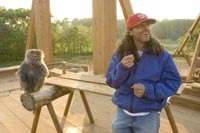
Shadyac and friend on the set of 'Evan Almighty'
But more than that, Shadyac, a Christian, also hopes that this sequel to 2003's Bruce Almighty delivers a message—that God not only loves us, but wants us to share that love with others and make a difference in the world.
That message comes across in Evan, in which Steve Carell plays a modern-day Noah—a U.S. Congressman who is asked by God (Morgan Freeman, reprising his role from Bruce) to build an ark. It is, like Bruce, both hilarious and thought provoking.
On a recent trip to LA, we sat down with Shadyac, 48, to talk about the new film, Hollywood's discovery of the "faith-based market," and the theology of laughter.
Why a sequel to Bruce Almighty?
Tom Shadyac: It's more like the next chapter in the God series than it is a sequel. We've thought about a trilogy for some time. We thought if Bruce worked out [it did, earning almost $500 million worldwide], that God could come and talk to someone else in other stories—just like he appears to Moses, to Abraham, to Paul. And to Noah.
Why not bring Jim Carrey back for this one? He was so good in Bruce.
Shadyac: Jim was hesitant because he felt he might be repeating himself playing the same character. And ultimately I think this was a much better way to go for both of us. He got to go and create new characters for himself, and we got to go spin this off into another direction, with a different tone and a wider audience.
Why do you think Bruce was such a hit?
Shadyac: First, it was funny. That's the main thing. Second, Bruce had kind of a universal experience—to feel powerless, like your life isn't what you want it to be. I think that really connected with people.
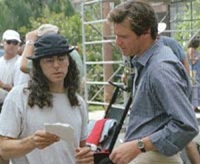
Shadyac and Carrey on the 'Bruce' set
It sure connected with the Christian audience. Was that part of the plan?
Shadyac: No. We just wanted to tell a human story and hook people who had some of these questions, thoughts, and frustrations. We don't think in terms of segmenting the audience. We want our films to reach as many people as we can, to spread whatever entertainment and light we can. We were pleased that the movie was embraced by the Christian community, but we wanted it to be as wide reaching as possible.
Did you have the Christian audience more in mind when you were making Evan?
Shadyac: Nope. Madeleine L'Engle talks about this in her book Walking on Water—that you would think it would be our Christianity that affects our art, but it's more like our art affects our Christianity. We're storytellers, and by engaging in stories, you become more aware of the human condition, of the journey, of the challenges. And that affects our faith. So we don't target faith-based audiences, but we do think the faith-based audience will enjoy this film.
But that's not why you make the movie.
Shadyac. Right. I make movies because they move me in some way. Now that is always connected with who I am and where I'm standing. I wouldn't have made this movie had I not been able to connect with the themes and spiritual inferences in the movie.
Do you have any kind of a personal mission statement?
Shadyac: Yeah, but I don't know how to articulate it in five words or less.
You don't have to.
Shadyac: I want to be a servant of the higher idea. And my particular way is to use laughter to break down walls, so you can tell stories that engage. I won't make a movie just for entertainment value. There's validity to that, but I'm looking to do something else.
It's a highly spiritual act to tell a hysterical story. If you create laughter, I think you've created something very spiritual. You've for a second brought people back into a childlike state. That's a high calling. But I want a movie to have another layer that engages people in thought, discussion.
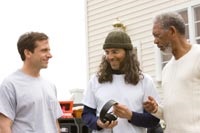
Steve Carell and Morgan Freeman with Shadyac while filming 'Evan'
You've made a lot of comedies. Are you interested in making a "serious" movie?
Shadyac: Let's just say I take comedy very seriously. I don't know if I'll ever make a serious movie. But I know this: I don't think I'll ever make a movie without a sense of humor. I love humor. Mark Twain said the basis of all humor is tragedy, and that there will be no laughter in heaven. But I disagree; I think there's going to be amazing laughter in heaven, but a different kind—the kind that comes from joy, not from the roots of pain. I think the Creator gave us a great tool to lighten things up, a great tool to heal ourselves, because I think he knew that we were going to make life difficult for ourselves. So, what a way to lose that difficulty for a moment, by just seeping yourself in laughter.
Article continues below
You almost make it sound like a theology of laughter.
Shadyac: Yes, it's theologically very sound doctrine. One of my favorite lines of Scripture is, "Unless you become like these little children …" Those little children are closer to kingdom of heaven, closer to God. What do they do? They laugh; they play. But when we grow up, we forget. So yeah, I think laughter is as gospel as anything we teach. And it's no accident that it heals as it releases endorphins in the body. People who laugh are generally healthier, at less risk of heart attack.
In the world of music, artists generally fall into two categories. There are "Christian musicians" who make Christians albums for Christian record labels that are being bought mostly by Christians. And then there are musicians who happen to be Christians. I take it you're a director who happens to be a Christian, and not a "Christian director."
Shadyac: Yeah, and I even have a hard time with that label—though you're not going to meet a bigger Jesus freak. Someone asked me the other day, "What's the biggest influence on your filmmaking career?" And they started naming filmmakers. I went, " Naw, it's Jesus actually."
Would you call your films "Christian movies"?
Shadyac: No. I think it's a mistake to think that a "Christian movie" has to be about Christians—or priests or nuns or ministers, or take place in a church. Some of the great movies—from To Kill a Mockingbird to It's A Wonderful Life to Forrest Gump—you can find their roots in truths that are found in Scripture. "The meek shall inherit the earth." "Love thy neighbor as thyself." All those things.
Bruce was PG-13, and now Evan is much more family friendly with a PG rating. Did you and your writers intentionally decide to make that shift?
Shadyac: Not really. It was more a matter of the tone being suggested by the material. In Bruce, you start with a guy who is so full of himself, and that egomania stretches to all ends of his life—even to turning on his girlfriend, because we thought that was true to character. And so it was a PG-13, because that material suggested it.
In Evan, you have an ark, animals, a boat and a flood. The ark story is a story that children embrace. I knew from the beginning it was going to be a PG movie. It would be wrong to have an R-rated or PG-13-rated movie about the ark story.
Article continues below
In the four years since Bruce, we've had The Passion of the Christ. We've had Christians like yourself, Scott Derrickson and Ralph Winter making big, mainstream movies. We've seen more "Christian movies." And now Fox Faith and Weinstein have "faith divisions." What does all this mean in the big picture?
Shadyac: Well the truth is I don't sense any of it, because I don't approach movies that way. I wish we could throw away all the labels. I want people to know who I am by how I behave—and to know my ethic and my spirituality by my movies. I've always approached material that way. So when you say Hollywood is embracing faith-based movies, I don't see it that way. I see them embracing good storytelling, and good storytelling is reaching people of faith.
If it is a trend, it's the oldest trend in the world: Tell a good story, tell a human story, tell an entertaining story, and people will come see it. And if it happens to be about the subject of faith, God and man and relationship, all the better. I don't think Hollywood's ever been afraid of faith-based movies. I think they're afraid of bad movies.
Shadyac and a couple of really big stars on the set
But between Bruce's success and The Passion's success, Hollywood suddenly realized that Christians buy a lot of tickets at the box office.
Shadyac: I agree, but I think that's a bass-ackwards embracing by show business. You don't get audiences by going, "Oh gee, there's a Christian audience, let's make Christian movies." Because then you get bad movies.
But I do agree completely that Hollywood didn't know how powerful the Christian audience was. When they showed up for The Passion, it spun heads, because Hollywood is colorblind except for one color, and it's green. They saw green. They've never seen anything like it—Christian organizations and churches buying out entire screenings. They saw numbers they couldn't believe for a movie that probably should have opened to a much softer number. It just really woke people up.
Hearing you say these things, it's kind of ironic, then, that Evan Almighty is being aggressively marketed to Christians and churches, including the Ark Almighty campaign on the side. Your movie has now become a part of that Christian marketing machine. Are you OK with that?
Shadyac: I'm OK with that. I mean, we're all here to spread good news. I believe strongly in this creative force we call God, and I love to spread the word. As long as that's done honestly, I'm good with it. When we started talking about making this movie, I had kept hearing that the Christian community wanted more "biblical, wholesome entertainment." And we thought we had something that they would embrace.
Article continues below
But are you afraid of being pigeonholed? Of people saying, "Oh, that Shadyac guy, he's that Christian director who makes movies for Christians."
Shadyac: Again, I don't like the label because of what the word Christian has become today, unfortunately—many people think it means "judgmental" and that it carries certain political ideas. I'm a Jesus freak. I respond to Jesus, the messages of the Sermon on the Mount, to this guy who talked about loving your neighbor and loving your enemy. I know what's moving me, and I know what I want to be true to in my work. And if people pigeonhole me for that, I don't really care.
What do you want people to walk away from Evan Almighty thinking about?
Shadyac: Hopefully they'll walk away entertained. But also, I think we all have this "idolatry of magnitude," thinking that if we don't do something huge for the world that we haven't done anything. We forget the story of the widow's mite. We have this idea we have to do something huge, when we don't take seriously enough the idea that it's just the way you say hello, the way you treat somebody, the way you conduct yourself at work or in your car, or how you treat the earth. I hope this idea sparks just a little different way of thinking of how we can all change the world.
For more on how you can help change the world, check out the film's "kindness campaign" at www.ArkAlmighty.com. Meanwhile, Shadyac is committed to serving others through a bottled water ministry, HtoO (Hope to Others), and to conservation through efforts like this one.
Beyoncé’s right. Whether listening to Cowboy Carter or reading theology, diversity is a good thing.
Khristi Adams
Make 'Em Laugh
1 of 4
Shadyac and friend on the set of 'Evan Almighty'Shadyac and Carrey on the 'Bruce' setSteve Carell and Morgan Freeman with Shadyac while filming 'Evan'Shadyac and a couple of really big stars on the set













 While we pray for peace, we need moral clarity about this war.
 We’ve got little information on Jesus’ appearance and personality. But that’s the way God designed it.españolFrançais
 Beyoncé’s right. Whether listening to Cowboy Carter or reading theology, diversity is a good thing.