


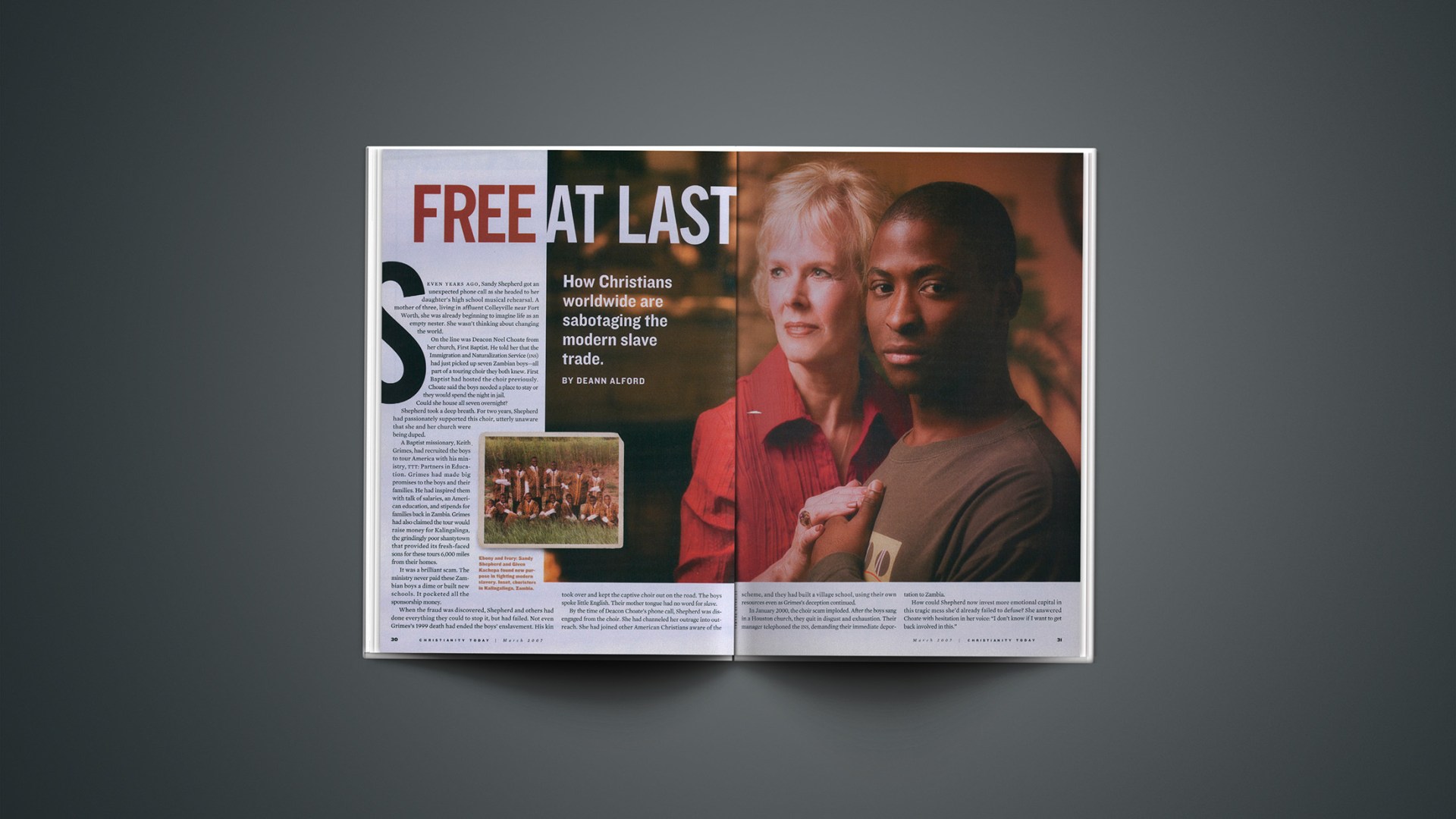

Seven years ago, Sandy Shepherd got an unexpected phone call as she headed to her daughter’s high school musical rehearsal. A mother of three, living in affluent Colleyville near Fort Worth, she was already beginning to imagine life as an empty nester. She wasn’t thinking about changing the world.
On the line was Deacon Neel Choate from her church, First Baptist. He told her that the Immigration and Naturalization Service (INS) had just picked up seven Zambian boys—all part of a touring choir they both knew. First Baptist had hosted the choir previously. Choate said the boys needed a place to stay or they would spend the night in jail.
Could she house all seven overnight?
Shepherd took a deep breath. For two years, Shepherd had passionately supported this choir, utterly unaware that she and her church were being duped.
A Baptist missionary, Keith Grimes, had recruited the boys to tour America with his ministry, TTT: Partners in Education. Grimes had made big promises to the boys and their families. He had inspired them with talk of salaries, an American education, and stipends for families back in Zambia. Grimes had also claimed the tour would raise money for Kalingalinga, the grindingly poor shantytown that provided its fresh-faced sons for these tours 6,000 miles from their homes.
It was a brilliant scam. The ministry never paid these Zambian boys a dime or built new schools. It pocketed all the sponsorship money.
When the fraud was discovered, Shepherd and others had done everything they could to stop it, but had failed. Not even Grimes’s 1999 death had ended the boys’ enslavement. His kin took over and kept the captive choir out on the road. The boys spoke little English. Their mother tongue had no word for slave.
By the time of Deacon Choate’s phone call, Shepherd was disengaged from the choir. She had channeled her outrage into outreach. She had joined other American Christians aware of the scheme, and they had built a village school, using their own resources even as Grimes’s deception continued.
In January 2000, the choir scam imploded. After the boys sang in a Houston church, they quit in disgust and exhaustion. Their manager telephoned the INS, demanding their immediate deportation to Zambia.
How could Shepherd now invest more emotional capital in this tragic mess she’d already failed to defuse? She answered Choate with hesitation in her voice: “I don’t know if I want to get back involved in this.”
Choate laid out the boys’ plight. The teens had done nothing wrong. The INS only had housing available in a federal jail. Could she meet him at 7 at the church?
Shepherd sighed. “I guess I’ll be there,” she said.
As Shepherd drove her van to her church through spotless neighborhoods of Texas-sized trophy houses, she begged God: “Lord, I don’t want to be involved in this anymore. Why are you calling me back?”
A song she sang in First Baptist’s choir popped into her head: “Yes, Lord, yes, I will answer the call.”
That night, the seven choristers slept in her home, and the course of her family’s life was changed forever—especially through the Shepherds’ relationship with Given Kachepa, then a skinny 13-year-old orphan.
Days later, TTT staff began peppering the Shepherd household with aggressive phone calls concerning the fate of the boys. Nobody was safe. The couple found other hosts. But Kachepa was soon homeless again. Without hesitation this time, Sandy and her husband, Deetz, took him in and enrolled him in the eighth grade. During the following years, the Shepherds included him in every family portrait, paid for braces on his teeth, and coached him through high school and into college.
These days, Kachepa and Shepherd are an unlikely duo: a freed modern-day slave and his reluctant liberator. They travel nationally, advising other victims of human trafficking, pushing lawmakers to make enforcement of antislavery laws a true priority, and speaking at antislavery events.
They combat an ancient scourge that has never really gone away. Two hundred years after William Wilberforce campaigned to abolish the slave trade within the British Empire, slavery continues. Experts estimate there are 27 million slaves worldwide today, probably more than at any time in human history. About 17,000 are trafficked annually into the United States.
“They are not slaves in a metaphorical sense,” notes International Justice Mission founder Gary Haugen. “They are held in forced servitude by other human beings.”
Shepherd, Kachepa, and Haugen are part of an alliance of modern Wilberforces. This alliance is both ordinary and extraordinary—each person deeply challenged by modern slavery and willing to pay the high price of personal involvement.
Their ranks include lawmakers, clergy, lawyers, bureaucrats, missionaries, social workers, and even reclusive Colorado billionaire Philip Anschutz. He bankrolled the new feature film Amazing Grace, which chronicles Wilberforce’s life.
Forced Labor of All Kinds
Modern-day slave trading, called human trafficking, funnels slaves into two types of forced servitude: sex and labor.
Sex slavery can include prostitution, pornography, stripping, lap dancing, live sex shows, and phone sex. Traffickers force labor slaves into farming, sewing, brick making, camel jockeying, cigarette rolling, domestic servitude, waging war—even singing hymns in churches. About 80 percent of slaves are women or children such as Kachepa.
“If you can make money from a choir, there’s a criminal who might want to try that,” said Kevin Bales, a Quaker sociology professor at a London university. Still, the enslaved gospel choir took the cake for Bales, founder of Free the Slaves and author of Disposable People.
“That one flipped me, and I thought I’d heard everything,” Bales said of Grimes.
Between the 1700s and 1860s, lawmakers banned slave trade and ownership in Europe and the Americas. In 1948, the United Nations condemned it in the Universal Declaration of Human Rights. Worldwide, many Christians have considered the victory complete and have found other causes to champion. The laws, however, merely drove slavery underground, and some nations do not enforce existing laws.
Modern slavery thrives through deception and secrecy. Traffickers lure millions of victims through lies, fraud, and coercion. A trafficker may offer to smuggle someone into a nation for legitimate work, such as becoming a waitress or nanny. Later, the unsuspecting target discovers the evil bait-and-switch: The actual labor is sinister and exploitive, with no pay, insane hours, and physical brutality.
By then, escape is nearly impossible. Traffickers confiscate passports. They relocate captives where they cannot speak the local language. In one infamous case, police caught traffickers after they had enslaved 1,000 mute or deaf Mexicans, whom they had lured into the U.S. to beg.
Traffickers instill hopelessness through violence and death threats against the slave or his or her family members. Bribed law enforcement officials look the other way.
Bonded labor is another ancient form of slavery that survives. Also known as “debt bondage,” it is rampant in certain parts of Asia. A loan shark or trafficker lends money to someone who works at a very low wage to pay it back. The debt may not be paid off for decades and can be passed along to family members, sometimes enslaving generations.
$20 for a Slave
The new fight against slavery dates to the early 1990s. The break up of the Soviet Union and Yugoslavia, along with increasing globalization, contributed to the number of people trafficked each year. In Europe and America, awareness grew as police exposed several major sex-trafficking rings.
Conservative Christians and Jews campaigned publicly on behalf of enslaved southern Sudanese. In some cases, American donors paid to free Sudanese slaves. In 1992, businessman Charles Jacobs opened up The Economist magazine and found a short article on page 47. There he read that in Sudan, just about anyone with $20 could buy a black woman as a slave. Outraged, the Orthodox Jew got involved, and two years later, he became co-founder of the American Anti-Slavery Group. This coalition raises awareness about slavery, especially in Mauritania and Sudan.
In 1997, lawyer Gary Haugen, who helped direct the U.N. investigation of genocide in Rwanda, founded International Justice Mission, best known for rescue raids of sex slaves in South Asia.
In 1998, Laura Lederer, a human-rights activist, helped assemble a coalition of faith-based, human-rights, and feminist groups to raise awareness of human trafficking. The National Association of Evangelicals sent a policy representative, Lisa Thompson. She and Lederer, now a State Department trafficking adviser, sought out church leaders and speaking engagements in churches. To their shock, no one invited them to discuss trafficking—even at a Sunday school class.
The coalition kept on keeping on. Other influential organizations came on board, addressing different aspects of modern slavery, including the following:
• World Vision works through the Child of War Center, Gulu, Uganda, a program to rehabilitate child soldiers.
• Shared Hope International, a not-for-profit that former Congresswoman Linda Smith of Washington State founded, rescues and rehabilitates women caught in sex trafficking.
• Project Rescue, a program associated with Teen Challenge and the Assemblies of God, helps enslaved women and children in India and Nepal.
• Anti-Slavery International, based in Britain, lobbies governments, supports research, educates the public on slavery, and runs rehabilitation and liberation projects.
• The Salvation Army, which named Thompson to head its anti-trafficking office in Washington, develops services for trafficking victims and presses for greater local church involvement and public policy reform.
• Concerned Women for America raises awareness among Christian women and pushes for strong enforcement of existing laws against sex trafficking.
Decriminalizing Victims
Illicit sex dominates public awareness of modern-day slavery. For years, when local police arrested a prostituted woman who was an illegal alien, she was deported. It was the perfect cover for sex traffickers and their clients. The state punished the victim, unaware of her enslavement.
International traffickers set up elaborate, clandestine pipelines to transport women and children thousands of miles to sustain the global sex industry. Experts now understand that these pipelines involve people from at least 150 nations. Existing laws criminalized fraud, unpaid labor, battery, extortion, rape, and related crimes. Laws that criminalized the trafficking pipeline were absent, however.
To stop slavery, faith-based and secular activists realized that national governments had to radically reorient their view of people who were trafficked. This realization set in motion one of the new abolitionist movement’s most stunning legislative success stories of the last 20 years. In the late 1990s, Rep. Chris Smith, R-N.J., and Sen. Sam Brownback, R-Kan., worked with antislavery groups to enact the Trafficking Victims Protection Act (TVPA). President Clinton, despite his initial resistance, signed the legislation in October 2000. In the U.S. alone, the new legislation and tough enforcement triggered an 800 percent increase in the number of federal trafficking cases during a five-year period.
The TVPA, strengthened in 2003 and 2005, fits sharp new teeth on existing state and federal laws. It criminalizes each element in the trafficking pipeline, from the country of origin (such as Thailand), to the so-called transit country (like Mexico or Greece), to the destination country (pehaps the U.S. or Europe). Those convicted of involvement in any part of the pipeline can face a life sentence in prison.
The Zambian choir case illustrates how difficult it was to prosecute modern slavery prior to the TVPA law.
The Feds Step In
In 1993, when Grimes visited Kalingalinga, he heard about its great pride: its singing boys. He auditioned scores of them to form a choir to tour the United States. He called it the Zambian Acappella Boys Choir (ZABC).
In August 1996, First Baptist Colleyville hosted the debut of a new 26-voice group. Choristers stayed with Sandy and Deetz Shepherd. Sandy arranged performances in public schools and churches.
In less than a year, the boys picked up enough English to defy Grimes. They confided in their hosts, telling them the staff stole gifts of cash and phone cards. They described grueling workdays with up to seven 60-minute concerts per day.
The choir generated huge donations. One ministry budget statement that CT obtained reveals that the choir in one year brought in $1 million.
The ministry contract contained many loopholes and tough restrictions: “Full education at home in a boarding school only if the team works together with TTT to accomplish this project.” Another: “I will complete my fall choir schedule and not complain about what is requested to complete the job.” Failure to comply resulted in the chorister’s return to Zambia without payment.
Health care was denied them. Defiant Louisiana hosts took an ill chorister to a doctor. The child had active tuberculosis. Health officials tested the whole group, and 21 of 26 skin-tested positive for TB.
On Christmas Eve 1997, Grimes told Shepherd he planned to return eight boys to Zambia for being “troublemakers.” Grimes had fresh voices from Kalingalinga ready to replace them. Among them was orphaned Given Kachepa, who lived in his aunt’s one-room shack.
“In Zambia [Grimes] was an angel,” Kachepa said. “This was the man who was going to change Kalingalinga.” Kachepa’s aunt gladly signed his contract, even though she couldn’t read English.
In May 1998, First Baptist curtailed its support. Meanwhile, activists Janet Tyson and Kathy Helm King (Methodists from Lake Dallas, Texas) detailed Grimes’s abuses in letters to then–Attorney General Janet Reno and other state and federal agencies.
What happened was worse than nothing: An FBI agent visited the boys. “At the time, it didn’t meet their definition of slavery,” Tyson told CT, “because the boys weren’t shackled.”
After Grimes died in April 1999, his daughter and her husband assumed control. The daughter demanded that federal agents jail two choirboys for being a “physical threat.” Officers handcuffed them, but then released them and opened an investigation.
After a January 2000 concert in Houston, the seven remaining choristers told Grimes’s daughter to pay their wages or call the INS to take them away. She drove them back to TTT’s compound in Sherman, Texas, and called the feds.
Eventually, the Department of Labor filed suit against TTT: Partners in Education. On December 4, 2000, federal Judge Paul Brown signed a $966,000 judgment by default against TTT, Grimes’s widow, their daughter Barbara I. Martens, and her husband, Gary, for back wages and overtime for 67 choristers from November 1, 1996, through May 1, 1999. In a Dallas Morning News article on Brown’s ruling, Barbara Martens was quoted saying the boys were “volunteers.”
In the six and a half years since the Grimeses’ case and passage of the TVPA, the U.S. and other nations, with the support of the U.N., have aggressively cracked down on human trafficking. Federal agencies report:
• A 170 percent increase in convictions worldwide for trafficking over a three-year period starting in 2003. In 2005, global convictions totaled 4,766.
• An 871 percent increase in U.S. prosecutions for trafficking from 2001 to 2005 compared to the previous five years (1996 to 2000).
• 1,189 special T visas issued to foreign-born victims of trafficking or family members, allowing them legal residence. (Up to 5,000 T visas per year are allowed.)
• Designation of 12 countries as “Tier 3” nations. These countries do not comply with antislavery laws. The governments of North Korea and Burma, for example, are actively engaged in human trafficking.
Recently, Ambassador John R. Miller, the first person to head the federal Office to Monitor and Combat Trafficking in Persons, stepped down. Before he left office, he handed out special “New Abolitionist” awards to a handful of activists, including Janice Crouse of Concerned Women for America. On a recent radio broadcast, Crouse said, “It pleases me immensely that those of us of the evangelical faith are right there on the front lines and have been acknowledged as leaders in the abolitionist movement.”
Evil Hidden within ‘Ministry’
The successes of the TVPA are enormous, yet many abolitionists say politics still get in the way of enforcement.
Here’s what happened in one European country that the U.S. judged as fully compliant with minimum standards for eliminating trafficking.
In early 2003, Kimberly and Milton Smith, American missionaries in Spain, answered an sos from a dilapidated Portuguese orphanage housing 19 sick children, ages 6 to 16, all from Botswana. Each bedroom contained video cameras that the home’s director had asked unsuspecting American supporters to buy as “surveillance security.”
One 9-year-old boy grew to trust the Smiths and revealed sodomy injuries at the “orphanage,” which turned out to be a brothel for pedophiles operated by sex traffickers.
Portuguese authorities refused to intervene because the children were not citizens. The Smiths sought legal guidance, linked with local Christians, and persisted. After the orphanage director threatened to kill the Smith family, the couple sent their daughters home to Alabama, but they decided to stick it out.
The Smiths threatened Portuguese authorities that they would tell the “outside world.” Authorities assured them the children had been rescued and legal action launched against the brothel owner.
In late 2003, the Smiths returned to their Birmingham, Alabama, home. They shared their story with supporting churches. Many churchgoers refused to listen. One church rescinded its speaking invitation after complaints the subject was too distressing. The Smiths politely left. The church slashed their support.
The Smiths then founded Make Way Partners, with trafficking prevention and rehabilitation projects in Romania, Hungary, and Sudan.
“There’s no way when your eyes have been opened that you can not do something about it. What’s broken my heart is how absent and silent we’ve been on the issue,” Kimberly said. “The Body of Christ is beginning to respond.”
Portuguese authorities described the case as a sensitive “Portuguese situation.” A December 2005 letter from the Portuguese justice department said the children were safe and their pimp was punished. Portugal ignored demands for proof. “I have conflicting information that tells me that man is now abroad and free,” Kimberly Smith said. “The illegal house is still operating now—as a ‘resource center.’ The same man owns it.”
Eventually, the federal 2006 Trafficking in Persons report downgraded Portugal to a Tier 2 nation—one not fully compliant with standards against trafficking.
Other Side of a Broken Heart
Since the enslaved choir disbanded, Kachepa and other choristers have struggled to remake their lives. A few of them still tour in the U.S. as the Zambian Vocal Group and Zambian Vocal Collection.
Zambian families who expected their children to return rich are still destitute, and lingering conflict has splintered homes. But some former hosts have adopted choir members, and other choristers have married Americans. Arkansas physicians sponsored one choirboy through medical school. Now he’s a doctor in Florida. With help from Shepherd and others, 17 former choristers have received T visas.
Kachepa can never return to Zambia. Corrupt government officials he exposed and envious former choristers have vowed to kill him.
Bales of Free the Slaves told CT that activist Shepherd is a typical antislavery crusader. She is an everyday citizen who would not let injustice prevail and was willing to risk personal involvement. “She understands it’s not just about one boy,” Bales said. “It’s got to be about the thousands of people who are in the same situation.
“She does it just doggedly. She’s warm, friendly, loving, and relentless.”
A T visa is valid for three years. Though recipients may apply for permanent residency after that, the first recipients of T visas are almost two years overdue for receiving permanent residency. Red tape and security concerns are putting their lives in a holding pattern.
Once Given Kachepa receives permanent residency, he hopes to have a reunion outside Zambia with his family. He has worked three jobs to support kin he last saw half his life ago. Enrolled in college, he aspires to study dentistry. Kachepa’s antislavery work earned him a 2006 “Teen That Is Going to Change the World” recognition from Teen People magazine.
But a rosy future is hard to come by for many enslaved persons. “Most people who are trafficked into the United States we never know anything about,” Bales said.
Behind her foster son’s captivating smile, Shepherd notes a deep sadness. Drop-dead handsome, yet humble, Kachepa’s spirit seems dogged by survivor’s guilt—ever mindful of God’s blessing, yet burdened to help others.
He yearns to move on. “I don’t like my identity—being known as a trafficking victim,” Kachepa said. “That’s why I’m working so hard, so I can create my own identity.”
At First Baptist Colleyville on a Sunday last October, Kachepa and his American parents heard a guest pastor’s sermon on how to heal a broken heart.
“God will use your scars and your pain to bring blessing to others,” said David Allen, dean of theology at Southwestern Baptist Theological Seminary in Fort Worth. “Only God can bring a ministry on the other side of a broken heart. Jesus will heal your broken heart, if you’ll bring all the pieces to him.”
Even broken Christians may bring moral authority and grassroots strength to the new abolition movement. “That combination has been potent,” said Allen D. Hertzke, director of religious studies at the University of Oklahoma and author of Freeing God’s Children: The Unlikely Alliance for Global Human Rights.
“There’s no question in my mind that without the Christian community, [the TVPA] would not have passed.”
Bales believes the actions of ordinary citizens have freed about one-third of the former slaves in the United States.
But the quest cannot end there. “We now have one of the best laws in the whole world,” Bales said. “We have to spend the money to enforce that law and train police how to use it.”
Wilberforce’s work remains unfinished. Today’s church is returning to a historic labor.
“God hates slavery,” Bales said. “We’re going to make sure the gift we give—not to each other but to God—is an end to this slavery.”
Deann Alford, a CT senior writer, is based in Austin, Texas.
Copyright © 2007 Christianity Today. Click for reprint information.
Related Elsewhere:
March’s Inside CT talks about what ordinary people can do to end slavery.
Other articles on slavery in the March issue of Christianity Today include ‘What Would Wilberforce Do?.’
The Amazing Change campaign includes a petition to end slavery.
Christianity Today‘s other articles on slavery and human trafficking include:
Red-Light Rescue | The ‘business’ of helping prostituted women help themselves. (December 29, 2006)
Child Sex Tours | The average victim is 14, and Americans make up 25 percent of the customers. (December 29, 2006)
Sex Isn’t a Spectator Sport | Germany’s World Cup pimping will fuel sex trafficking. (July 1, 2006)
Asia: Christian Women Combat Sex Trafficking | Christian women lead girls out of sexual bondage. (October 4, 1999)
Back From the Brothel | Thanks to brave ministries, prostitutes are still entering the kingdom. (January 2005)
Churches Rescue Thailand’s Sex Tourism Workers | Protestants and Catholics work against $2.2 billion industry (November 1, 1999)
Fighting the other slave trade | Women against sexual trafficking.(Christian History & Biography, April 1, 2006)
We’re Still Supporting Slavery | New efforts to stop U.S. troops from visiting prostitutes abroad are a good step, but let’s not whitewash what’s happening. (September 1, 2004)
The Dick Staub Interview: Francis Bok Is Proof that Slavery Still Exists | “After spending 10 years in slavery, the young Sudanese man is telling his story to the world” (October 1, 2003)
Finding the ‘Real God’ | An interview with a sex trafficking survivor (November 11, 2003)
Redeeming Sudan’s Slaves | Americans are becoming instant abolitionists. But is the movement backfiring? (August 9, 1999)
Photo essays tell about slavery in Brazil and Britain (put the cursor on the photo for the victim’s story). St Paul’s Cathedral is exhibiting ‘Slave Britain: The 21st Century Trade in Human Lives’ until the end of March.
BBC has a special section on slavery today.
The US State Department links to recent news on anti-trafficking activity.
Robot camel jockeys are now being used to replace child slaves in the Arabian Peninsula, says Wired magazine.
Other news on modern slavery includes:
UN estimates human trafficking is on the rise | On a global scale, trafficking in human beings is an 8.5 to 12 billion Euros per year business. ( ABC Online, Australia)
117000 Ukrainians Victims Of Human Trafficking | Ukrainian officials say low salaries and unemployment increase the vulnerability of the country’s citizens to human trafficking and forced labor. (RadioFreeEurope/ RadioLiberty, Czech Republic)
Sex trade moves its modern-day slaves into the suburbs | Criminal gangs are moving sex slaves out of brothels and into private houses in an attempt to take the trade “underground” and avoid discovery by the police. (The Telegraph)