There are essentially two things you need to know about 300: It's extremely violent, and it's unlike anything you've seen before.
The first point should come as little surprise for a movie about the Greco-Persian Wars, specifically The Battle of Thermopylae in 480 BC. According to history, King Xerxes (yep, the same guy who takes Esther to be queen in the Bible) launched a massive campaign against Greece with an army that most claim to have numbered in the hundreds of thousands—some even say the millions. Many states were easily conquered by Persia's might, and Sparta seemed poised to fall next.
Not if King Leonidas could help it. Sparta was a militaristic state, reputed for its disciplined warriors—the special-ops forces of their time. As the film tells it, nationalistic pride drove Leonidas to refuse Xerxes' demand for submission. However, despite his requests to dispatch the combined Greek army for retaliation, the local priests and their oracle refused, apparently because of a religious festival—Sparta's equivalent to the Sabbath. As Leonidas asks in the film, what must a king do to save the very city whose laws demand he do nothing?
Leonidas (Gerard Butler) seeks the counsel of his wife and queen, Gorgo (Lena Headey)
With defiant loyalty to his country and firm convictions bordering on madness, Leonidas rallied together all he could muster: a small detachment of his 300 finest warriors, plus a small army of less experienced Greeks willing to participate. Those odds seem suicidal, yet the fiercely courageous Spartans managed to wipe out wave after wave of stunned Persian soldiers at a strategic mountain pass, with hope that reinforcements might eventually arrive.
The battle was previously depicted in Rudolph Maté's 1962 film The 300 Spartans, but not with this level of graphic detail. Gladiator? Braveheart? Kid stuff. 300 offers hundreds of stabbings, impalements, dismemberments, and beheadings—not to mention blood galore. I can't say it any more plainly: If you don't like movie violence, do not see this film.
And yet I must also confess, the violence didn't shock me as I expected. You might call it desensitization, though I still wince at the graphic brutality in films like Braveheart, Schindler's List, and Saving Private Ryan. Chalk it up instead to the stunning visuals, which brings me back to point number two: This movie is unlike anything you've seen before.
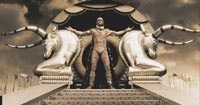
Xerxes (Rodrigo Santoro), the Persian king who claims to be a god
300 is based on the graphic novel of the same name by Frank Miller (Sin City, Batman: Year One), and as with Sin City, director Zack Snyder (2004's Dawn of the Dead) uses the same technique of computer generated art direction to faithfully reproduce every panel of Miller's acclaimed work, only adding scenes out of necessity to elaborate on the story and provide character development—particularly Queen Gorgo and her efforts to persuade the Greek council to send the army to support her husband.
The result is an eye-popping vision with massive armies, imaginative landscapes, and lots of slow-motion action. It's all so stylized, 300 comes off less as a horrific reenactment than as an art museum or history book come to life. Aside from the actors, most everything you see is computer-generated—including the blood—presumably allowing Snyder to control every component of the shot to make it as artful as possible. Virtually any given still from this movie could pass for a hyper-realistic painting.
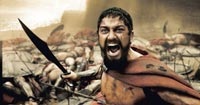
A wounded Leonidas roars his defiance at the Persian invaders
As such, the violence almost appears fake at times, and that's not necessarily a bad thing. I prefer not to be distracted by shock value and "quality kills." This is history played up as folklore—the sort of thing where a storyteller recounts how a hero slew a hundred men with but one swing of his sword. Indeed, 300 shows a Spartan stopping a rhino with a single spear throw. Another soldier recounts the history of Leonidas, who as a ten-year old killed a demonic-looking wolf with gleaming eyes. Xerxes himself is portrayed as a bronzed and bejeweled Goliath, at least eight feet tall with a deep voice, yet effeminate face. The overall mood is thus more mythical than reality, which is probably why the film seems more palatable.
But make no mistake. Some will object to the film's apparent revelry in violence. To some extent it's necessary—just as violence of some magnitude would be necessary in bringing the book of Judges to the big screen. The real question is whether 300 glorifies violence unnecessarily, and it probably does since The 300 Spartans wasn't as graphic. But much of the violence in 300 isn't that far removed from what was seen in the Lord of the Rings trilogy, which at times came close to an R rating with its decapitations and dismemberments.
Some will feel that 300's other adult content is more problematic. The aforementioned oracle does some sensual writhing in the nude. There's a grotesque Persian orgy that goes a little too far in making its point. Leonidas shares a short, somewhat graphic love scene with his queen. There's also an implied rape. And let's not forget that we're watching 300 ultra-ripped, half-naked male specimens with 12-pack abs on screen for most of the film. Like everything else in this movie, it's all artfully handled, but is it also too much to take? Consider yourself warned, and use careful discernment.
Article continues below
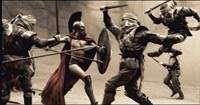
The battle scenes are few, but quite intense
All things considered, you'd think 300 is nothing more than a testosterone fueled, sword-clanging epic with stylish visuals. But I have to believe that the two guys who sat near me—giggling and rubbing their hands in anticipation as the battles geared up—were a little disappointed that such a movie is so talky. 300 is not the popcorn action flick some might be expecting. It's more like a war movie for fans of comic books, art history, and opera—propelled more by ideas and images, not action.
There's much talk (and posturing) between the action sequences, raising interesting themes about what the Spartans were fighting for: idealism vs. realism, perhaps even their very souls. Consider a scene where one Spartan offers to betray his countrymen for personal reasons. Xerxes comes across as the Devil himself, promising him wealth, women, and power, repeatedly extolling his kindness: "Leonidas would have you stand. All I ask is that you kneel." It's one of the most striking scenes of temptation I've ever seen in film, while providing some insight into what the Spartan "stand" truly represents—to take a self-proclaimed "god-king" down a peg by sheer force of will (and sheer force).
I cannot stress enough that this movie is not for everyone because of its violence and excesses. Nevertheless, the execution is artful (literally and figuratively) and it presents some lofty ideas in the process. With filmmaking both epic and imaginative, 300 is the stuff that legends are made of.
Talk About It
Discussion starters
What do you think was the cause of the battle? Was Leonidas prideful in his actions and decisions, or was he merely doing what was required of him as king?
The Spartans' religious festival prevented full use of the Greek army. Do you believe Leonidas acted wisely or rashly in response? Think of examples today where common sense conflicts with our beliefs. What roles do free will and faith play when religion and reason are at odds? How should we make such decisions, particularly when the Bible tells us to submit to authority (Romans 13:1-3, Hebrews 13:16-18, 1 Peter 2:12-14)?
300 makes a point of contrasting idealism with realism. Should we rely on one over another? Is one more practical to matters of state than the other? What about matters of faith? Is there room for balance?
Article continues below
A key character is persuaded to betray the Spartans after Xerxes tempts him with wealth, women, and more. What did such betrayal cost him? Can you think of ways that we too are faced with the choice to kneel or stand?
Does 300 glorify violence? Does it show us more than we need to see? Does it show anything that we don't read about in the Old Testament? Which is more powerful: the written word or the visual medium? Where do you draw the line between excess and necessity in depicting violence on screen?
The Family Corner
For parents to consider
300 is rated R for graphic battle sequences throughout, some sexuality, and nudity. The film earns the R rating and should not be taken lightly. The violence is highly stylized, and perhaps not as graphic or realistic as other war movies. But the battle sequences nevertheless include numerous slashes, stabbings, impalements, beheadings, and dismemberments. The film also contains some sexuality and nudity, including a grotesque Persian orgy, a love scene between Leonidas and his wife, sensual writhing by an oracle, and 300 half-naked Spartan warriors.
The government plans to close its porous border with Myanmar to boost security, separating ethnic groups that straddle the boundary.
Surinder Kaur and Angela Lu Fulton
300
1 of 4
Leonidas (Gerard Butler) seeks the counsel of his wife and queen, Gorgo (Lena Headey)Xerxes (Rodrigo Santoro), the Persian king who claims to be a godA wounded Leonidas roars his defiance at the Persian invadersThe battle scenes are few, but quite intense















 While we pray for peace, we need moral clarity about this war.
 We’ve got little information on Jesus’ appearance and personality. But that’s the way God designed it.españolFrançais
 The government plans to close its porous border with Myanmar to boost security, separating ethnic groups that straddle the boundary.