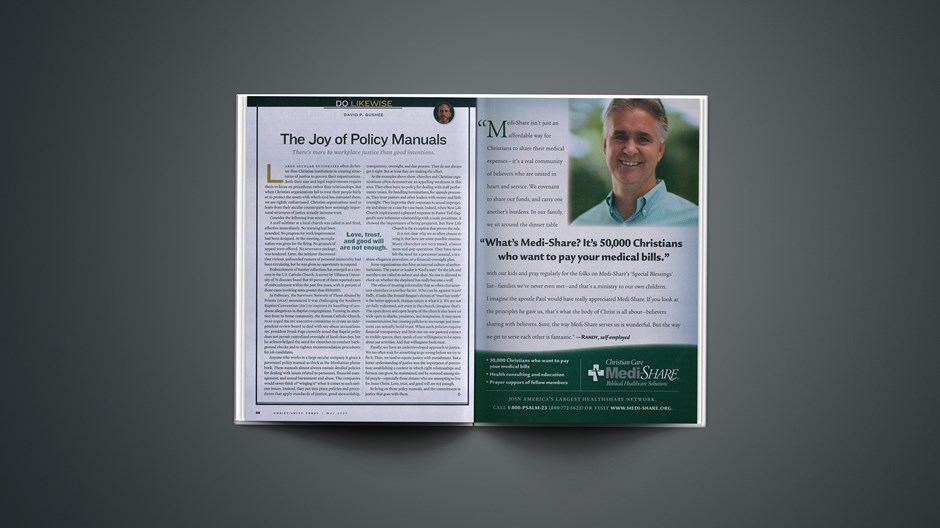
Large secular businesses often do better than Christian institutions in creating structures of justice to govern their organizations. Both their size and legal requirements require them to focus on procedures rather than relationships. But when Christian organizations fail to treat their people fairly or to protect the assets with which God has entrusted them, we are rightly embarrassed. Christian organizations need to learn from their secular counterparts how seemingly impersonal structures of justice actually increase trust.
Consider the following true stories.
A staff minister at a local church was called in and fired, effective immediately. No warning had been extended. No program for work improvement had been designed. At the meeting, no explanation was given for the firing. No grounds of appeal were offered. No severance package was tendered. Later, the minister discovered that vicious, unfounded rumors of personal immorality had been circulating, but he was given no opportunity to respond.
Embezzlement of Sunday collections has emerged as a concern in the U.S. Catholic Church. A survey by Villanova University of 76 dioceses found that 85 percent of them reported cases of embezzlement within the past five years, with 11 percent of those cases involving sums greater than $500,000.
In February, the Survivors Network of Those Abused by Priests (SNAP) announced it was challenging the Southern Baptist Convention (SBC) to improve its handling of sex-abuse allegations in Baptist congregations. Turning its attention from its home community, the Roman Catholic Church, SNAP urged the SBC executive committee to create an independent review board to deal with sex-abuse accusations. SBC president Frank Page correctly noted that Baptist polity does not permit centralized oversight of local churches, but he acknowledged the need for churches to conduct background checks and to tighten recommendation procedures for job candidates.
Anyone who works in a large secular company is given a personnel policy manual as thick as the Manhattan phone book. These manuals almost always contain detailed policies for dealing with issues related to personnel, financial management, and sexual harassment and abuse. The companies would never think of "winging it" when it comes to such serious issues. Instead, they put into place policies and procedures that apply standards of justice, good stewardship, transparency, oversight, and due process. They do not always get it right. But at least they are making the effort.
As the examples above show, churches and Christian organizations often demonstrate an appalling weakness in this area. They often have no policy for dealing with staff performance issues, for handling terminations, for appeals processes. They trust pastors and other leaders with money and little oversight. They improvise their responses to sexual impropriety and abuse on a case-by-case basis. Indeed, when New Life Church implemented a planned response to Pastor Ted Haggard's now infamous relationship with a male prostitute, it showed the importance of being prepared. But New Life Church is the exception that proves the rule.
It is not clear why we so often choose to wing it. But here are some possible reasons. Many churches are very small, almost mom-and-pop operations. They have never felt the need for a personnel manual, a sex-abuse allegation procedure, or a financial-oversight plan.
Some organizations also have an internal culture of authoritarianism. The pastor or leader is "God's man" for the job, and members are called to submit and obey. No one is allowed to check on whether the shepherd has really become a wolf.
The ethos of trusting informality that so often characterizes churches is another factor. Who can be against trust? Sadly, it looks like Ronald Reagan's dictum of "trust but verify" is the better approach. Human nature is what it is. We are not yet fully redeemed, not even in the church (imagine that!). The open doors and open hearts of the church also leave us wide open to sharks, predators, and temptation. It may seem counterintuitive, but creating policies to encourage just treatment can actually build trust. When such policies require financial transparency and limit one-on-one pastoral contact to visible spaces, they speak of our willingness to be open about our activities. And that willingness feeds trust.
Finally, we have an underdeveloped approach to justice. We too often wait for something to go wrong before we try to fix it. Thus, we tend to equate justice with punishment. But a better understanding of justice sees the importance of prevention: establishing a context in which right relationships and fairness can grow, be maintained, and be restored among sinful people—especially those sinners who are attempting to live for Jesus Christ. Love, trust, and good will are not enough.
So bring on those policy manuals, and the commitment to justice that goes with them.
David Aikman is professor of history and writer-in-residence at Patrick Henry College and wrote for Time magazine from 1971 to 1994. Among his books are Jesus in Beijing and A Man of Faith: The Spiritual Journey of George W. Bush. His column, "Global Prognosis," ran from 2006 to 2007.

















 While we pray for peace, we need moral clarity about this war.
 We’ve got little information on Jesus’ appearance and personality. But that’s the way God designed it.españolFrançais
 How groups like Hillsong learned to let go of the literal in favor of creative collaboration.españolPortuguês






