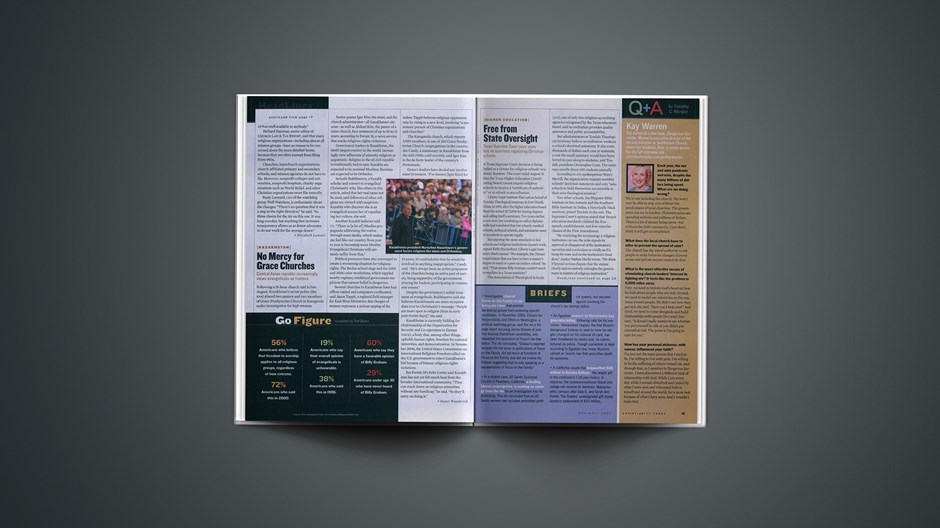
The author of a new book, Dangerous Surrender, Warren is executive director of the HIV/AIDS Initiative at Saddleback Church, where her husband, Rick, is senior pastor.
It tells the story of how she was transformed from a living a comfortable middle-class life as a pastor's wife and mother to becoming active in the church's global response to the HIV/AIDS pandemic.
From Nov. 28-30, Saddleback Church will host its third global summit on HIV/AIDS on its main campus in Lake Forest in Orange County, California, followed by the Dec. 1 Youth Summit on World AIDS Day. A shortened version of this interview appeared in the November issue.
Each year, the HIV and AIDS pandemic worsens, despite the many billion of dollars being spent. What are we doing wrong?
We're not including the church. We won't ever be able to stop AIDS without the involvement of local churches. The government can try its hardest. They spend billions of dollars. And philanthropists are spending millions and millions of dollars. There's a lot of money being spent—finally. But without the faith community, I just don't think it will get accomplished.
What does the local church have to offer in preventing the spread of HIV/AIDS?
The church has a distribution network already in place. I can attend these conferences and sit, and they'll say, "What about orphans? There's millions and millions of orphans. What can we do about all of the orphans?" I'm in the back of the room raising my hand going, "The church. The church."
The church has to care and can take care of orphans. The church can be a distribution center for medication and for helping people having peer counseling who can help people remember to take their medication. It sounds so simple, but that one act alone, having another person who will call and say, "Hey, did you take your medication today?" can extend a person's life. The church has the moral authority to ask people to make behavior changes. Governments and private sector cannot do that.
There are six things churches can do:
1. They can care for and support the sick.
2. They can encourage people to get tested or [they can] actually become testing centers themselves.
3. They can unleash volunteers.
4. They can reduce the stigma. When the church says it's not a sin to be sick, it changes the way everybody in the community looks at people who are HIV positive.
5. The church can promote God's standards of behavior and ask for behavior change.
6. The church can actually come alongside people who are sick and be those treatment coaches, if you will, that encourage them to take their medication.
What is the most effective means to stimulate church leaders' interest in this area of fighting HIV? It feels like the problem is 5,000 miles away.
Pastors and church leaders, Christians, all of us need to take a fresh look at Scripture. Look at Scripture and ask: What do I think God's response is to people who are sick?
Read the Old Testament, the New Testament, to see a God who is deeply compassionate about people who are sick. You'll see in Ezekiel where God said to the shepherd of Israel, "You have not bound up the wounded; you have not gone after the sick or the weak sheep; you have not taken care of their wounds. You have taken care of the fat sheep and driven the thin sheep away."
God is angry and he says, "I'm going to do something different. I'm going to go after the wounded ones. I'm going to bind up the wounds. I'm going to take care of the sick ones. I'm going to bring the weak ones back into the fold."
Then when you take a look at Jesus' response in the New Testament, everybody knows a third of his ministry was healing the sick. And if you look at it and say: Did Jesus ever ask anybody, "How did you get sick?" We get stuck on the "How did you get sick? How did you become infected?" We look with everybody with HIV and assume they did something wrong and that's why they're sick. You will not find Jesus asking, "How did you get sick?" He just said, "What can I do? How can I help you?"
First, we need to get God's heart on how he feels about people who are sick. Second, we need to model our ministries after the way Jesus treated people. Third, we need to come alongside and build relationships with people that says it doesn't really matter to me whether you put yourself at risk or you didn't put yourself at risk. The point is I'm going to care for you. My response is going to be the same.
Why are so many secular groups still resistant to working against HIV with evangelicals?
They've experienced us as those who reject rather than accept. Anyone who's HIV positive, the stigma is overwhelming, not just here in the United States, but around the world. Our rejecting attitude, I think, is our biggest barrier. They get caught on our messages about prevention. We get caught on the "How did you get sick?"
Your new book is entitled Dangerous Surrender. Does your own surrender to God's will still feel dangerous to you?
Every day I look up to the heavens and I say, "God, if I didn't believe you were good, I couldn't do this, because what you ask is so hard and it pushes me so far outside of my comfort zone, so far beyond what I think I can do and how I can respond."
Article continues below
In your book, you talk about being disturbed by God. How can you be disturbed by HIV/AIDS without going crazy?
That's taken a while to learn, because I feel like I live in three worlds now. I used to just think I lived in two worlds. I lived in the world of where I raise my family, where I go to the grocery store, where I go to work. Then I have the spiritual world, the Ephesians 1 concept of being seated in the heavenlies, that spiritual world of which I'm primarily a citizen.
I just didn't know too much about the second world. I knew about it, but I didn't know how to live in it, that world where there's extreme suffering. Now I feel like I'm a citizen of three worlds, and I've only got two feet but somehow I'm straddling all three of those worlds.
The passage of Scripture that has helped me the most is Philippians 4:12-13, the part that's real famous is where Paul says, "I can do all things through Christ who strengthens me." When you look at the verses before that, suddenly you look at it in a different light.
In the verses before he says: I know what it's like to get along in plenty and I know what it's like to get along with nothing. I know what it's like to have more than an abundance and how to live with nothing. I can do all things through Christ who strengthens me.
Suddenly that relieved the guilt that I experienced after I first became disturbed. I didn't know how to live in this world where I live where there's so much, and I felt guilty about everything.
How has your personal sickness, with cancer, influenced your faith?
I'm just not the same person that I used to be. I'm willing to live with pain. I'm willing to let the suffering of others wound me. Through that, as I mentioned in Dangerous Surrender, I have discovered a different kind of relationship with God. I understand in ways that I never did before what it means to share in the fellowship of the sufferings of Christ. While I cry every day, while I remain disturbed and ruined by what I have seen and witnessed both in myself and around the world, he is more real because of what I have seen. And I wouldn't trade that.
It seems as though there are couples being called to do ministry together in a way that evangelicals haven't experienced before. But what does this mean for a marriage?
Article continues below
Rick's not the person I married, and I'm not the person he married. We are very different people than we were as college students. This constantly has to be a renegotiation as you change and as God does different things within your heart; you have to be very intentional about your relationship. I think if you're two very busy people and have very active ministries, if you're not careful, you can end up pretty far apart, and I don't think that brings glory to God.
What brings glory to God is the unity and harmony between us as we seek to fulfill that. And sometimes we do it well. Sometimes we don't. Sometimes we kind of look at each other and go: "Wow. Who are you and what are you up to?" We have to sit down and just really spend some time together in conversation and actual time alone and reconnecting. It's a constant battle to stay really connected.
Hurricane Heroes | Government may have been tripped up by Katrina and Rita, but the Southern Baptists, among others, are standing tall. (November 1, 2007)


















 While we pray for peace, we need moral clarity about this war.
 How Jesus rescued a New Age psychic from spiritual darkness.
 The champion of “native missions” trained more than 100,000 evangelists but got in trouble for financial mismanagement.