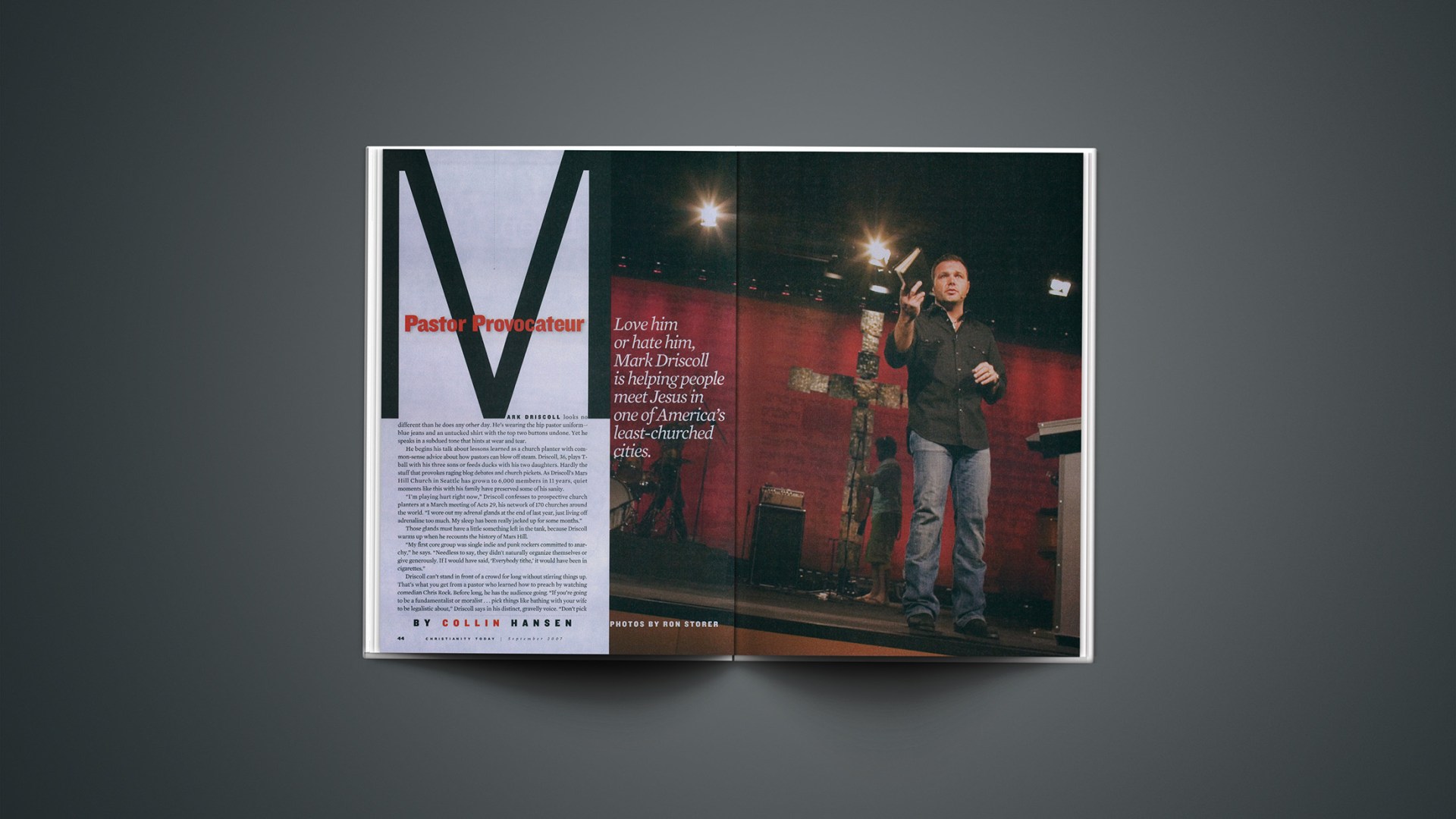

Mark Driscoll looks no different than he does any other day. He's wearing the hip pastor uniform—blue jeans and an untucked shirt with the top two buttons undone. Yet he speaks in a subdued tone that hints at wear and tear.
He begins his talk about lessons learned as a church planter with common-sense advice about how pastors can blow off steam. Driscoll, 36, plays T-ball with his three sons or feeds ducks with his two daughters. Hardly the stuff that provokes raging blog debates and church pickets. As Driscoll's Mars Hill Church in Seattle has grown to 6,000 members in 11 years, quiet moments like this with his family have preserved some of his sanity.
"I'm playing hurt right now," Driscoll confesses to prospective church planters at a March meeting of Acts 29, his network of 170 churches around the world. "I wore out my adrenal glands at the end of last year, just living off adrenaline too much. My sleep has been really jacked up for some months."
Those glands must have a little something left in the tank, because Driscoll warms up when he recounts the history of Mars Hill.
"My first core group was single indie and punk rockers committed to anarchy," he says. "Needless to say, they didn't naturally organize themselves or give generously. If I would have said, 'Everybody tithe,' it would have been in cigarettes."
Driscoll can't stand in front of a crowd for long without stirring things up. That's what you get from a pastor who learned how to preach by watching comedian Chris Rock. Before long, he has the audience going. "If you're going to be a fundamentalist or moralist … pick things like bathing with your wife to be legalistic about," Driscoll says in his distinct, gravelly voice. "Don't pick something stupid like, 'Don't listen to rock music.' I don't know who's choosing all the legalisms, but they picked the worst ones. Eat meat, bathe together, and nap—those would be my legalisms. Those are things I can do."
Driscoll "comes off as a smart-aleck former frat boy," according to The Seattle Times. Guilty as charged. If he hasn't offended you, you've never read his books or listened to his sermons. On any given Sunday at Mars Hill, it's possible that a visiting fire marshal will get saved. But it's just as likely that a guest will flip him off before walking out.
The spectrum of response speaks to his sharp tongue—his greatest strength and his glaring weakness. But Driscoll also disturbs many fellow evangelicals because he straddles the borders that divide us. His unflinching Reformed theology grates on the church-growth crowd. His plan to grow a large church strikes postmoderns as arrogant. His roots in the emerging church worry Calvinists. No one group can claim him. Maybe that's why they all turn their guns on him.
Different Stories
Driscoll gave me a hearty hug when we met at his beautiful new home, tucked in a pleasant Seattle neighborhood where you might not expect to see this pastor with a "bad boy" reputation. His forehead looked normal, not sloped. He wasn't drunk, either. And if he packed a firearm, I couldn't see it. So much for the stereotypes Driscoll said Christianity Today readers might have about him.
Driscoll first picked up his reputation when thousands met him in Donald Miller's Blue Like Jazz as Mark the Cussing Pastor. Yet his background pegs Driscoll not as a rebel, but as an overachiever. High-school classmates in Seattle elected him student-body president. He also captained the baseball team and edited the school newspaper. He didn't read the Bible until college at Washington State, when he flipped open a copy of the niv given to him by a pastor's attractive daughter. At first, Driscoll sided with the Pharisees, because he admired their self-control. But God soon revealed to Driscoll that Jesus was the true hero. Driscoll also heard from God that he should marry that pastor's daughter, now his wife, Grace.
After college, Driscoll returned to Seattle and worked with college students for a year on the staff of Antioch Bible Church, one of the area's few large churches. Less than 10 percent of Seattle's residents identify as evangelical, and fewer still worship in mainline Protestant or Roman Catholic churches. In 1996, Driscoll founded Mars Hill, because he didn't see a church in Seattle that shared his missional vision.
Driscoll now uses Sunday services to equip church members to be missionaries in Seattle. The approach requires a high degree of cultural assimilation, a trait he shares with other emerging leaders. For instance, Mars Hill has made contact with many Seattle residents through the Paradox, a concert venue owned by the church that hosts bands with no Christian ties. And an early, outdoor Bible study that Driscoll used to grow the church allowed smoking.
In Mars Hill's early days, Driscoll struggled to find the right balance between unchanging orthodox theology and flexible methods of outreach.
"I also did not explain in written form that we were theologically conservative and culturally liberal, which caused great confusion because half of the church was angry that the other half was smoking, while the other half was angry that I taught from the Bible," Driscoll writes in Confessions of a Reformission Rev.
The church's unconventional look and feel has earned Mars Hill abundant local attention, some of it positive. The main campus meets in a former Napa Auto Parts store in Ballard, an industrial district giving way to urban hipsters. The simple, spacious building seats 1,200 in a dark auditorium. Young couples quickly fill the church's abundant nursery space.
Anticipation builds well before Sunday services begin, giving the worship a concert feel. Though I arrive more than half an hour early for the 9 a.m. service, college students quickly surround me and save seats up front for their friends. The music takes an indie-rock flavor. Two bouncers flank the stage. With tight, black T-shirts and folded arms that accentuate their biceps, they stare down the congregation. Earpieces connect them with Mars Hill's extensive security presence. Just inside one church entrance is the security headquarters, dubbed the "war room." All this seems a bit much—until you hear the stories.
Last fall, a man wielding a knife stormed the stage. Security sacked him before he could reach Driscoll. On occasion, Driscoll has preached in a bulletproof vest following death threats. As Driscoll would say, that's life in a city where nude bicyclists ride past a statue of Lenin.
Driscoll, while still emerging, no longer belongs to Emergent. Starting in 1995, Driscoll traveled around the country speaking for events hosted by Leadership Network, out of which grew Emergent Village in 2001. That's when Driscoll split. He began to suspect that Emergent leaders wanted to revise Christian orthodoxy. Since then, Emergent Village has advocated an experimental, open approach to theology. Emergent Village coordinator Tony Jones has not sat down and talked with Driscoll in five years, Jones told me. Though they have sparred over theology, Jones spoke highly of Driscoll's leadership gifts.
"He is uncommonly intelligent," Jones said. "He is uncommonly articulate and humorous. He could have been a stand-up comedian. He could have been a great actor probably."
But Driscoll seems to have tired of debates about the relationship of theology to postmodernism. Knowing his erstwhile Emergent friends will not be persuaded, Driscoll nevertheless references 641 Bible verses supporting his view in just 14 pages of Listening to the Beliefs of Emerging Churches: Five Perspectives. Doug Pagitt, pastor of Solomon's Porch in Minneapolis, gets it right when he responds, "I think much of our difference comes from the fact that in many ways we are telling different stories of Christianity."
Strategic Offender
Driscoll offers a decidedly un-Emergent list of evangelical leaders when asked who has influenced him. He cites giants such as John Stott, Francis Schaeffer, J. I. Packer, Charles Colson, and Billy Graham. From a somewhat younger set, John Piper and theologians D. A. Carson and Wayne Grudem make his list. Asked about megachurch pastors Rick Warren and Bill Hybels, Driscoll says he has never heard them preach, though he does offer appreciative words about their methods. For all you can learn from Packer and Schaeffer, they will not teach you how to shepherd 6,000 church members.
For Driscoll, 6,000 is just a mile marker on the road to 20,000 and beyond. Gerry Breshears remembers Driscoll talking about a strategic growth plan in 2002. Driscoll didn't immediately impress Breshears, chair of theological and biblical studies at Western Seminary in Portland, Oregon. Driscoll dripped with brash sarcasm, Breshears recalls. Driscoll had visited Western Seminary looking for help pursuing advanced study, since he hadn't attended seminary before planting Mars Hill. Once Breshears got past Driscoll's sarcasm, he observed a deep commitment to Scripture and Bible-based theology.
"Since then, I've come to realize that Mark is a blinking genius," Breshears says. "He is a first-rank intellect. A lot of his success comes from his amazing intellect and entrepreneurial ability that's one in a million."
Working together since 1999, Breshears observes that Driscoll now spends less time criticizing others and more time speaking positively about the church's mission to love Seattle. Even so, Driscoll has hardly become less controversial over that time. Driscoll told me that he has learned much from Ed Stetzer, a missiologist who works for the Southern Baptist Convention's North American Mission Board (NAMB). Stetzer directs the Center for Missional Research, which studies culture and evaluates church effectiveness. However, NAMB declined to make Stetzer, a member of the Acts 29 board, available for this profile. Spokesman Mike Ebert told me that the denomination has "controversial differences" with some of Driscoll's "views and practices."
Indeed, according to Breshears, "he offends everybody." "[Driscoll's approach is,] 'If Jesus says it, I'm gonna stick it in your face. Get used to it,'" Breshears says. "But that's part of what people respond to. Here's a guy who stands up, opens his Bible, and says, 'Dude, this is it.' When he says, 'Dude,' he turns off a whole lot of folks. And when he says, 'this is it,' he turns off a lot of folks."
Beautiful Rebuke
All the debate Driscoll stirs up over his edgy preaching and his style of evangelism pales compared to reactions when he talks about women.
"If I could change one part of the Bible," Driscoll told The Seattle Times about Paul's writings on gender roles, "that would be the part, just so I could be left alone."
Mars Hill teaches that only men can serve as church elders and that fathers should lead their homes. But Driscoll frequently turns his sights on "men who cheat on their wives, beat their kids, look at porn, get divorced." Driscoll grew up behind a strip club in a rough neighborhood. He's still brawling today.
"I see that the world is filled with bad men, and the only way to protect women is to be tougher than they are," he explains. "I'm not talking about being a thug, a bully, or a jerk. But I'm saying when a thug, a bully, or a jerk shows up at the playground and starts picking on kids, somebody's got to get in his face, and somebody's got to shove him down."
Driscoll would have been wise last fall to take his own advice and stick to men's issues when he commented on Ted Haggard's resignation from the National Association of Evangelicals. Writing on his blog, Driscoll offered helpful, practical advice for young pastors who might struggle to ward off sexual temptation. But one comment stood out.
"It is not uncommon to meet pastors' wives who really let themselves go; they sometimes feel that because their husband is a pastor, he is therefore trapped into fidelity, which gives them cause for laziness," Driscoll wrote. "A wife who lets herself go and is not sexually available to her husband in the ways that the Song of Songs is so frank about is not responsible for her husband's sin, but she may not be helping him either."
Though not directed at Haggard's wife, the comments understandably drew rebuke. A Seattle group called People Against Fundamentalism emerged with plans to picket Mars Hill Church. However, Driscoll preempted the protest by apologizing on his blog and sitting down with the protest organizers for an extended meeting.
Driscoll admits that he did not carefully articulate his point: Christians should not have a false sense of security about their spouses' fidelity. He also confesses to poor judgment with the timing.
The Haggard comment did not surprise Driscoll's critics, who say his efforts to protect women actually devalue them. Jennifer McKinney, director of the women's studies program at Seattle Pacific University, says she started teaching about the sociology of gender in part because of issues raised at nearby Mars Hill. She notices that many female students who attend Mars Hill abandon career ambitions as social workers or youth pastors. Instead, they prepare to become wives and mothers.
"I can't say that folks who go to this church are not active, thinking beings," McKinney says. "But the perception on campus is that these women completely change."
Driscoll and Mars Hill shrug off such criticism. One reason is that single women compose the largest demographic group at Mars Hill. Plus, one expects a pastor would be happy to know that people in his church really change. That's especially true of Mars Hill, which traces 40 percent of its growth to conversions. And controversy doesn't appear to have hurt the church—at least not in the long run. Before last Christmas, more than a month after Driscoll's comments about Haggard, the church had fallen $400,000 behind budget. The church laid off staff for the first time. But once church members learned of the need, giving exploded. In January alone, church attendance grew by 1,000.
Still, exposure to criticism does not make church leaders immune to it. Wendy Alsup, the Mars Hill deacon responsible for women's theology and training, shook with emotion as we sat down in the "war room" and talked about Driscoll. She said that Mars Hill will "always be open to criticism, because God has grown us faster than we can handle." Alsup defended Driscoll with evident passion.
"He asks forgiveness more than any pastor I have ever seen," she said. "He publicly confesses sin. He's such a great example to young, idealistic, confident, inexperienced, immature pastors that you have to say you're wrong when you're wrong. And he does it to women. I know. He has apologized in times when he has gotten things wrong, and I'm thankful he doesn't apologize for the things he hasn't said wrong."
Jonathan MacIntosh was one of those young, confident, immature pastors. As a new church planter in 2004, he showed up for an Acts 29 boot camp looking for guidance and funding. His church had struggled to grow past 40, despite strong lay leadership. Driscoll asked him why. MacIntosh blamed his over-churched town in Mississippi. Driscoll didn't buy it.
"Then he looked at my wife and said, 'Ashley, honey, you tell me what's going on in your opinion. I want you to be honest with me. Look me in the eyes and tell me the truth,'" MacIntosh recounts. "At first she gave stock answers. But then she completely broke right there. 'My husband is off doing this church-planting thing. I'm stuck in this job I hate, slaving away to support us. People are in and out of our apartment at all hours of the night. I'm losing my husband to this thing. I'm miserable. It's sapping my joy for life, my love for God, and my respect for my husband.'"
At that point, MacIntosh was pretty sure Acts 29 would not subsidize his church. Then Driscoll unloaded on him. "You're a good-looking, eloquent, hip, Bible-teaching, Jesus-loving [wimp]." MacIntosh remembers Driscoll telling him. "You think you can lead and love God's bride when you can't lead and love your own bride? The issue with your church is you and your marriage. Everyone knows it. You're photocopying your marriage. That's your church, and that's why it's jacked up. How dare you."
"Man, it was beautiful," MacIntosh says.
Driscoll told MacIntosh to take his wife to a nice restaurant, find a hotel room, and send him the bill. Now MacIntosh works for Acts 29 and evaluates church planters. When we met at Driscoll's home, he opened his wallet and showed me a picture of his baby daughter.
"God used that day and that encounter to save my marriage," he says. "It was a wake-up call from Jesus."
Throwing Rocks
Even among those who share his views on gender roles and his concern about the emerging church, Driscoll is scarcely less controversial. John Piper says no other speaker at his Desiring God conference has caused such a stir. Some Calvinists do not fully trust Driscoll because it took time for his Reformed theology to solidify. Preaching through Exodus early in his career, Driscoll was struck by God's sovereignty over Pharaoh. He saw how God acted to deliver his people. The Book of Romans eliminated any remaining doubt about Reformed theology, which he summarizes this way: "People suck, and God saves us from ourselves."
Venerable Reformed expositor John MacArthur has complimented Driscoll's soteriology. He is thankful that Driscoll stresses substitutionary atonement and justification by faith alone. But that doesn't make up for his "infatuation with the vulgar aspects of contemporary society," MacArthur wrote last December in Pulpit magazine.
"[T]he lifestyle he models—especially his easygoing familiarity with all this world's filthy fads—practically guarantees that [his disciples] will make little progress toward authentic sanctification."
The evidence seems to belie MacArthur's criticism. Alsup likens Mars Hill to an emergency room triage, with so many new believers working through so many horrible problems. Before the service I attended, I talked with Lynette Palmer, who became a Christian a few years ago at the University of Washington. Her family has endured lots of physical and emotional abuse. In the last few years, her mother and three sisters have come to faith and begun attending Mars Hill. But her father spent eight years in jail—for raping one of Lynette's sisters. Driscoll's sermons have helped bring healing to Palmer.
"Once I started looking at what God says about his sovereignty," Palmer said, "I realized that Satan has no power to destroy people."
Driscoll relates many stories of God's transforming power in his Confessions book. Still, Driscoll says receiving MacArthur's criticism is "like a frat guy getting paddled. It doesn't feel good, but I guess it means you're in." As a new Christian, Driscoll picked up hundreds of tapes to learn from MacArthur's preaching. He regrets that MacArthur chose a public forum for criticism, when he would have gladly flown to Los Angeles to hear MacArthur's advice.
Without directly implicating MacArthur, Driscoll distinguishes between missionaries who study culture and fundamentalists who try to avoid culture.
"Fundamentalism is really losing the war, and I think it is in part responsible for the rise of what we know as the more liberal end of the emerging church," Driscoll says. "Because a lot of what is fueling the left end of the emerging church is fatigue with hardcore fundamentalism that throws rocks at culture. But culture is the house that people live in, and it just seems really mean to keep throwing rocks at somebody's house."
Few but Driscoll's friends come to his defense, because no one else can peg him. That's fine with Driscoll, so long as his band of acculturated missionaries sticks to their tasks. Hundreds of young ministers planting churches around the world, they understand him. They cut him slack as he searches for the balance between provocative and sensitive.
"You can't escape your upbringing," says Darrin Patrick, vice president of Acts 29. "Mark is a street fighter."
And even the Good Shepherd had to fight off wolves.
Collin Hansen is a CT associate editor. His book on the rise of Reformed theology among young evangelicals will be published by Crossway in 2008.
Copyright © 2007 Christianity Today. Click for reprint information.
Related Elsewhere:
Mark Driscoll blogs at TheResurgence.com and Acts 29.
Salon, Pacific Northwest, and Evangelical Right: The Internet's Home for Sinners Destined to Be Left Behind published profiles of Driscoll.
Mars Hill Church has audio clips of Driscoll's sermons and other media resources.
Driscoll is a council member of the Gospel Coalition and founder of the Paradox Theater.
Adrian Warnock interviewed Driscoll and a deacon from his church.
Other relevant Christianity Today articles include:
What's Next: Local Church | We asked 114 leaders from 11 ministry spheres about evangelical priorities for the next 50 years. First up: Fresh basics for the local church. (October 2, 2006)
Young, Restless, Reformed | Calvinism is making a comeback—and shaking up the church. (September 22, 2006)
Men Are from Mars Hill | Mark Driscoll praises Jesus, blasts mega-churches, and extols Reformed theology. (July 4, 2006)