


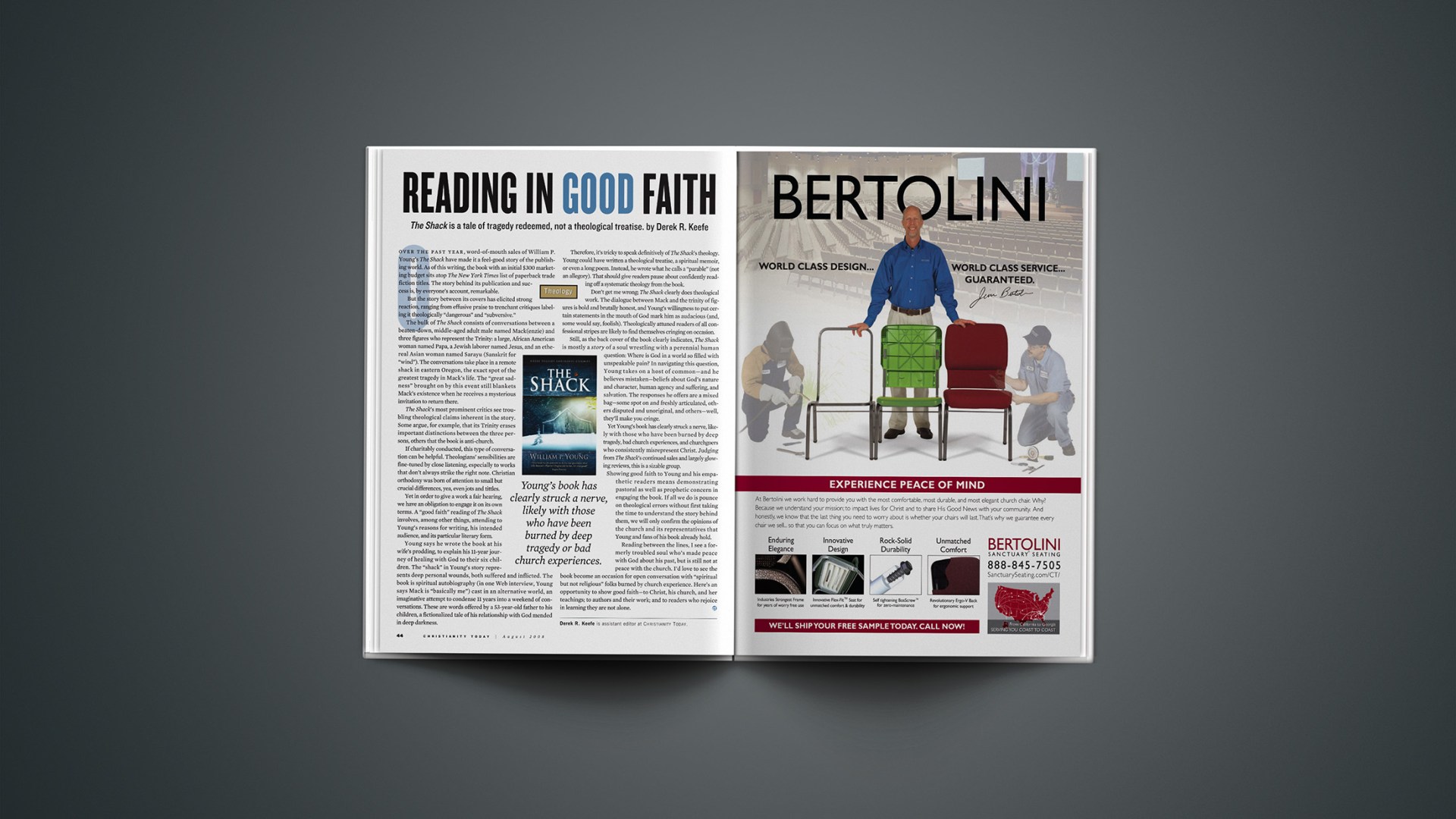

Exclusive for CT Online readers: Download chapter one of The Shack by William P. Young, free from Oasis Audio and powered by Audible.com.
Over the past year, word-of-mouth sales of William P. Young’s The Shack have made it a feel-good story of the publishing world. As of this writing, the book with an initial $300 marketing budget sits atop The New York Times list of paperback trade fiction titles. The story behind its publication and success is, by everyone’s account, remarkable.
But the story between its covers has elicited strong reaction, ranging from effusive praise to trenchant critiques labeling it theologically “dangerous” and “subversive.” The bulk of The Shack consists of conversations between a beat-down, middle-aged adult male named Mack(enzie) and three figures who represent the Trinity: a large African American woman named Papa, a Jewish laborer named Jesus, and an ethereal Asian woman named Sarayu (Sanskrit for “wind”). The conversations take place in a remote shack in eastern Oregon, the exact spot of the greatest tragedy in Mack’s life. The “great sadness” brought on by this event still blankets Mack’s existence when he receives a mysterious invitation to return there.
The Shack‘s most prominent critics see troubling theological claims inherent in the story. Some argue, for example, that its Trinity is modalistic, others that the book is anti-church.
If charitably conducted, this type of conversation can be helpful. Theologians’ sensibilities are fine-tuned by close listening, especially to works that don’t always strike the right note. Christian orthodoxy was born of attention to small but crucial differences, yea, even jots and tittles.
Yet in order to give a work a fair hearing, we have an obligation to engage it on its own terms. A “good faith” reading of The Shack involves, among other things, attending to Young’s reasons for writing, his intended audience, and its particular literary form.
Young says he wrote the book at his wife’s prodding, to explain his 11-year journey of healing with God to their six children. The “shack” in Young’s story represents deep personal wounds, both suffered and inflicted. The book is spiritual autobiography (in one web interview, Young says Mack is “basically me”) cast in an alternative world, an imaginative attempt to condense 11 years into a weekend of conversations. These are words offered by a 53-year-old father to his children, a fictionalized tale of his relationship with God mended in deep darkness.
Therefore, it’s tricky to speak definitively of The Shack‘s theology. Young could have written a theological treatise, a spiritual memoir, or even a long poem. Instead, he wrote what he calls a “parable” (not an allegory). That should give readers pause about confidently reading off a systematic theology from the book.
Don’t get me wrong; The Shack clearly does theological work. The dialogue between Mack and the trinity of figures is bold and brutally honest, and Young’s willingness to put certain statements in the mouth of God mark him as audacious (and some would say foolish). Theologically attuned readers of all confessional stripes are likely to find themselves cringing on occasion.
Still, as the back cover of the book clearly indicates, The Shack is mostly a story of a soul wrestling with a perennial human question: Where is God in a world so filled with unspeakable pain? In navigating this question, Young takes on a host of common—and he believes mistaken—beliefs about God’s nature and character, human agency and suffering, and salvation. The responses he offers are a mixed bag—some spot on and freshly articulated, others disputed and unoriginal, and others—well, they’ll make you cringe.
Yet Young’s book has clearly struck a nerve, likely with those who have been burned by deep tragedy, bad church experiences, and churchgoers who consistently misrepresent Christ. Judging from The Shack‘s continued sales and largely glowing reviews, this is a sizable group.
Showing good faith to Young and his empathetic readers means demonstrating pastoral as well as prophetic concern in engaging the book. If all we do is pounce on theological errors without first taking the time to understand the story behind them, we will only confirm the opinions of the church and its representatives that Young and fans of his book already hold.
Reading between the lines, I see a formerly troubled soul who’s made peace with God about his past, but is still not at peace with the church. I’d love to see the book become an occasion for open conversation with “spiritual but not religious” folks burned by church experience. Here’s an opportunity to show good faith—to Christ, his church, and her teachings; to authors and their work; and to readers who rejoice in learning they are not alone.
Derek R. Keefe is assistant editor at Christianity Today.
Copyright © 2008 Christianity Today. Click for reprint information.
Related Elsewhere:
Download chapter one of The Shack by William P. Young, free from Oasis Audio and powered by Audible.com.
The book and audio versions of The Shack are available from ChristianBook.com and other retailers.
The book’s website has a readable version of chapter 1.
Cindy Crosby reviewed the book.
Collin Hansen discussed The Shack‘s depiction of the Trinity in “The Trinity: So What?“
USA Today reported on criticisms of The Shack‘s theology.