As the economy suffers, charities naturally anticipate a drop in income. But a given charity's dependence on the economy's ups and downs varies widely.
Charitable organizations as a whole will suffer in proportion to the rest of the economy. For instance, if the U.S. gross domestic product (GDP) drops by 2 percent, charity income will likely drop about 1.4 percent, says Arthur C. Brooks, president of the American Enterprise Institute and author of Who Really Cares? The Surprising Truth about Compassionate Conservatism.
But some nonprofit organizations—soup kitchens, the Salvation Army, and others that work with the poor directly—actually receive more money during a recession, Brooks says, because donors are more aware of recipients' heightened needs.
Giving to secular organizations drops more than the drop in gdp, while giving to religious organizations typically drops less. Those hit hardest are secular nonprofits dependent on large donations, such as symphony orchestras and environmental charities.
Donors also react differently to a recession, Brooks says. Religious donors, who in general give four times more annually than secular donors, are far less likely than their secular counterparts to stop giving in a bad economy.
"There are all kinds of reasons that people give, from the sense of society or of community to a warm glow to religious observance to purely economic motivations to publicity," Brooks told ct. "But what you find is that religious people tend to give under all different circumstances, because they believe they are speaking to a higher authority than just what's going on with their 401(k)."
All of this means good news for churches.
Historically, church giving tends to stay level for the first year or two of a recession before it drops, says Sylvia Ronsvalle, executive vice president of Empty Tomb, Inc., a research ministry based in central Illinois.
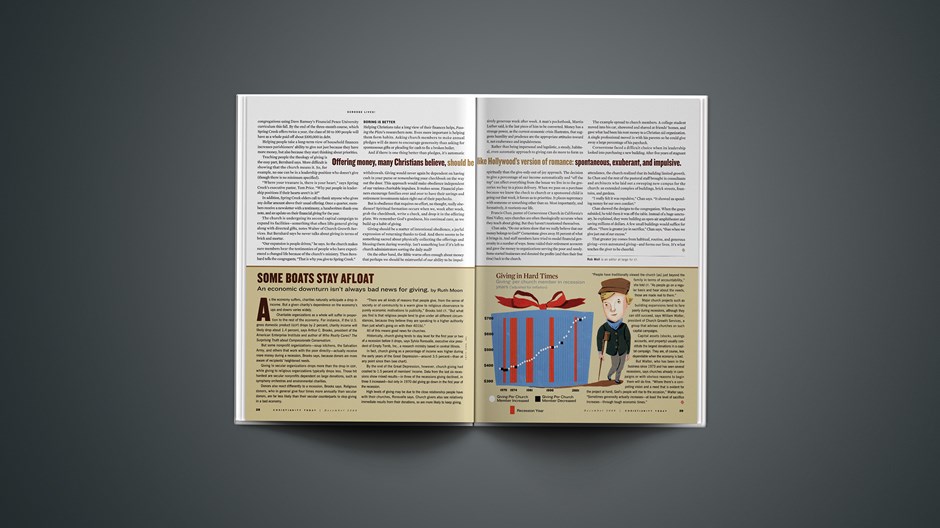
In fact, church giving as a percentage of income was higher during the early years of the Great Depression—around 3.5 percent—than at any point since then (see chart).
By the end of the Great Depression, however, church giving had crashed to 1.5 percent of members' income. Data from the last six recessions show mixed results—in three of the recessions giving declined, in three it increased—but only in 1970 did giving go down in the first year of the recession.
High levels of giving may be due to the close relationship people have with their churches, Ronsvalle says. Church givers also see relatively immediate results from their donations, so are more likely to keep giving.
"People have traditionally viewed the church [as] just beyond the family in terms of accountability," she told CT. "As people go on a regular basis and hear about the needs, those are made real to them."
Major church projects such as building expansions tend to fare poorly during recessions, although they can still succeed, says William Walter, president of Church Growth Services, a group that advises churches on such capital campaigns.
Capital assets (stocks, savings accounts, and property) usually constitute the largest donations in a capital campaign. They are, of course, less dependable when the economy is bad.
But Walter, who has been in the business since 1973 and has seen several recessions, says churches already in campaigns or with obvious reasons to begin them will do fine. "Where there's a compelling vision and a need that is evident for the project at hand, God's people will rise to the occasion," Walter says. "Sometimes generosity actually increases—at least the level of sacrifice increases—through tough economic times."















 While we pray for peace, we need moral clarity about this war.
 We’ve got little information on Jesus’ appearance and personality. But that’s the way God designed it.españolFrançais
 The rage of the mob is a poor substitute for real community.






