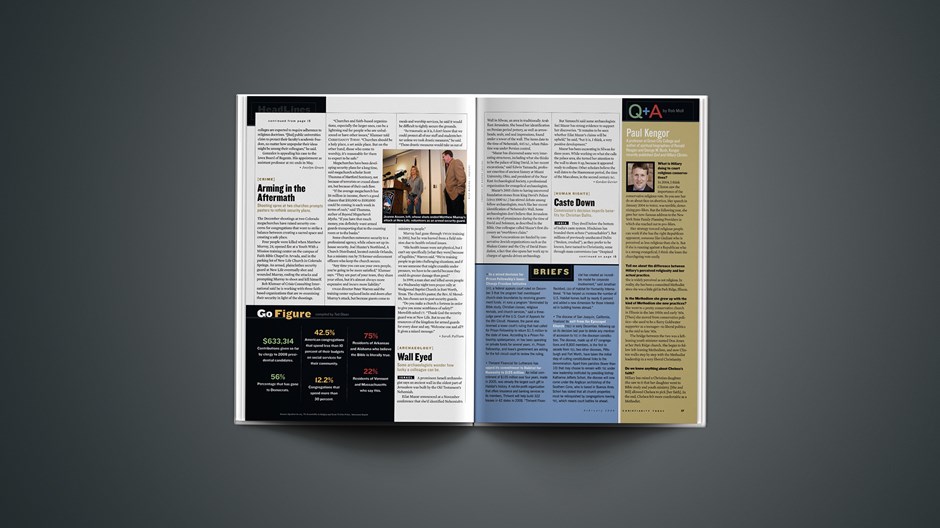
A prominent Israeli archaeologist says an ancient wall in the oldest part of Jerusalem was built by the Old Testament's Nehemiah.
Eilat Mazar announced at a November conference that she'd identified Nehemiah's Wall in Silwan, an area in traditionally Arab East Jerusalem. She based her identification on Persian period pottery, as well as arrowheads, seals, and seal impressions, found under a tower of the wall. The items date to the time of Nehemiah, 445 B.C., when Palestine was under Persian control.
"Mazar has discovered some very interesting structures, including what she thinks to be the palace of King David, in her recent excavations," said Edwin Yamauchi, professor emeritus of ancient history at Miami University, Ohio, and president of the Near East Archaeological Society, a professional organization for evangelical archaeologists.
Mazar's 2005 claim to having uncovered foundation stones from King David's Palace (circa 1000 B.C.) has stirred debate among fellow archaeologists, much like her recent identification of Nehemiah's Wall. Some archaeologists don't believe that Jerusalem was a city of prominence during the time of David and Solomon, as described in the Bible. One colleague called Mazar's first discovery an "overblown claim."
Mazar's excavations are funded by conservative Jewish organizations such as the Shalem Center and the City of David Foundation, a fact that also opens her work up to charges of agenda-driven archaeology.
But Yamauchi said some archaeologists feel Mazar has strong evidence to support her discoveries. "It remains to be seen whether Eilat Mazar's claims will be upheld," he said, "but it is, I think, a very positive development."
Mazar has been excavating in Silwan for three years. While working on what she calls the palace area, she turned her attention to the wall to shore it up, because it appeared ready to collapse. Other scholars believe the wall dates to the Hasmonean period, the time of the Maccabees, in the second century B.C.















 While we pray for peace, we need moral clarity about this war.
 We’ve got little information on Jesus’ appearance and personality. But that’s the way God designed it.españolFrançais
 The plan would organize UMC churches in four global regions, with each given more leeway around same-sex marriage and other theological issues.






