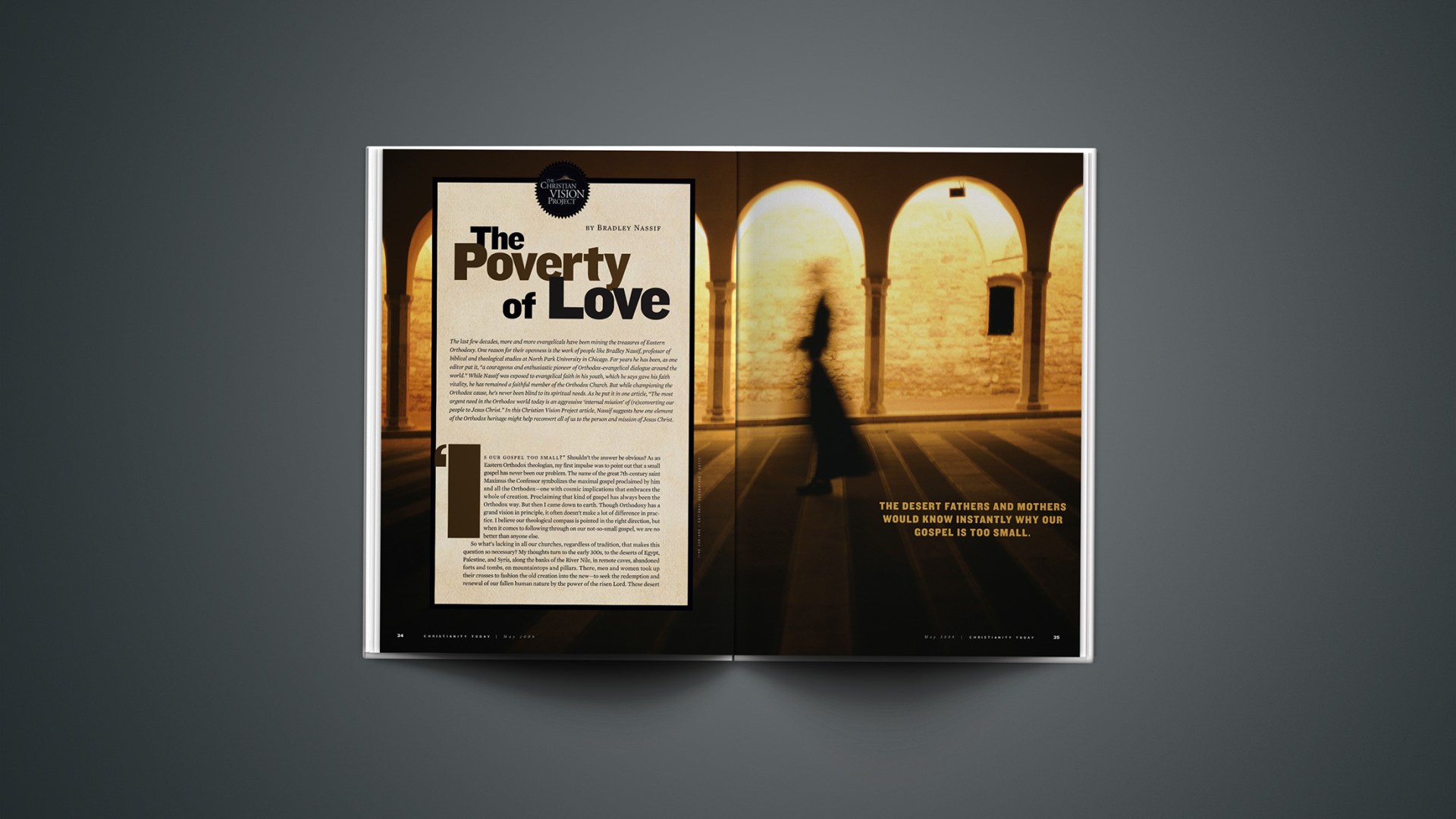

The last few decades, more and more evangelicals have been mining the treasures of Eastern Orthodoxy. One reason for their openness is the work of people like Bradley Nassif, professor of biblical and theological studies at North Park University in Chicago. For years he has been, as one editor put it, “a courageous and enthusiastic pioneer of Orthodox-evangelical dialogue around the world.” While Nassif was exposed to evangelical faith in his youth, which he says gave his faith vitality, he has remained a faithful member of the Orthodox Church. But while championing the Orthodox cause, he’s never been blind to its spiritual needs. As he put it in one article, “The most urgent need in the Orthodox world today is an aggressive ‘internal mission’ of (re)converting our people to Jesus Christ.” In this Christian Vision Project article, Nassif suggests how one element of the Orthodox heritage might help reconvert all of us to the person and mission of Jesus Christ.
“Is our gospel too small?” Shouldn’t the answer be obvious? As an Eastern Orthodox theologian, my first impulse was to point out that a small gospel has never been our problem. The name of the great 7th-century saint Maximus the Confessor symbolizes the maximal gospel proclaimed by him and all the Orthodox—one with cosmic implications that embraces the whole of creation. Proclaiming that kind of gospel has always been the Orthodox way. But then I came down to earth. Though Orthodoxy has a grand vision in principle, it often doesn’t make a lot of difference in practice. I believe our theological compass is pointed in the right direction, but when it comes to following through on our not-so-small gospel, we are no better than anyone else.
So what’s lacking in all our churches, regardless of tradition, that makes this question so necessary? My thoughts turn to the early 300s, to the deserts of Egypt, Palestine, and Syria, along the banks of the River Nile, in remote caves, abandoned forts and tombs, on mountaintops and pillars. There, men and women took up their crosses to fashion the old creation into the new—to seek the redemption and renewal of our fallen human nature by the power of the risen Lord. These desert dwellers provide us with the wisdom we seek.
The desert fathers and mothers heard Christ’s call to deny themselves, take up the cross daily, and follow him (Luke 9:23) in a time similar to our own. Under Emperor Constantine, large numbers joined the church for the social privileges it bestowed. Many sought status and prosperity more than the cross. This influx of nominal Christians made the church a spiritually sick institution, and a radical illness called for a radical remedy. Ordinary men and women, most of them illiterate, heard the death-call of the gospel and responded by fleeing to the desert to live out their calling—either alone or in community. Peasants, shepherds, camel traders, former slaves, and prostitutes were the first to go.
The desert was not a place of escape as much as a place of countercultural engagement. The desert was the front line of spiritual warfare—as in the Bible, a place of testing and death. It was where the heart was purified, the passions conquered, sin destroyed, and humanity renewed.
Like the prophets of old, the desert dwellers reminded the church that the kingdom of God is not of this world. They insisted that if we confuse the gospel’s values with our culture’s values, it will have lethal results. They exposed the underside of a form of religion that fuels our hunger for self-centered living. Still today, their lives stand against the easy assurance of a too-inculturated gospel. They offer an alternative spiritual order, one based on Trinitarian divine love and human freedom. They offer an alternative portrait of what being human really means. And perhaps most radically, they call us to engage our external challenges by first conquering our own inner passions through the lordship of Christ.
Athletes of God
The monastic movement was a response to the church’s spiritual poverty—the poverty of love. The monks protested that knowledge wasn’t the problem; the problem was love. Their perspective is all the more surprising when we compare the low literacy rate then (perhaps 4 percent) with the high literacy rate now (75 percent). There is more Bible knowledge available now than at any other time in human history. Yet we are still asking, “Is our gospel too small?”
If these desert dwellers were alive today, I believe they would tell us that our gospel is too small because our wills are too big. The core battleground, they argued, is the human heart. They would counsel us to declare war on the inner adversaries that hide secretly in our hearts, and to be watchful of their stealth attacks. We’re wisest, they taught, when we concentrate our energies on the source of all our problems, the inner person—its selfish orientation, dark impulses, sexual preoccupations, greed, lust, anger, unforgiveness, hatred, and other “works of the flesh” (Gal. 5:19–21). Every believer still has a powerful attraction to sin. So the monks took decisive action in their reliance on God, engaging in the hard work of holiness, something they called ascesis, or spiritual training. Some monks were such great trainers, they acquired the name “athletes of God” or “soldiers of Christ.”
At the heart of their training was repentance. They were convinced that their inner natures were so out of sync with the will of God that nothing but a strong dose of God’s grace could fix them. Only repentance could clear away the stony rubble in the soil of their hearts so God’s grace could take root and grow. The gospel was so alive in the monks because repentance was a lifestyle for them, not a single event. Even after spending a lifetime in repentance, we hear them on their deathbeds encouraging the younger ones not to give up: “I’m only a beginner,” they would say. “I’ve just begun to repent!”
All this talk of repentance may sound neurotic, but the fathers and mothers specifically avoided the “deadly thoughts” of depression and gloom. Nor was it their habit to keep dwelling on past sins, as later medieval piety would encourage. They simply knew the depths of their own disobedience, and they took steps to deal with their hearts. The lives of the great desert fathers and mothers of the 3rd through 6th centuries show us how big our gospel can become in each of us when we obey Scripture. The more we keep company with these delightful people, the more they lead us away from relying on external remedies. They tell us that our gospel is too small not because we need to hear more sermons, or do more Bible study, or attend more church services, or create new programs. Nor is it too small because we have not followed modern theological scholars into a nearly idolatrous reliance on the intellect. The monks interpreted the Scriptures not just through study, but also by putting them into practice.
Serapion lamented, “The prophets wrote books. Then came our ancestors who lived by them. Those who came later understood them from the heart. Then came the present generation who copied them but put them on their shelves unused.” I imagine that those reading this article have more Bible knowledge than they will ever put into practice in their lifetime. Yet it’s not more knowledge we need; it’s more love and obedience.
Trinitarian Love
Some readers may be wondering whether all this talk of hard work will lead to “works righteousness,” a focus on the self and a dependence on the self’s efforts for salvation and sanctification. But the great monastic leaders disavowed such confusion.
First, they understood that spiritual disciplines in themselves don’t lead to loving obedience. Anthony the Great (4th century) was once asked by a fellow monk who exceeded Anthony in ascetic rigor (which was no small feat, by the way), “Anthony, I fast and pray more than you do, but you are more well known than I. Why is that so?” Anthony replied, “Because I love God more than you do.” Anthony wasn’t bragging. He was just telling it like it was.
When practiced in humility, ascetic rigor results in greater love. The monks fasted because they were hungry to love God more; they prayed because they wanted closer communion with God and neighbor; they contemplated so they could better fix their gaze on their divine spouse; they practiced silence because they wanted to hear God so they could speak and act more wisely to the people around them. The end goal of every spiritual practice employed by the monks was love.
Second, in a treatise titled “On Those Who Think They Are Made Righteous by Works,” Mark the Ascetic says grace is opposed to merit, but it is not opposed to effort: “The kingdom of heaven is not a reward for works, but a gift of grace prepared by the Master for his faithful servants.”
Why, then, did the monks sweat so profusely in the effort to refashion fallen humanity into the new creation? Different fathers answered in different ways, but with the same basic vision. Irenaeus put it this way: “The glory of God is a human fully alive.” Athanasius wrote, “God became human so that humans might become divine.” Together they tell us that we can’t be truly godly unless we’re first truly human. And we can’t be truly human unless we’re in communion with Christ in his Trinitarian relations. Modern evangelical writer Darrell Johnson has said it well in his book Experiencing the Trinity: “At the center of the universe there is a relationship. … It is out of that relationship that we were created and redeemed, and it is for that relationship we were created and redeemed.” Our desert disciples would have cheered in agreement.
But we need to aim not at love in the abstract but at love in the particular. Each individual needs to ask herself, “What is it that keeps me from love?” Whether it’s anger, indifference, laziness, despondency, impulsiveness, or an evil imagination, St. Anthony advises us that each corresponding virtue requires its own special tool: “Whoever hammers a lump of iron first decides what he is going to make of it—a scythe, a sword, or an axe. Even so we ought to make up our minds what kind of virtue we want to forge, or else we labor in vain.”
Our resolve to fashion the old creation into the new is weak today because most of us trick ourselves into thinking that our wayward humanity is par for the course. We take “the flesh” in stride and learn to live in peaceful coexistence with its darkening presence. But the words of Jesus would not permit these desert folk to indulge in that delusion. Furthermore, Jesus’ words became a call to arms not just to rein in the flesh, but to transform the heart as well: “For out of the heart come evil thoughts, murder, adultery, sexual immorality, theft, false testimony, slander” (Matt. 15:19).
St. Anthony’s Spiritual Advice
The greatest of these monks wielded enormous power in the ancient world. Because of their reputation for humility and holiness, crowds would flock to see them. Emperors, generals, politicians, as well as the poor, would travel long distances by foot or donkey just to sit at their feet. In Syria, St. Simeon preached atop a 40-foot column, in the process converting Bedouin Arab tribes to Christ. In Egypt, John the Dwarf had an entire town “hanging from his little finger because of his humility.” Some monks’ characters were so transfigured by the Holy Spirit that their sheer presence was enough to effect a transformation in others.
Yet whether a beginner or a seasoned monk, everyone needed advice from a spiritual elder from time to time. The custom in the desert was to ask an elder, “Abba, give me a word that I may live!” This request was for a personal word of wisdom that would open their heart like a key to a locked door.
What if I asked Anthony the Great the same question the Christian Vision Project has asked me? If I could get on a donkey and travel to the remote deserts of Egypt to ask, “Abba, give me a word that I may live. Why is our gospel so small today?” I imagine he might answer, with characteristic simplicity: “The poverty of your love.”
Bradley Nassif is professor of biblical and theological studies at North Park University and host of the Internet podcast Simply Orthodox on Ancient Faith Radio (ancientfaith.com).
Copyright © 2008 Christianity Today. Click for reprint information.
Related Elsewhere:
Previous Christian Vision Project themes were culture in 2006 and mission in 2007. 2008 articles include:
An Open-Handed Gospel | We have to decide whether we have a stingy or a generous God. (April 3, 2008)
The 8 Marks of a Robust Gospel | Reviving forgotten chapters in the story of redemption. (February 29, 2008)
Singing in the Chains | To be saved means more than we might think. (January 31, 2008)
The Lima Bean Gospel | The Good News is so much bigger than we make it out to be. (January 8, 2008)