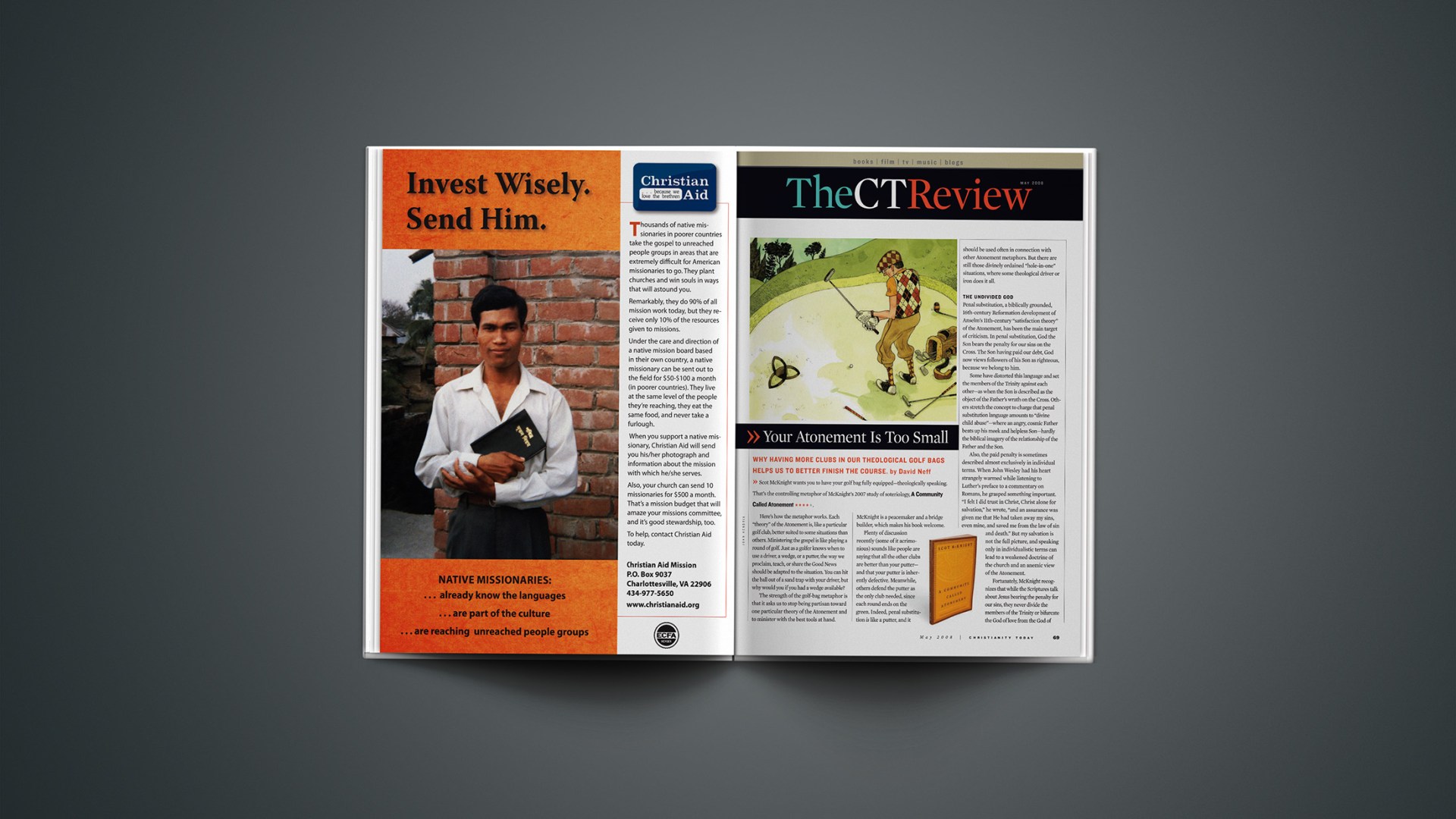

Scot McKnight wants you to have your golf bag fully equipped—theologically speaking. That’s the controlling metaphor of McKnight’s 2007 study of soteriology, A Community Called Atonement (4 stars).
Here’s how the metaphor works. Each “theory” of the Atonement is, like a particular golf club, better suited to some situations than others. Ministering the gospel is like playing a round of golf. Just as a golfer knows when to use a driver, a wedge, or a putter, the way we proclaim, teach, or share the Good News should be adapted to the situation. You can hit the ball out of a sand trap with your driver, but why would you if you had a wedge available?
The strength of the golf-bag metaphor is that it asks us to stop being partisan toward one particular theory of the Atonement and to minister with the best tools at hand. McKnight is a peacemaker and a bridge builder, which makes his book welcome.
Plenty of discussion recently (some of it acrimonious) sounds like people are saying that all the other clubs are better than your putter—and that your putter is inherently defective. Meanwhile, others defend the putter as the only club needed, since each round ends on the green. Indeed, penal substitution is like a putter, and it should be used often in connection with other Atonement metaphors. But there are still those divinely ordained “hole-in-one” situations, where some theological driver or iron does it all.
The Undivided God
Penal substitution, a biblically grounded, 16th-century Reformation development of Anselm’s 11th-century “satisfaction theory” of the Atonement, has been the main target of criticism. In penal substitution, God the Son bears the penalty for our sins on the Cross. The Son having paid our debt, God now views followers of his Son as righteous, because we belong to him.
McKnight recognizes that while the Scriptures talk about Jesus bearing the penalty for our sins, they never divide the members of the Trinity or bifurcate the God of love from the God of wrath.
Some have distorted this language and set the members of the Trinity against each other—as when the Son is described as the object of the Father’s wrath on the Cross. Others stretch the concept to charge that penal substitution language amounts to “divine child abuse”—where an angry, cosmic Father beats up his meek and helpless Son—hardly the biblical imagery of the relationship of the Father and the Son.
Also, the paid penalty is sometimes described almost exclusively in individual terms. When John Wesley had his heart strangely warmed while listening to Luther’s preface to a commentary on Romans, he grasped something important. “I felt I did trust in Christ, Christ alone for salvation,” he wrote, “and an assurance was given me that He had taken away my sins, even mine, and saved me from the law of sin and death.” But my salvation is not the full picture, and speaking only in individualistic terms can lead to a weakened doctrine of the church and an anemic view of the Atonement.
Fortunately, McKnight recognizes that while the Scriptures talk about Jesus bearing the penalty for our sins, they never divide the members of the Trinity or bifurcate the God of love from the God of wrath. Whatever took place at the Cross, it was a unitary act of the whole Trinity—and it was intended to redeem a community of faith.
Thus, John Stott could devote a chapter of his magnum opus, The Cross of Christ, to “The Self-Substitution of God.” And the apostle Paul could write about God setting forth his own hilasterion (a Greek word that means “something that makes someone happy,” but that is also a technical term for the place on the Ark of the Covenant where Israel’s chief priest sprinkled sacrificial blood). Paul clearly stressed that any appeasement is God’s self-appeasement. Self-appeasement? Such language is enigmatic, signaling that Paul wanted to get at something bigger and more mysterious than the picture often portrayed by those who preach penal substitution.
Wide-angle Lens
But A Community Called Atonement is not just a bridge-building book. It is also an expand-your-vision book. To parody J. B. Phillips’s famous title, this book could have been called Your Atonement Is Too Small.
Classic evangelical writers tended to use the word Atonement to refer to what Jesus accomplished in his death on the Cross. When most of these expositors wanted to talk about the bigger picture, they used a phrase like “the plan of salvation.”
Unfortunately, when the word Atonement is used that narrowly, it’s easy to miss the broad reach of God’s atoning activity. God was in Christ reconciling you and me to himself. But that’s not all. Paul also says that God was in Christ reconciling the entire kosmos to himself.
McKnight’s gaze follows the way Paul focuses his wide-angle lens. McKnight reviews the various metaphors, pictures, and theories of Atonement implicit in Scripture and looks for the big picture. Taking themes expounded by the earliest church fathers—victory, ransom, recapitulation—he wraps them together into one package called “identification for incorporation.”
It works like this: In Christ, God identified with the descendants of Adam to the point of experiencing an ignominious death. He was raised to new life so that he, the new Adam, might incorporate members of the fallen race into a new humanity. He became what we were so that we might become what he is. The creator God re-creates, in other words, but he does so in a way that does not leave the old creation to languish in sin and brokenness.
This broad-horizon approach to Atonement requires a corporate understanding of humanity and of the church. And that is the point of McKnight’s title: A Community Called Atonement. It also requires a missional understanding. In 2 Corinthians, Paul writes that as a result of God’s reconciling the world to himself, the members of his church are given a ministry of reconciliation. God’s reconciling action and our shared ambassadorial role are bound tightly together in Paul’s thought. God does not simply reconcile us to himself. He does so with the purpose of making us his agents of reconciliation.
McKnight’s call to see Atonement in a bigger context is nothing less than a call to mission, a mission of participation in the reconciling work of God.
David Neff, editor in chief of Christianity Today
Copyright © 2008 Christianity Today. Click for reprint information.
Related elsewhere:
A Community Called Atonement is available from ChristianBook.com and other book retailers.
McKnight blogs at JesusCreed.org.
Other Christianity Today articles on the Atonement include:
Cross Purposes | Biggest Christian conference splits amid growing Atonement debate. (July 2, 2007)
Nothing But the Blood | More and more evangelicals believe Christ’s atoning death is merely a grotesque creation of the medieval imagination. Really? (May 2006)
A Multifaceted Gospel | Why evangelicals shouldn’t be threatened by new tellings of the Good News. By Al Hsu (Apr. 10, 2008)
Our sister publication, Books & Culture , ran a series on the atonement:
Violence and the Atonement | Perhaps no doctrine has been more central to evangelical theology, yet today among evangelicals, as among orthodox Christians more generally, one often hears that the classical understanding of this doctrine is deeply flawed, that we must “rethink the atonement.” Is that really so? By Richard J. Mouw (January 1, 2001)
The Disappearance of Punishment | Metaphors, models, and the meaning of the Atonement. By Hans Boersma (March 1, 2003)
The Meaning of Christ’s Suffering | Graphic meditation on Christ’s suffering doesn’t appear before the late medieval era, approximately the 14th century. Before that, the presentation is more in accord with the way Christ appears in the Gospel of John. In iconography, he reigns serene from the Cross, a victorious conqueror who has rescued us from Death. By Frederica Mathewes-Green (March 1, 2004)
Antonement: The Penal View? | Toward a trinitarian theology of atonement. By Stephen N. Williams (January 1, 2005)
Christianity Today articles by Scot McKnight include:
Five Streams of the Emerging Church | Key elements of the most controversial and misunderstood movement in the church today. (Jan. 19, 2007)
The 8 Marks of a Robust Gospel | Reviving forgotten chapters in the story of redemption. (Feb. 29, 2008)
The Mary We Never Knew | Why the mother of Jesus was more revolutionary than we’ve been led to believe. (Nov. 28, 2006)
Performing Orthodoxy | The Hermeneutics of Doctrine argues that belief is as much about embodiment as affirmation. (Mar. 26, 2008)