Day 2, October 30, 2008
The morning began with New York City heaving its traffic in the normal way. With cameras tagging along, Hitchens and Wilson found themselves a coffee shop and settled into conversation. But before long, they were shuffled into a cab, and were off grid-locking their way to a heliport, a chopper to Philadelphia, and a debate at Westminster Theological Seminary.
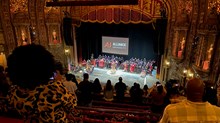
The Phillies had won the World Series the day before, and it was evident everywhere in the city—even in Van Till Hall, the venue for the debate. Phillies jerseys, tees, and caps were crowded in beyond the room's capacity. Both men were given Phillies hats beforehand and Wilson produced his early on, promising the audience that he would put it on if he began to lose the debate (as a sure-fire way to win back the crowd).
After two days of travel and laughter, agreement and disagreement, meals and missed meals (in plenty and in want), the men began their debate with a stronger mutual rapport than the previous day. They both drew laughter from the audience throughout the discussion, but also regular laughter and acknowledgement from each other.
Substantively, Wilson began by claiming that if you deny the existence of God, you banish any standard of beauty or aesthetic criticism from the world. Nothing is more beautiful than anything else. In response (and ironically) Hitchens waxed eloquent about the marvels of reality. He became positively poetic as he paid tribute to stars and black holes and what he believes to be the inevitable destruction of our planet (at the hands of the Andromeda Galaxy).
But he didn't stop at poetry. When describing the Event Horizon of a black hole, he ceased to sound like a rationalist and began to sound more and more like a mystic—referring to the transcendent majesty of the thing itself (as it is imagined by some modern scientists) and reveling in the sci-fi idea of being able to simultaneously see both the past and the present, standing and ceasing to exist at that brink where space and time and light descend into darkness. It was odd, coming from the empirical rationalist, and he seemed unable to believe that in Christians, such thoughts (or visions) would stir up the desire to worship and obey the Artist behind such astonishing art.
Christopher Hitchens and Douglas Wilson both marvel at the same creation, and they turn to the same words and poetry to describe that creation and its effect on them. The difference, and never so stark as in this debate, is that one man reacts into extreme gratitude and thankfulness for the marvels of reality, while the other struggles to prevent that reaction, but is unable to even check his use of religious language and vocabulary in doing so.
Copyright © 2008 Christianity Today. Click for reprint information.
Related Elsewhere:
Hitchens and Wilson are promoting their book, Is Christianity Good for the World?, which began as a debate on Christianity Today's website.
The first day's dispatch focused on enemies.
CT also has a special section on atheism.







Support Our Work
Subscribe to CT for less than $4.25/month