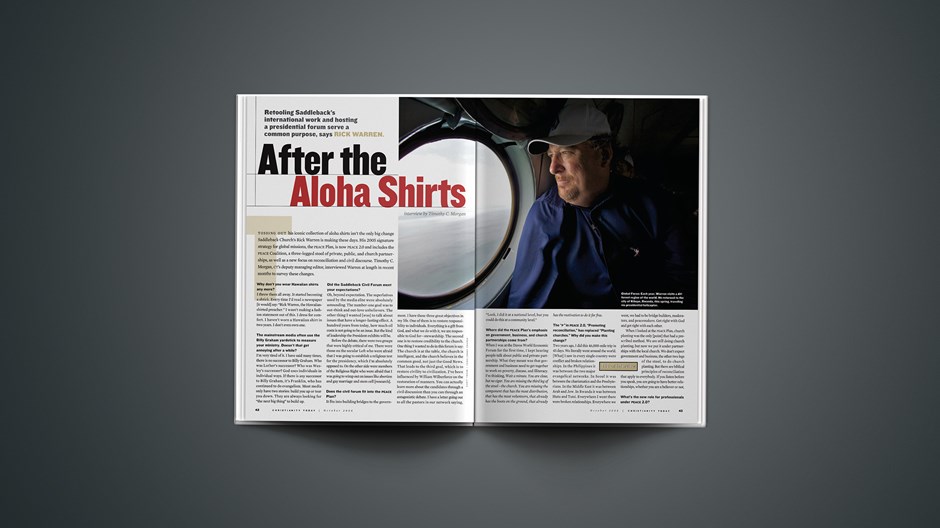
Tossing out his iconic collection of aloha shirts isn't the only big change Saddleback Church's Rick Warren is making these days. His 2005 signature strategy for global missions, the PEACE Plan, is now PEACE 2.0 and includes the PEACE Coalition, a three-legged stool of private, public, and church partnerships, as well as a new focus on reconciliation and civil discourse. Timothy C. Morgan, CT's deputy managing editor, interviewed Warren at length in recent months to survey these changes.
Why don't you wear Hawaiian shirts any more?
I threw them all away. It started becoming a shtick. Every time I'd read a newspaper [it would] say: "Rick Warren, the Hawaiian-shirted preacher." I wasn't making a fashion statement out of this. I dress for comfort. I haven't worn a Hawaiian shirt in two years. I don't even own one.
The mainstream media often use the Billy Graham yardstick to measure your ministry. Doesn't that get annoying after a while?
I'm very tired of it. I have said many times, there is no successor to Billy Graham. Who was Luther's successor? Who was Wesley's successor? God uses individuals in individual ways. If there is any successor to Billy Graham, it's Franklin, who has continued to do evangelism. Most media only have two stories: build you up or tear you down. They are always looking for "the next big thing" to build up.
Did the Saddleback Civil Forum meet your expectations?
Oh, beyond expectation. The superlatives used by the media elite were absolutely astounding. The number-one goal was to out-think and out-love unbelievers. The other thing I wanted [was] to talk about issues that have a longer-lasting effect. A hundred years from today, how much oil costs is not going to be an issue. But the kind of leadership the President exhibits will be.
Before the debate, there were two groups that were highly critical of me. There were those on the secular Left who were afraid that I was going to establish a religious test for the presidency, which I'm absolutely opposed to. On the other side were members of the Religious Right who were afraid that I was going to wimp out on issues like abortion and gay marriage and stem cell [research].
Does the civil forum fit into the PEACE Plan?
It fits into building bridges to the government. I have these three great objectives in my life. One of them is to restore responsibility to individuals. Everything is a gift from God, and what we do with it, we are responsible to God for—stewardship. The second one is to restore credibility to the church. One thing I wanted to do in this forum is say: The church is at the table, the church is intelligent, and the church believes in the common good, not just the Good News. That leads to the third goal, which is to restore civility to civilization. I've been influenced by William Wilberforce on the restoration of manners. You can actually learn more about the candidates through a civil discussion than you can through an antagonistic debate. I have a letter going out to all the pastors in our network saying, "Look, I did it at a national level, but you could do this at a community level."
Where did the PEACE Plan's emphasis on government, business, and church partnerships come from?
When I was at the Davos World Economic Forum for the first time, I kept hearing people talk about public and private partnership. What they meant was that government and business need to get together to work on poverty, disease, and illiteracy. I'm thinking, Wait a minute. You are close, but no cigar. You are missing the third leg of the stool—the church. You are missing the component that has the most distribution, that has the most volunteers, that already has the boots on the ground, that already has the motivation to do it for free.
The "p" in PEACE 2.0, "Promoting reconciliation," has replaced "Planting churches." Why did you make this change?
Two years ago, I did this 46,000-mile trip in 45 days. We literally went around the world. [What] I saw in every single country were conflict and broken relationships. In the Philippines it was between the two major evangelical networks. In Seoul it was between the charismatics and the Presbyterians. In the Middle East it was between Arab and Jew. In Rwanda it was between Hutu and Tutsi. Everywhere I went there were broken relationships. Everywhere we went, we had to be bridge builders, moderators, and peacemakers. Get right with God and get right with each other.
When I looked at the PEACE Plan, church planting was the only [point] that had a prescribed method. We are still doing church planting, but now we put it under partnerships with the local church. We don't expect government and business, the other two legs of the stool, to do church planting. But there are biblical principles of reconciliation that apply to everybody. If you listen before you speak, you are going to have better relationships, whether you are a believer or not.
What's the new role for professionals under PEACE 2.0?
The role of professionals is to train amateurs. When a dentist says, "I'd like to go to Latin America and pull teeth," that's great. That's addition. I'd like him to go to Latin America and train people how to pull teeth. It's not just addition—it becomes multiplication. In the Great Commission, Jesus says, "And teach them to do all things I've commanded you." He doesn't say, "Do it for them." He says, "Teach them to do." PEACE is all about teaching them to do.
Article continues below
There are three key words in 2.0: Scalable. Sustainable. Reproducible. We never sacrifice sustainability or reproducibility or scalability for speed. The faster way to do it is always to do it yourself.
Is the career missionary obsolete?
We need far more missionaries than we have right now. What we need is in addition to that. We need an amateur movement out of love. We have to remember that in the first 300 years of the church, it was pretty much all amateurs. Paul and Barnabas were sent out by a church. It was local churches sending out their people to go around the world. My prayer is that we will work hand in hand. The expertise of missionaries can be used and multiplied.
There are more than 1 billion Roman Catholics and Orthodox believers. Where do they fit in?
We need to mobilize a billion Catholics and Orthodox [believers]. I'm not really that interested in interfaith dialogue. I am interested in interfaith projects. Let's do something together. You are probably not going to change your doctrinal distinctives, and I'm probably not going to change my doctrinal distinctives. We have different beliefs. But the fact is, we do serve the same Lord. Let's work on the things we can agree on.
At Saddleback's PEACE summit in May, you spoke about what you call a "new wineskins" model for Christian leaders. What did you mean by that?
The essence of the new wineskins concept is that hierarchy is going to be replaced by network. The organization of the future of Christianity is the network. PEACE is a framework and a network for global missions. It's not my framework. All I am saying is: Let's do it the way Jesus did it. The lesson of Jesus is: I do it and you watch. Stage two is: You do it and I watch. Stage three is: I'm out of here and you're doing it on your own.
Every time the Word of God has been taken into a new technology, there is renewal, revival, or a reformation. Now we've got the Internet. I can talk to somebody in Sri Lanka as easily as I can talk to you. PEACE is also a network in which local churches can now work with each other instead of being in denominational silos. It allows collaboration in global missions that we could never have done before.
Article continues below
Scholars and critics of the PEACE Plan say it has the same limitations as short-term missions in not significantly improving the lives of needy people or bringing lasting change in the lives of ministry volunteers.
We expect criticism. Any time you are starting a new way, the existing organization is going to oppose it. We talk about six renewals: personal, relational, cultural, structural, missional, and institutional. Institutions are never the source of innovation. The purpose of institutions is to preserve the innovation of the previous generation. Now there's nothing wrong with that. The purpose of an institution is to preserve continuity and not to create new things. Look at a tree: all of the growth happens on the newest branches. I see things like seminaries and institutions as the trunk. But the new fruit is going to be out there on the new branches.
Are you talking about more synergy and creative tension between innovators and institutions?
That's exactly what I'm talking about. The institutions' role is to provide stability, continuity, and historical memory. Christianity is not rootless. The PEACE Plan is not really new. It's going back to the first century. So rather than spending time attacking the PEACE Plan or saying, "Well, it's not going to work," how about lending your expertise? Or, "Here's the lesson of history that you might want to remember, and by the way, here were some of the mistakes that came along in previous efforts."
The role of NGOs [nongovernmental organizations] has been vital. But it's a drop in the bucket compared to what we could be doing if we had mobilized the entire church. The parachurch needs to support the church. Unfortunately, for many years, it has been the opposite. The church supported the NGO, provided money, provided members, provided creativity. The NGO got credit.
Get down to the bottom line. Who gets the credit? Who gets strengthened? Who's the hero? Not Saddleback Church, not the PEACE Plan. We want the local church in a village to be the hero. The more I honor the church, the more God blesses me.

















 While we pray for peace, we need moral clarity about this war.
 Alcoholism among women is rising. Can the church help?
 Drake and Kendrick Lamar’s rivalry reveals our craving for controversy—and what’s lost when community is based on shared hatred, not love.