Igor Stakhovskiy cracks jokes and blinks furiously as his car, loaded down with eight passengers, inches up a hill at walking speed. His is one of the few cars in Kyiv* that is not a bright, sleek Toyota Jazz or a new black Volkswagen—it's a pastor's car. Once it reaches the summit and starts rattling down the hill toward his apartment, Igor resumes telling me about his call to ministry and the little evangelical church he pastors.
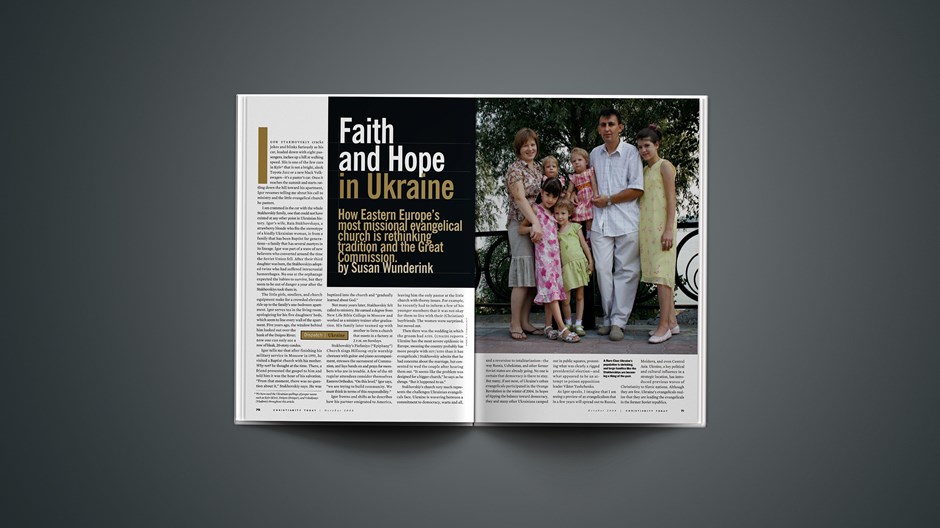
I am crammed in the car with the whole Stakhovskiy family, one that could not have existed at any other point in Ukrainian history. Igor's wife, Raia Stakhovskaya, a strawberry blonde who fits the stereotype of a kindly Ukrainian woman, is from a family that has been Baptist for generations—a family that has several martyrs in its lineage. Igor was part of a wave of new believers who converted around the time the Soviet Union fell. After their third daughter was born, the Stakhovskiys adopted twins who had suffered intracranial hemorrhages. No one at the orphanage expected the babies to survive, but they seem to be out of danger a year after the Stakhovskiys took them in.
The little girls, strollers, and church equipment make for a crowded elevator ride up to the family's one-bedroom apartment. Igor serves tea in the living room, apologizing for his five daughters' beds, which seem to line every wall of the apartment. Five years ago, the window behind him looked out over the bank of the Dnipro River; now one can only see a row of bleak, 20-story condos.
Igor tells me that after finishing his military service in Moscow in 1991, he visited a Baptist church with his mother. Why not? he thought at the time. There, a friend presented the gospel to him and told him it was the hour of his salvation. "From that moment, there was no question about it," Stakhovskiy says. He was baptized into the church and "gradually learned about God."
Not many years later, Stakhovskiy felt called to ministry. He earned a degree from New Life Bible College in Moscow and worked as a ministry trainer after graduation. His family later teamed up with another to form a church that meets in a factory at 2 p.m. on Sundays.
Stakhovskiy's Fiofaniya ("Epiphany") Church sings Hillsong-style worship choruses with guitar and piano accompaniment, stresses the sacrament of Communion, and lays hands on and prays for members who are in trouble. A few of the 40 regular attendees consider themselves Eastern Orthodox. "On this level," Igor says, "we are trying to build community. We must think in terms of this responsibility."
Igor frowns and shifts as he describes how his partner emigrated to America, leaving him the only pastor at the little church with thorny issues. For example, he recently had to inform a few of his younger members that it was not okay for them to live with their (Christian) boyfriends. The women were surprised, but moved out.
Then there was the wedding in which the groom had AIDS. (UNAIDS reports Ukraine has the most severe epidemic in Europe, meaning the country probably has more people with HIV/AIDS than it has evangelicals.) Stakhovskiy admits that he had concerns about the marriage, but consented to wed the couple after hearing them out. "It seems like the problem was designed for a bigger church," he says as he shrugs. "But it happened to us."
Stakhovskiy's church very much represents the challenges Ukrainian evangelicals face. Ukraine is wavering between a commitment to democracy, warts and all, and a reversion to totalitarianism—the way Russia, Uzbekistan, and other former Soviet states are already going. No one is certain that democracy is there to stay. But many, if not most, of Ukraine's urban evangelicals participated in the Orange Revolution in the winter of 2004. In hopes of tipping the balance toward democracy, they and many other Ukrainians camped out in public squares, protesting what was clearly a rigged presidential election—and what appeared to be an attempt to poison opposition leader Viktor Yushchenko.
As Igor speaks, I imagine that I am seeing a preview of an evangelicalism that in a few years will spread out to Russia, Moldova, and even Central Asia. Ukraine, a key political and cultural influence in a strategic location, has introduced previous waves of Christianity to Slavic nations. Although they are few, Ukraine's evangelicals realize that they are leading the evangelicals in the former Soviet republics.
Anatoly Prokopchuk, president of Kyiv Theological Seminary (KTS), says many Slavic nations are looking to Ukraine as an example in both religious rights and politics: "They think that if Ukraine succeeds, it will give hope that Russia [will do the same]. So we are like a touchstone, experimental country." While Ukraine's evangelicals are confident in God's power to strengthen the movement, the unique challenges they face make it unclear exactly what the Great Commission means in their context.
Article continues below
A Thinning Flock
Ukraine, a fertile steppeland crisscrossed by ancient trade routes, hasn't been independent for much of its existence. In the 800s, Scandinavians established Kyiv as the capital of Kyivan Rus', a predecessor state of Ukraine, Russia, and Belarus. The Polish-Lithuanian Commonwealth picked up the pieces of Ukraine a couple centuries after Mongols had sacked it.
Fast forward to the 19th century, when western Ukraine fell under Austrian rule, and the rest of the country was incorporated into the Russian Empire. There, the distinction between Ukrainian and Russian was blurred. During the Soviet era, the Ukrainian Soviet Socialist Republic was one of the places hardest hit by Stalin's food policies. Up to 10 million Ukrainians starved to death during the Great Famine of 1932.
It was in the late 1980s, shortly after the Chernobyl Nuclear Power Plant disaster, that Ukrainians "smelled freedom," says Vasily Lopatin, vice president of development at Odessa Theological Seminary. Even before the ussr officially fell in 1991, many Christians had already begun to feel safe enough to practice a more public faith.
Igor Agapoff of the Christian Broadcasting Network describes the mid-1990s in Eastern Europe and Russia as "a time when evangelism and growth were incredible; it surprised everybody. It was the harvest time. You could double your church size in a month in those days."
Archimandrite Cyril Hovorun of the Orthodox ChurchMoscow Patriarchate says, "The church happened to be the only authority, the only trustworthy institution in this society after the collapse of the Communist regime and the Communist Party," so seekers overwhelmed all of the existing churches.
The growing churches soon turned inward, spending their energies on discipling new converts. Evangelism nearly stopped. When the churches noticed, they cranked up outreach again. In Ukraine, however, a period of prosperity sabotaged spiritual interest, and stagnation set in.
Konstantin Goncharov, vice president of KTS, explained, "Ukraine is like a hub of Christianity in a sense because we have the largest number of churches and percentage of Christians of all Soviet countries. But if you look at how we are doing as evangelicals after all these years—almost 15 years of freedom—the statistics show a decline. It started to disturb us. Weak churches can't fulfill the Great Commission."
Article continues below
Many seminaries that sprang up during the mid-1990s are dying. They are having trouble recruiting students and teachers, although there is great need for theological education. On top of that, there is a noticeable split among evangelical ranks.
Thawing out Tradition
On a Saturday morning, all of the national monuments in Kyiv are flocked with brides. They pose in front of war memorials and outlooks over the Dnipro, hitch up their skirts, and continue on to the next monument. Everyone who is out and about seems to be 20-something with an edgy haircut and jeans. But in one of the wedding parties, a middle-aged Slavic woman in a dark skirt and headscarf is conspicuous.
She is sticking to the dress code of many older evangelical churches—plain fabrics, skirts and scarves for women, dark pants for men—a style far more striking in the cities than in rural areas. It identifies a subculture of traditional Christians, setting them apart from the business-casual masses. Slightly anachronistic clothing is a matter of holiness for many Christians, who say it is part of the battle against worldliness and dissolution.
But to many of those who grew up in traditional Protestant churches under persecution, as well as to those who converted after the fall of Communism, the clothing symbolizes insularity. It's not just that many Protestant traditions were formed during a completely different era; it's that they never worked, says Prokopchuk, a third-generation Baptist.
"We were nearly destroyed in Soviet times," he says. "People think it was a holy time. But when I look back I say, 'We didn't gain, we lost.' It was not so evangelical, not so holy, but it was family-like. People want to stay in this kind of frozen condition."
Michael Cherenkov was a fourth-generation member of such a church. He still has the dark pants and strait-laced demeanor, but he no longer fellowships with the church. He earned its disapproval by pursuing higher education.
Two PhDs away from his upbringing, Cherenkov is gaining recognition for his work with the Association for Spiritual Renewal ministry. He says evangelicals need a new theology: "not a theology of duplication or past tradition, but a theology of change." He argues that they need "social evangelism, not internal spirituality," especially in reaching out to Ukrainian youth.
"We can combine church traditions in Ukraine and the new situation in society and the church. We can find a balance between future and past." But that can be done "only by young leaders," he says.
Article continues below
Being Slavic
During Kyiv's mayoral elections last May, one political party handed out flyers opposing a candidate who attended Nigerian pastor Sunday Adelaja's Embassy of God Church. The fliers read, "It's shameful that in the capital of an Orthodox country, the mayor should be a member of a cult [sektant, the catchall term for cults and non-Orthodox denominations]." Other fliers showed the candidate next to Adelaja, whose mouth and eyes were wide open as he preached. The message was clear: Evangelicals are not just crazy but also unpatriotic.
In a country where 82 percent of the population claims to be Christian, evangelicals are still considered oddities. Sergiy Sannyakov, executive director of the Euro-Asian Accrediting Association, says they probably make up one to two percent of the total population, with between 460,000 and 910,000 adherents. The Ukrainian media, Cherenkov laments, characterizes evangelical churches as "totalitarian sects" who turn normal people into "zombies" who then "make Ukrainian politics." Increased prominence during the Orange Revolution, due in part to Yushchenko's appointment of former Baptist pastor Olexander Turchinov as head of the state security organization, has been partly responsible for this skewed view of evangelicals. One of evangelicals' PR tasks is to set the record straight about who they are and how they fit into a Christianized nation.
The apostle Andrew is said to have landed on Ukraine's Black Sea shores and spread the gospel as far north as Kyiv by A.D. 55. But the region was still officially pagan in the 10th century, when Volodymyr the Great converted and compelled the citizens of Kyiv to be baptized in the Dnipro River. Eastern Orthodoxy soon became the majority religion of the region. Since then, Christian influence from Catholic Rome, Counter-Reformation Poland, Protestant Germany, and, after a couple of centuries, the U.S. and other Western nations, spread into the region.
Eastern Orthodoxy is divided among more than three bodies in Ukraine, and accounts for some 80 percent of the nation's Christians. Eastern-rite Catholics, Pentecostals, Baptists, and others make up the rest of its Christian presence. Neo-charismatic churches with international connections, such as Hillsong Kyiv and Embassy of God—the largest evangelical church in Europe, claiming 25,000 in weekly attendance—have an impressive following but remain independent.
Article continues below
The influence of American Christians is a tender spot for many Ukrainian evangelicals. Some organizations, such as SEND International and Campus Crusade, had a presence in the country before it was legal for missionaries to be there. Ukrainian church leaders almost universally express gratitude for the people, funding, and resources that have come from U.S. ministries. But they sometimes seem to regret that a missionary presence has reinforced a view of evangelicalism as an American cultural imposition.
Evangelicals who reject the traditional Protestant subculture are still looking for a distinct Christian identity. Some are embracing Orthodox traditions to embody an evangelicalism that is compatible with an indigenous Slavic faith. Others, such as Stakhovskiy's church and Kyiv Theological Seminary, acknowledge that people can be born again within the Orthodox and Catholic churches, and try to remind everyone of their ethnic context.
Sergei Tereschenko, academic dean of KTS, says, "We have this Western style of worship with the loud music, but we are in an Orthodox country."
Both evangelical and Orthodox leaders acknowledged tensions but expressed a longing for unity. Archimandrite Hovorun says several denominations work together in social ministries. But that kind of cooperation is likely all they will see for some time.
Tereschenko once helped pay for a relative's Orthodox burial, even though one of the main points of the funeral sermon was the hopelessness of salvation outside the Orthodox Church and the uselessness of evangelicalism. Prokopchuk refers to an incident when a KTS alumnus's car was blown up. He attributes the attack to anti-evangelical sentiment. But both he and Tereschenko give counterexamples of Orthodox priests who are friendly toward evangelical preachers.
Teaching their students to respect Slavic religious tradition by showing love and not hostility—even when they receive hostility—is a matter of obedience to Christ, Tereschenko says.
For all the challenges evangelicals face, they remain robustly evangelistic. Richard Strahm, who teaches at KTS through SEND International, is impressed with how quickly Ukrainian evangelicals went from being underground to missionary. "As soon as freedom came, they were ready to go, plant churches, and evangelize," he says.
Catherine Wanner, an associate professor at Penn State who has studied Ukraine's evangelicals for over a decade, says that freedom has a lot to do with Ukraine's government. "For starters, the laws and the bureaucracy in Ukraine have created circumstances that are far more conducive to missionizing, and they're far more welcoming of the arrival of missionaries and religious leaders from elsewhere, as well as the arrival of humanitarian aid and allowing local religious organizations to distribute that aid." That freedom is likely to continue, she says.
Article continues below
"If you would even look at the churches in Russia [of all denominations], more than 50 percent are led by Ukrainians," says Steve Weber, regional director of CBN WorldReach in Kyiv. Agapoff adds that of the new churches in Russia, that statistic could be as high as 80 percent. Ministry leaders such as Cherenkov, Prokopchuk, and Sannyakov can rattle off a list of far-flung places where they have church plants: Spain, India, Italy, England, Turkey, Indonesia, Thailand, Turkmenistan, Abkhazia, India, Portugal, the Baltic states, and even China. Many of these missionaries go straight to the Ukrainian diaspora, in which there is already a common language and a shared culture. Missions to Muslim populations are also picking up speed. "I think I know of at least 50 people last summer [who] went to Kazakhstan or Russia or Kyrgyzstan. And that's the big target right now, all the Muslim nations around," says Strahm.
But the model at home and abroad needs to be subtle, says Cherenkov: "We need new, legal models of ministry that are appropriate in the new situation: not direct evangelism but humanitarian help and work with high-risk groups." First Baptist Church of Odessa's slew of social ministries may be the kind Cherenkov has in mind. The 130-year-old fellowship is bridging the gap between its past and future. It has had to adapt before.
"It had been a factory," says First Baptist's youth minister, Sergei Bezvershenko, describing a building the government permitted the congregation to rent. "We went in to have a look around and saw that there was a layer of blue dust on everything. The factory had manufactured a special type of paint, and the dust was poisonous." But the church took the building, cleaned it up, and met there until 1996. When perestroika was declared, First Baptist had about 100 members.
More than 17 years after Ukraine gained independence, the church is breathing easy, although like most Ukrainians, they emphasize that they don't take their freedom for granted. They use their new brick building with the steeple on top as often as possible. They now have about 1,000 members, with a healthy proportion of people of all ages. (Balance is uncommon, with contemporary churches very young-adult-heavy and older churches very senior-citizen-heavy.) And they are also engaged with their community and even with civic government.
Article continues below
Bezvershenko is proud of his 15-passenger van ("the only one like it in Odessa"), which he uses for his chaplaincy to sailors through the International Sailors' Society. He parks it at the curb in front of the church, and we go up the staircase to the church's 4th-floor office. While the choir in the sanctuary sings hymns in four-part harmony, First Baptist's lead pastors, Vladimir Parfenenko and Bezvershenko, hop up to gather brochures and photos as they describe their many ministries.
First Baptist is involved in as many ministries as a U.S. megachurch. It used to work with Joni and Friends to distribute wheelchairs to disabled children; it hosts children from unstable homes for a Christmas concert; its choirs perform for all kinds of charity events; and its members visit the sick in hospitals (especially in connection with the ministry to sailors) and do AIDS education in schools. All of this is in addition to First Baptist's Sunday school classes, multiple choirs, prayer meetings, and four weekly services.
Newer churches, even very small ones, have also caught the social-ministry bug. Most speak of ministries to street children and substance abusers.
Others take on AIDS—a much edgier calling. "It's a painful question for us," says Alexandr Zigalenko, president of Kremenchuk Bible College. "On the state level, very little is being done. The church is hesitant about it. But we have to expect that people with AIDS will join our churches, and we need to be prepared to deal with them. There is a growing understanding that people with AIDS are just people."
Embassy of God's Ludmila Gannoha directs the church's center for addiction recovery. Over 80 percent of the people coming to the center have AIDS, usually due to intravenous drug use. The center, run mainly by volunteers, incorporates multiple recovery methods, including a 12-step program and sports therapy. Gannoha says everything is based on the Bible, which is one explanation for the ministry's high success rate. Another is the way it involves families.
Article continues below
Gannoha also directs the Women's and Mother's Movement against Immorality, one of Embassy's activist arms. Embassy members take to the streets to oppose racism, homosexuality, and AIDS. That church has introduced a more confrontational approach to these issues, which urban Ukrainians, who see themselves as cosmopolitan and tolerant, are not sure they like.
A Healthier Evangelicalism
Evangelicals also feel a great need for infrastructure, which would greatly contribute to increased theological literacy and Christian unity. KTS's Goncharov is the main force—a "hero," as Strahm calls him—behind the Healthy Church movement, which is partially inspired by the 20th-century evangelical movement in America. Goncharov says, "Sometimes we feel very uncomfortable or unwelcome, even among evangelicals. It's not healthy. How can we create a different environment where we all feel welcome and help each other feel effective? How can we be welcoming, perfecting our ministry [and] helping each other?"
Goncharov and his collaborators are mapping out the terms of fellowship among evangelicals, which is very much a task of theological education. They have seven spiritual values, starting with the absolute authority of Scripture and including others who hold orthodox theology positions, "good, strong biblical preaching," and the freedom to change or eliminate extra-biblical tradition. The initiative is growing. In the fall they hosted a conference to discuss the values.
The results of Kyiv's spring 2008 mayoral election disappointed many democrats: the incumbent, widely believed to be corrupt, was reelected. With his government splitting into factions, President Viktor Yushchenko scheduled elections for early December — about the same time NATO will determine whether to give Ukraine and Georgiamembership action plans. The election results may show whether the country is leaning toward the West (in choosing Yushchenko) or trying to keep ties with Russia (in choosing Tymoshenko Bloc). For evangelicals, the matter is complicated by Tymoshenko's record of appointing Christians to high posts.
The number of powerful denominations in Ukraine has created a sort of balance of power that protects religious rights. But if public disapproval of evangelicals grows, they may find their message rebuffed by Christians and non-Christians alike. Such a situation would make evangelism more difficult, but it's unlikely to dampen evangelicals' missionary impulse.
Article continues below
Lopatin, at Odessa Theological Seminary, says he has been impressed with American Christians' faithfulness to God. He sees this in their desire to forsake the conveniences of American life and go to a country that is hardly known and one they have never seen. He adds, "I dream about the time when Ukraine would be economically well enough to follow this example, and remember how our brothers helped us when we had a need."
The Stakhovskiys are already responding to that impulse. Even with their five girls, Igor says he and Raia are distressed over the children they see their society rejecting. He imagines they might start a home for street children. Or maybe create an organization for breaking down stereotypes against children with AIDS. "God put it in my heart, and I don't know what to do with it," Igor says.
One year after adoption, Nadezhda and Vera—"Hope" and "Faith" in English—are nearly unstoppable. They often escape the nursery corner during services. Nadezhda runs up to hug Igor's leg as he preaches one Sunday. He pauses, picks her up, and tells a short version of a story he tells often: that his family accepted the girls, believing it was what God had called them to. "We believe what God, not doctors, told us." The twins have become an encouragement to everyone who needs to see a case study of God's ability to save. On a larger scale, as Ukrainian evangelical leaders pursue their mission, they will also, in the words of Cherenkov, demonstrate that "Christ is better than stability."
Susan Wunderink is CT's international editor.
* We have used the Ukrainian spellings of proper nouns such as Kyiv (Kiev), Dnipro (Dnieper), and Volodymyr (Vladimir) throughout this article.















 While we pray for peace, we need moral clarity about this war.
 We’ve got little information on Jesus’ appearance and personality. But that’s the way God designed it.españolFrançais
 The rage of the mob is a poor substitute for real community.






