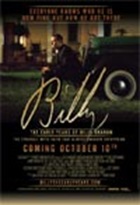
Billy Graham has appeared in many movies over the years, most of them produced by World Wide Pictures, the movie studio that he founded through his evangelistic ministry in the 1950s. But apart from a handful of parodies, no actor has ever played him before, and certainly no film has tried to show what kind of person he was prior to becoming the internationally recognized preacher that he is today. So there was lots of fertile ground for Billy: The Early Years, the first major Graham biopic, to explore. Too bad, then, that the film does such a poor job of bringing his story to life.
Directed by Robby Benson (an actor-turned-director best known for voicing the furry prince in Disney's Beauty and the Beast) from a script by William Paul McKay (who produced the miraculous-survival-of-Israel documentary series Against All Odds) and Jana Lyn Rutledge (whose résumé includes the Canadian Christian kids' show Circle Square), the film does have one brilliant idea, but squanders its potential.
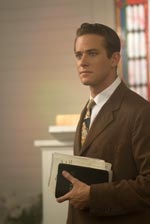
Armie Hammer as Billy Graham
The film takes its cue from Amadeus, and tells the story of Graham's life through the eyes of Charles Templeton (Martin Landau), an old, hospitalized man who worked with Graham in the early days but then lost his faith. Now, decades after abandoning the ministry, Templeton is on his deathbed and giving an interview to a reporter (Jennifer O'Neill) who wants to know what working with Graham was like.
In an ideal world, this set-up would allow the filmmakers to wrestle with questions of faith and doubt, with Graham (Armie Hammer) on one side and Templeton (the younger version of whom is played by Kristoffer Polaha) on the other. In an ideal world, this set-up would allow the filmmakers to go deeper than the typical hagiography; it would allow the modern viewer to get seriously involved in Graham's life story and the issues it raises, far more than any mere sermon could ever do.
But alas, this device never really works, for several reasons.
For one thing, despite the fact that old Templeton narrates much of the 98-minute movie, young Templeton does not share the screen with Graham until about an hour into the film (though we do get brief glimpses of the young Templeton's own preaching, which he did before meeting Graham, as an aside). So basically two-thirds of Graham's life story is narrated by a guy who wasn't even there. This gives us no opportunity to compare and contrast their characters, and it causes us to wonder why the framing device was needed in the first place.
Given that the film covers 15 years in Graham's life—from his conversion as a teen at a revival meeting in 1934 to his landmark Los Angeles crusade in 1949—perhaps the filmmakers wanted to use this device to smooth over the various transition points, as the narrative hops from one episode in Graham's life to another. But if that was the idea, it doesn't work. The movie tends to skim the various bits and pieces of Graham's life story as though it were offering a point-form synopsis of his biography, like the sidebar in an encyclopedia entry, rather than telling a story, and no amount of narration can hide the fact that the film keeps things pretty superficial.
For example, no sooner does Templeton say that Graham went to Bob Jones College, than we are suddenly sitting in Bob Jones's office, watching him chew Graham out, without any first-hand knowledge of the experiences on campus to which Jones and Graham refer. The scene seems over-the-top as Jones yells at Graham that he will "never! never! NEVER! amount to anything," and that his life apart from BJC will be nothing more than "failure! failure! and MORE FAILURE!" While Graham's autobiography—and several consultants who knew Bob Jones—confirm that the scene is accurate, it still seems overblown (and overacted) without the appropriate context.
That's but the tip of the iceberg in a screenplay that is full of extremely obvious and heavy-handed moments, a film that quickly moves from one highlight in Graham's life to the next. In fact, the BJC scene is immediately followed by a glimpse of Graham's next school, Florida Bible Institute, where the students apparently sat in class and smiled like they were in a promotional video.
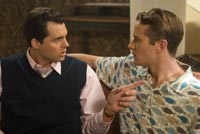
Billy and Charles Templeton (Kristopher Polaha)
I do like the scenes in which we see Graham rehearse his preaching voice, yelling and waving his arms as he steps out of the shower or walks down the hall. But when he actually preaches for the first time, things get wildly over-the-top again, as the camera rushes in on the churchgoers who clutch their Bibles and jerk their heads back as though the sheer force of Graham's voice has knocked them over.
The film is full of other head-scratchers, too. Early on in Graham's attempts to woo his Wheaton College classmate Ruth Bell (Stefanie Butler), we can hear Roy Orbison's 'In Dreams' playing in the background, presumably on the cafeteria's speakers. But wait a minute: even if this choice of song were not woefully anachronistic (the Grahams married in 1943, the song came out in 1963), would an evangelical college really have accepted secular pop music so casually back then?
Article continues below
And then there is the dialogue. When Templeton gives a big speech announcing his agnosticism, he uses awkward expressions like "I realize it to the center of my core"—and presumably also to the middle of his hub and the heart of his nucleus—and he says he can longer accept many of "the tenants, the fundamental tenants" of Christianity. (Presumably he meant "tenets".) And when Graham, disturbed by his colleague's professions of doubt, asks his mother (Lindsay Wagner) what to do, she replies with one of the oldest Hollywood clichés: "Listen to your heart, Billy."
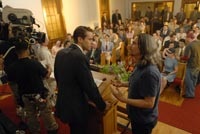
Director Robby Benson works with Hammer
Without giving too much away, the film ends on a couple of awfully muddled notes, as well. Throughout the framing narrative, old Templeton—who suffered from Alzheimer's before his death in 2001—keeps telling seemingly invisible people in the hospital to "go away," and it is only at the end that we find out what he is looking at. But then he suddenly starts saying other, happier things, as if the filmmakers wanted to end on an uplifting note and they needed him to have a deathbed conversion, rather than stay bitter—the way that Salieri did at the end of Amadeus. I haven't a clue whether there is any historical basis for this last-minute change of heart for Templeton, but as drama, this sudden, unexplained shift in tone is confusing, more than anything else.
And then there is our last image of the young Graham himself. Some of the real-life Grahams have expressed concern that a film about the preacher might draw attention away from the One being preached, and the final scene—of Graham preaching and calling on his listeners to come forward and give their lives to Christ—seems like an attempt to address that concern. But there's just one catch: the preaching in question is set at the Los Angeles crusade of 1949, which is widely recognized as the point when Graham became something of a national celebrity. So after Graham calls on his audience to come forward, the film cuts to a shot from behind his back, as he stands there with his arms outstretched, and a series of flashbulbs go off. It might be going too far to say that Graham eclipses Christ in this scene, but at the very least, the main emphasis does seem to be on Graham's newfound status as the evangelistic equivalent of a rock star.
The film does have its merits. The sets and costumes do a decent job of bringing the past to life, and Hammer does a credible Graham impression, while finding some nice bits of humor in the movie's more intimate moments, especially where Billy's relationship with Ruth is concerned. But if the script isn't up to snuff, none of the other stuff matters. And this particular screenplay is nowhere close to that.
Article continues below
Talk About It
Discussion starters
How does seeing the Billy Graham story through the eyes of an agnostic affect the way you see it? Are you drawn to his faith? Puzzled by it? Challenged by it?
One of Graham's roommates says spreading the gospel is just like selling Fuller brushes. What do you make of that analogy? Is preaching another form of salesmanship? Is it more? Always or only sometimes? Why or why not?
Several people—including Bob Jones and a woman who refuses to date Billy—tell Graham that he won't amount to anything. Do you think they could have been proven wrong even if Graham had not become famous in the end? If so, how?
What do you make of the debate between Graham and Templeton over the infallibility of the Bible and the existence of God? Do you think they should have discussed those issues before going into ministry? How do you know when you're ready enough, or secure enough in your beliefs, to minister to others?
The Family Corner
For parents to consider
Billy: The Early Years is rated PG for thematic material (discussions of faith and doubt, etc.) including some disturbing images (such as graphic footage of the Holocaust, and a bloodied child being wheeled down a hospital corridor), brief language (a "damn" or two) and smoking.














 While we pray for peace, we need moral clarity about this war.
 As my doubts about his teachings grew, so did a secret fascination with Jesus.
 The plan would organize UMC churches in four global regions, with each given more leeway around same-sex marriage and other theological issues.