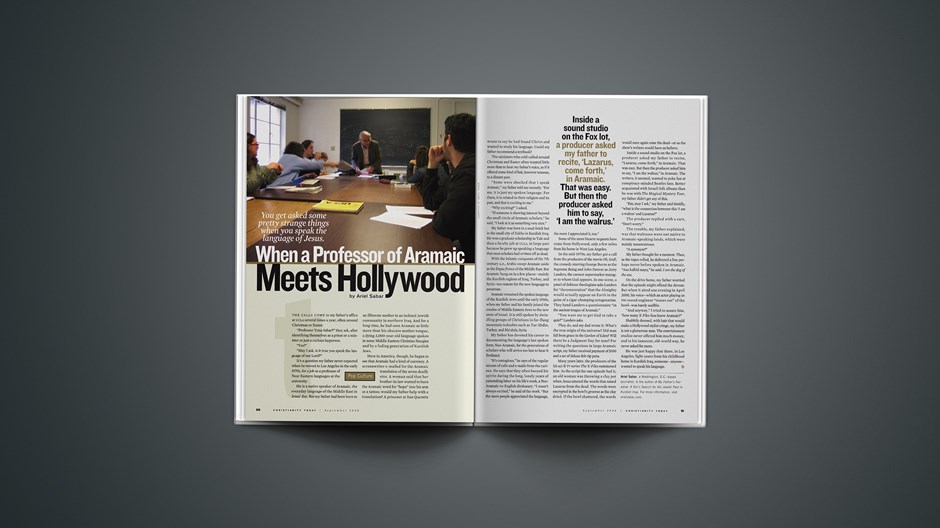
The calls come to my father's office at UCLA several times a year, often around Christmas or Easter.
"Professor Yona Sabar?" they ask, after identifying themselves as a priest or a minister or just a curious layperson.
"Yes?"
"May I ask, is it true you speak the language of our Lord?"
It's a question my father never expected when he moved to Los Angeles in the early 1970s, for a job as a professor of Near Eastern languages at the university.
He is a native speaker of Aramaic, the everyday language of the Middle East in Jesus' day. But my father had been born to an illiterate mother in an isolated Jewish community in northern Iraq. And for a long time, he had seen Aramaic as little more than his obscure mother tongue, a dying 3,000-year-old language spoken in some Middle Eastern Christian liturgies and by a fading generation of Kurdish Jews.
Here in America, though, he began to see that Aramaic had a kind of currency. A screenwriter e-mailed for the Aramaic translation of the seven deadly sins. A woman said that her brother-in-law wanted to burn the Aramaic word for "hope" into his arm as a tattoo; would my father help with a translation? A prisoner at San Quentin wrote to say he had found Christ and wanted to study his language. Could my father recommend a textbook?
The ministers who cold-called around Christmas and Easter often wanted little more than to hear my father's voice, as if it offered some kind of link, however tenuous, to a distant past.
"Some were shocked that I speak Aramaic," my father told me recently. "For me, it is just my spoken language. For them, it is related to their religion and its past, and that is exciting to me."
"Why exciting?" I asked.
"If someone is showing interest beyond the small circle of Aramaic scholars," he said, "I look at it as something very nice."
My father was born in a mud-brick hut in the small city of Zakho in Kurdish Iraq. He won a graduate scholarship to Yale and then a faculty job at UCLA, in large part because he grew up speaking a language that most scholars had written off as dead.
With the Islamic conquests of the 7th century A.D., Arabic swept Aramaic aside as the lingua franca of the Middle East. But Aramaic hung on in a few places—mainly the Kurdish regions of Iraq, Turkey, and Syria—too remote for the new language to penetrate.
Aramaic remained the spoken language of the Kurdish Jews until the early 1950s, when my father and his family joined the exodus of Middle Eastern Jews to the new state of Israel. It is still spoken by dwindling groups of Christians in far-flung mountain redoubts such as Tur Abdin, Turkey, and Ma'alula, Syria.
My father has devoted his career to documenting the language's last spoken form, Neo-Aramaic, for the generations of scholars who will arrive too late to hear it firsthand.
"It's contagious," he says of the regular stream of calls and e-mails from the curious. He says that they often buoyed his spirits during the long, lonely years of painstaking labor on his life's work, a Neo-Aramaic-to-English dictionary. "I wasn't always excited," he said of the work. "But the more people appreciated the language, the more I appreciated it, too."
Some of the more bizarre requests have come from Hollywood, only a few miles from his home in West Los Angeles.
In the mid-1970s, my father got a call from the producers of the movie Oh, God!, the comedy starring George Burns as the Supreme Being and John Denver as Jerry Landers, the earnest supermarket manager to whom God appears. In one scene, a panel of dubious theologians asks Landers for "documentation" that the Almighty would actually appear on Earth in the guise of a cigar-chomping octogenarian. They hand Landers a questionnaire "in the ancient tongue of Aramaic."
"You want me to get God to take a quiz?" Landers asks.
They do, and my dad wrote it: What's the true origin of the universe? Did man fall from grace in the Garden of Eden? Will there be a Judgment Day for man? For writing the questions in large Aramaic script, my father received payment of $100 and a set of deluxe felt-tip pens.
Many years later, the producers of the hit sci-fi TV series The X-Files summoned him. As the script for one episode had it, an old woman was throwing a clay pot when Jesus uttered the words that raised Lazarus from the dead. The words were encrypted in the bowl's grooves as the clay dried. If the bowl shattered, the words would once again raise the dead—or so the show's writers would have us believe.
Inside a sound studio on the Fox lot, a producer asked my father to recite, "Lazarus, come forth," in Aramaic. That was easy. But then the producer asked him to say, "I am the walrus," in Aramaic. The writers, it seemed, wanted to poke fun at conspiracy-minded Beatles fans. Better acquainted with Israeli folk albums than he was with The Magical Mystery Tour, my father didn't get any of this.
"Em, may I ask," my father said timidly, "what is the connection between this 'I am a walrus' and Lazarus?"
The producer replied with a curt, "Don't worry."
Article continues below
The trouble, my father explained, was that walruses were not native to Aramaic-speaking lands, which were mainly mountainous.
"A synonym?"
My father thought for a moment. Then, as the tapes rolled, he delivered a line perhaps never before spoken in Aramaic. "Ana kalbid maya," he said. I am the dog of the sea.
On the drive home, my father worried that the episode might offend the devout. But when it aired one evening in April 2000, his voice—which an actor playing an FBI sound engineer "teases out" of the bowl—was barely audible.
"And anyway," I tried to assure him, "how many X-Files fans know Aramaic?"
Shabbily dressed, with hair that would make a Hollywood stylist cringe, my father is not a glamorous man. The entertainment studios never offered him much money, and in his innocent, old-world way, he never asked for more.
He was just happy that there, in Los Angeles, light-years from his childhood home in Kurdish Iraq, someone—anyone—wanted to speak his language.















 While we pray for peace, we need moral clarity about this war.
 We’ve got little information on Jesus’ appearance and personality. But that’s the way God designed it.españolFrançais
 The government plans to close its porous border with Myanmar to boost security, separating ethnic groups that straddle the boundary.






