The resurgence of the cinematic western genre may have hit its peak last year (3:10 to Yuma, No Country for Old Men, There Will Be Blood), but it is clearly not gone yet, as evidenced by Appaloosa, a western in every sense of the word.
Adapted from the 2005 novel by crime-fiction writer Robert B. Parker, Appaloosa weaves a pretty standard yarn about the Wild West—specifically the wilds of a town called Appaloosa in the "New Mexico Territory, 1882." This town is in desperate need of some serious law-keeping, so the lily-livered civic leaders employ the services of Virgil Cole (Ed Harris, who also directs the film) and wingman Everett Hitch (Viggo Mortensen) to save the day. The hired hands are a pair of self-described "peacemakers" who roam western landscapes looking for some freelance mercenary law-keeping. They are no-nonsense and capable—entrusted by the townspeople to protect them from shady characters, especially Randall Bragg, a rancher bully with designs on controlling the town and everything in it.
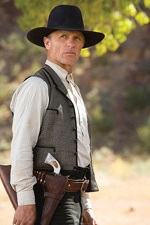
Director and star Ed Harris
Upon settling in Appaloosa as the paid lawmakers/sheriffs, Virgil and Everett immediately befriend a wayfaring woman, Ms. French (Renee Zellweger), who comes to the town from who knows where, with who knows what on her mind. She and Virgil pair off in no time, while Everett looks on with dubious eyes. Virgil, who has previously only had relationships with prostitutes and "that one Apache woman," is smitten with Ms. French for simple enough reasons: "she speaks well, chews her food nice, and cooks good." He doesn't seem to mind that Ms. French turns out to be a total player—propositioning most of the men in town, including Virgil's closest friend, Everett.
Alas, the primary romance in this movie is not between Ms. French and Virgil, but Virgil and Everett. No, not in a Brokeback Mountain way, but rather the classic pseudo-homoerotic trope of the western genre. Virgil and Everett are two men who have been doing this kind of rogue vigilante business together for a long, long time. They know each other in a deep and personal way—the sort of relationship where a particular eyebrow movement can communicate way more than words. They look out for each other, and are not about to let a woman ruin their friendship. When Ms. French asks Virgil, "Would you believe Everett over me?" Virgil unabashedly replies, "Yes, that is correct."
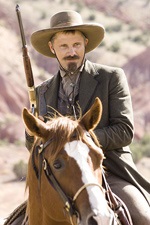
Viggo Mortensen as Deputy Everett Hitch
The re-teaming of Mortensen and Harris, who previously worked together on A History of Violence, is the film's best asset. Their buddy chemistry is crucial to this film, which hinges upon the camaraderie of its protagonist lawmen duo—a pair of men with many complimentary differences that become more evident as the film goes on.
As Virgil, Harris embodies a man who is in many ways a classic, John Wayne-esque western figure: grizzled and slightly brutish, but principled and with a heart of gold. He's uneducated, but wise in the ways of the world. He frequently must ask Everett for the proper vocabulary when he is trying to make a point—words like "obsolete" and "byproduct." Everett, meanwhile, is the quieter, double-barrel-shotgun-toting sidekick—an intelligent man who secretly wonders why we even have laws. Both are superb quick-draw gunmen, and both teeter precariously on the edge of using their talents for non-lawful purposes.
By the end of the film, Everett—the more world-weary of the two—rides off into the ultimate clichéd western movie ending (a desert sunset), but not before renouncing the notion that justice is only ever what the established society says it is. Everett has seen too much evil in the world to believe in a rational, black-and-white system of justice. In this way the films feels almost like a revisionist western like Clint Eastwood's Unforgiven. Unfortunately, Ed Harris is no Clint Eastwood.
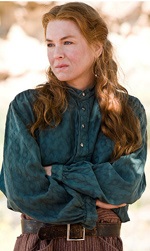
Renee Zellweger as Allison French
Herein lies the film's biggest problem: its lackluster, incoherent direction. Harris gives a noble effort, but his inexperience behind the camera (his only other directorial effort was 2000's crisper Pollock) shows itself in the film's awkward pacing and haphazard emotional tenor. At times it is a very funny, witty film; at others it is corny or even saccharine; occasionally it is deadly serious and overly subtle. The lack of a cohesive center is the biggest complaint one can offer about Appaloosa. It never feels like Harris fully understands the scope and mythical power of the western; his film travels in the superficial symbols and tropes of the genre, but doesn't pack the sort of epic punch that a John Ford film might.
Appaloosa is entertaining, certainly, but it feels rather slight and feeble next to some of its more superior recent cohorts in the western genre. It is profound in fits and starts, mainly in little lightbulb acting moments from Mortensen or Harris, but that is about the extent of it. It is evident that Harris—who co-wrote, directed, produced, and starred in the film—had something on his mind in making this film, but whatever that was did not come through.
Article continues below
I will credit Harris with one remarkable feat: playing down the violence. At a time when new westerns feel that they necessarily must be much more violent than their mid-century forebears, Appaloosa makes a daring move by including only PG-13 levels of violence. It's refreshing to know that an outlaw/shoot-em-up movie can still be made without buckets of blood. Harris rightly chose to focus on relationships and characters rather than spectacular shoot-outs and chase scenes.
It's just too bad the end result wasn't a little more interesting.
Talk About It
Discussion starters
At the end of the movie, why do Virgil and Everett make the decision that they do?
What does the presence of Ms. French reveal about the characters of and relationship between Virgil and Everett?
What is this film saying about justice? Must we always cling to the laws? Is there a place for vigilantism?
The Family Corner
For parents to consider
Appaloosa is rated R for some violence and language, but is far less "R-rated" than most films of its type. There is a fair amount of violence, but it is all relatively tame and not especially explicit. There is language as well, but not a gratuitous amount. Sexuality plays a large role in the film, but the act is never shown on screen. There is a brief scene of a man and woman bathing in a river, which includes some rear nudity. Otherwise, Appaloosa is a film that features protagonists with better-than-average principles and morals.













 While we pray for peace, we need moral clarity about this war.
 We’ve got little information on Jesus’ appearance and personality. But that’s the way God designed it.españolFrançais
 Beyoncé’s right. Whether listening to Cowboy Carter or reading theology, diversity is a good thing.