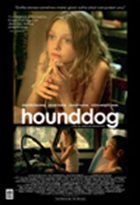
Hounddog is a tragedy of a film, and not in the sense that it strives to be. It's a tragedy, on one level, because it is quite simply an artistic disaster. But mostly it is a tragedy because of the way it uses and abuses its starring actress—the then 12-year-old Dakota Fanning.
It is not surprising that Hounddog, which caused quitea stir at the 2007 Sundance Film Festival as the "Dakota Fanning rape movie," has taken so long to find a distributor and get released. Apart from appealing to dilettante arthouse moviegoers and those drawn to controversy and, well, shocking acts of onscreen barbarism, this film has precious little in the way of mass-market appeal.
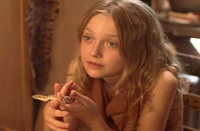
Dakota Fanning as Lewellen
Not that it isn't an ambitious effort. Director Deborah Kampmeier tries very hard to craft a Southern gothic mood piece with high art tendencies, somewhere between Flannery O'Conner and David Gordon Green (director of Southern-set art films like George Washington and Undertow). Unfortunately for Hounddog, it ends up being of closer kin to something between a bad John Grisham novel and an art school senior thesis project.
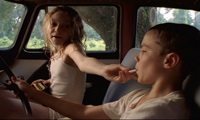
It's a shame, because there are many reasons why this could have been an interesting film. Set in the 1950s South during the days when Elvis was the talk of teen (and preteen) America, Hounddog tackles large-scale gender issues through the prism of small-town social dynamics and domestic melodrama. Fanning plays Lewellen, a 12-year-old girl from an abusive home who finds solace in blues music, particularly that of Mr. Presley. Like most people in the film, Lewellen is struggling with her sexuality, finding very few role models who might guide her through these complicated adolescent years. Her crazy father (David Morse) and grandmother (Piper Laurie) are no help, and the one older female she can relate to (Robin Wright Penn) turns out to be even more confused than she is.
Robin Wright Penn as 'Stranger Lady'
Confusion, by and large, is the word to describe this film. It is muddled with far too many thoughts and images about sex, family, religion, geography, nature, and music to be at all cohesive. The rape scene—mostly off-camera, and you only see Fanning's face and reaction—is about the most straightforward thing in Hounddog, and it comes and goes far too easily and unexamined. There is an intriguing aura of mystery that comes from the film's syncretistic blend of Christian references (Eden is the most obvious) and pagan/witchcraft elements (recalling such films as Sam Raimi's The Gift), but all it adds up to is an annoying and familiar evocation of new age spiritual floundering.
The considerable talents of Hounddog's great cast are largely squandered, with someone as forceful as Wright Penn relegated to a feeble caricature of a battered woman. As Lewellen's father, Morse is similarly weak—his character begins as a goofy parody of a beer-guzzling Southern working man and only gets goofier when, midway through the film, he is struck by lightning and reduced to a slurring, slobbering, shell of a man. Only Laurie seems to understand the ridiculousness of her role; she has a grand time portraying the world's wackiest, Bible-beating grandmother who makes a mean marmalade jam.
Of course, all eyes are on Fanning, who proves little in this film except for how tedious child acting can be when one receives too many accolades too early in life. There are impressive moments of subtlety here and there, but for the most part Fanning's performance is a textbook example of an immature actor trying too hard to be serious, "important," and "natural." Combined with a most unfortunate Southern accent and an inescapably reptilian appearance (aided in no small part by the overabundance of snakes slithering around every corner of the film), Fanning's work here is spotty at best. One hopes that this film, doubtless intended by her handlers to propel her into indie/Oscar realms, will come and go without doing too much damage to her career.
Filmmakers are trying to make Fanning grow up too fast
But beyond its unfortunate exploitation of one particularly vulnerable child actress with too many "instincts" for her age, Hounddog represents, I fear, a larger trend in culture: the "disappearance of childhood" (to borrow a phrase from Neil Postman). In many ways the film can be seen as an elegiac meditation on the loss of innocence. The kids in the film are somewhere between carefree and world-weary, with Lewellen representing the latter end of that spectrum. Her resonance with Elvis makes sense—he was himself a symbol of sexual discovery and revolution, an icon of youth mixed with previously taboo "adult" qualities (like suggestive hip shaking, which young Lewellen loves to mimic).
Indeed, the Elvis mania of the '50s was the first step in the positioning of "youth culture" as the nexus of mass-market capitalism. It was the discovery that selling sex to America's young, wrapped in the package of rock rebellion, was an unstoppable market force. Kampmeier uses this cultural shift as a fixed background in front of which she paints an abstract, fluid portrait of an array of oblique thematic concerns. It might have been better to more firmly ground her story in the "Elvis moment," however, rather than use it only in a metaphoric sense. As is, Hounddog is too crowded with ideas to be remotely coherent. (The film's website includes a list of "themes" addressed, including: motherlessness, religion, silencing, fecundity of the feminine, snake medicine, and the cycle of abuse. What?? Exactly.)
Article continues below
Films as committed to obscurity as Hounddog rarely work, and in efforts to achieve artistic mystery and subtlety they frequently come across as quite heavy-handed. Here, the heavy-handedness includes a plot that is utterly predictable, characters that are offensively stereotypical, and an overall palette that tries so hard to look Southern (sepia tones, lightning bugs, humidity, whiskey, black men with spiritual wisdom) that it winds up looking like not much at all. Likewise, for a film that talks a good deal about the spiritual and metaphysical, it is largely devoid of any sort of soul.
Talk About It
Discussion starters
What do you make of the film's spirituality? What is the lightning (bolt, bugs) imagery all about? Why is there so much snake and animal imagery?
Who are the real villains and victims in this film?
What was Lewellen seeking and why was she having such a hard time finding it?
The Family Corner
For parents to consider
Hounddog is rated R for a disturbing sexual assault of a young girl, and brief sexuality. The much-discussed rape scene is mostly off-camera, and you only see Fanning's face and reaction. Still, the mere suggestion of it is quite disturbing, and is not appropriate for children. Elsewhere in the film there is nudity and scenes of sexuality between adults, as well as disturbing images of snakes (biting humans, being killed and skinned, etc), and some profane language.














 While we pray for peace, we need moral clarity about this war.
 We’ve got little information on Jesus’ appearance and personality. But that’s the way God designed it.españolFrançais
 Beyoncé’s right. Whether listening to Cowboy Carter or reading theology, diversity is a good thing.