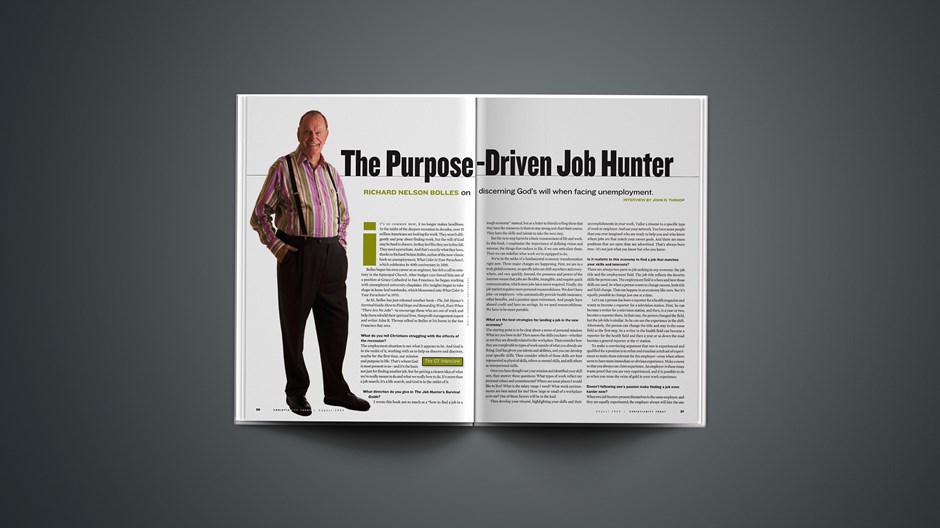
It's so common now, it no longer makes headlines: In the midst of the deepest recession in decades, over 15 million Americans are looking for work. They search diligently and pray about finding work, but the will of God may be hard to discern. So they feel like they are in free fall. They need a parachute. And that's exactly what they have, thanks to Richard Nelson Bolles, author of the now-classic book on unemployment, What Color Is Your Parachute?, which celebrates its 40th anniversary in 2010.
Bolles began his own career as an engineer, but felt a call to ministry in the Episcopal Church. After budget cuts forced him out of a position at Grace Cathedral in San Francisco, he began working with unemployed university chaplains. His insights began to take shape in loose-leaf notebooks, which blossomed into What Color Is Your Parachute? in 1970.
At 82, Bolles has just released another book—The Job Hunter's Survival Guide: How to Find Hope and Rewarding Work, Even When "There Are No Jobs"—to encourage those who are out of work and help them rebuild their spiritual lives. Nonprofit management expert and writer John R. Throop talked to Bolles at his home in the San Francisco Bay area.
What do you tell Christians struggling with the effects of the recession?
The employment situation is not what it appears to be. And God is in the midst of it, working with us to help us discern and discover, maybe for the first time, our mission and purpose in life. That's where God is most present to us—and it's the basis not just for finding another job, but for getting a clearer idea of what we're really meant to do and what we really love to do. It's more than a job search; it's a life search, and God is in the midst of it.
What direction do you give in The Job Hunter's Survival Guide?
I wrote this book not so much as a "how to find a job in a tough economy" manual, but as a letter to friends telling them that they have the resources in them to stay strong and chart their course. They have the skills and talents to take the next step.
But the next step has to be a basic reassessment of life and work. In this book, I emphasize the importance of defining vision and mission, the things that endure in life, if we can articulate them. Then we can redefine what work we're equipped to do.
We're in the midst of a fundamental economic transformation right now. Three major changes are happening. First, we are in a truly global economy, so specific jobs can shift anywhere and everywhere, and very quickly. Second, the presence and power of the Internet means that jobs are flexible, intangible, and require quick communication, which most jobs have never required. Finally, the job market requires more personal resourcefulness. We don't have jobs—or employers—who automatically provide health insurance, other benefits, and a pension upon retirement. And people have abused credit and have no savings. So we need resourcefulness. We have to be more portable.
What are the best strategies for landing a job in the new economy?
The starting point is to be clear about a sense of personal mission: What are you here to do? Then assess the skills you have—whether or not they are directly related to the workplace. Then consider how they are transferable to types of work outside of what you already are doing. God has given you talents and abilities, and you can develop your specific skills. Then consider which of these skills are best represented as physical skills, others as mental skills, and still others as interpersonal skills.
Once you have thought out your mission and identified your skill sets, then answer these questions: What types of work reflect my personal values and commitments? Where are some places I would like to live? What is the salary range I need? What work environments are best suited for me? How large or small of a workplace suits me? One of these factors will be in the lead.
Then develop your résumé, highlighting your skills and their accomplishments in your work. Tailor a résumé to a specific type of work or employer. And use your network. You have more people than you ever imagined who are ready to help you and who know where jobs are that match your career goals. And there are more positions that are open than are advertised. That's always been true—it's not just what you know but who you know.
Is it realistic in this economy to find a job that matches your skills and interests?
There are always two parts to job seeking in any economy: the job title and the employment field. The job title reflects the favorite skills the person uses. The employment field is where and how those skills are used. So when a person wants to change careers, both title and field change. That can happen in an economy like ours. But it's equally possible to change just one at a time.
Let's say a person has been a reporter for a health magazine and wants to become a reporter for a television station. First, he can become a writer for a television station, and then, in a year or two, become a reporter there. In that case, the person changed the field, but the job title is similar. So he can use the experience in the shift. Alternately, the person can change the title and stay in the same field as the first step. So a writer in the health field can become a reporter for the health field and then a year or so down the road become a general reporter at the tv station.
Article continues below
To make a convincing argument that one is experienced and qualified for a position is to refine and translate a rich set of experiences to make them relevant for the employer—even when others seem to have more immediate or obvious experience. Make a move so that you always can claim experience. An employer in these times wants proof that you are very experienced, and it is possible to do so when you mine the veins of gold in your work experience.
Doesn't following one's passion make finding a job even harder now?
When two job hunters present themselves to the same employer, and they are equally experienced, the employer always will hire the one who has the greatest enthusiasm for the job. The word enthusiasm is of Greek origin meaning, "God in us." So, a person who simply settles for a job—or is desperate for one—will find death in the job hunt. If a person is in the search with full vision and a firm conviction of God's call and design, then the search will be fruitful. We hear about all sorts of people who have lost their jobs. But we never hear that in recent months, 4.3 million jobs were filled—and that 3 million vacancies remain. Passion can get you in the unfilled job a lot faster than you might think.
How does faith play a role in the job search?
God is trying to cram as much of himself into our lives as we will allow. God wants to be in partnership with us, and to lead us into the best we can do with all that he has given us. I have a real sense of God's grace in these circumstances. He is trying to provide us the situations that can make our lives better. But we have to be in tune with God and God's call.
As Phillips Brooks, a 19th-century Episcopal priest, said, "Do not look for tasks equal to your strength, but for strength equal to your tasks." The strength, the call, and the skills are gifts from God. And when times are tough, God's grace gives us all the strength we need.
















 While we pray for peace, we need moral clarity about this war.
 We’ve got little information on Jesus’ appearance and personality. But that’s the way God designed it.españolFrançais
 The plan would organize UMC churches in four global regions, with each given more leeway around same-sex marriage and other theological issues.






