I commend President Obama for forcing the issue of health-care reform into the public debate. Our present system, still the best in the world, needs to expand coverage to the uninsured. I've seen why.
The husband of a woman in my wife's Bible study lost his job and health insurance. Though in pain, he delayed seeing a doctor for months. Finally, his father loaned him money, and he had a large tumor removed from his colon. Had the tumor been discovered earlier, his prognosis might not have been so grim. Christians are helping this family, but there's little such hope for most of the 45 million uninsured Americans.
So, while it's clear we need health-care reform, it's not clear how to implement it, or who will decide who gets medical care. A May court case illustrates this problem. A mentally retarded Georgia teenager suffering from cerebral palsy had been receiving 94 hours of in-home nursing care from Medicaid per week, until the state decided to reduce it to 84. The patient's doctor protested. Her mother sued. Then, in Moore v. Medows, arguing before the 11th Circuit Court of Appeals, the government attorney argued that the state is the "final arbiter" of medical decisions. While the court tried to find middle ground, it affirmed the government's position, stating, "A private physician's word on medical necessity is not dispositive."
This should be a warning sign for nationalizing health care: The government will make medical decisions, including, as we've seen in Canada and Britain, decisions of life and death. A British ophthalmologist who always had supported her country's National Health Service recently wrote about how a Zip Code lottery would decide the fate of her cancer-stricken father. She explained, "It is only now, sitting on the side of the patient, that I have seen the injustice inherent in our system."
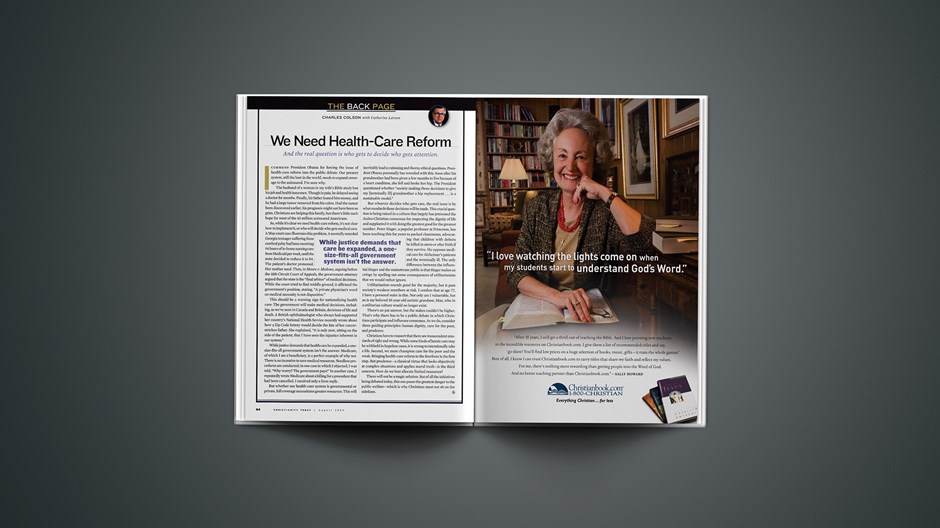
While justice demands that health care be expanded, a one-size-fits-all government system isn't the answer. Medicare, of which I am a beneficiary, is a perfect example of why not. There is no incentive to save medical resources. Needless procedures are conducted; in one case in which I objected, I was told, "Why worry? The government pays!" In another case, I repeatedly wrote Medicare about a billing for a procedure that had been cancelled. I received only a form reply.
But whether our health-care system is governmental or private, full coverage necessitates greater resources. This will inevitably lead to rationing and thorny ethical questions. President Obama personally has wrestled with this. Soon after his grandmother had been given a few months to live because of a heart condition, she fell and broke her hip. The President questioned whether "society making those decisions to give my [terminally ill] grandmother a hip replacement . . . is a sustainable model."
But whoever decides who gets care, the real issue is by what standards those decisions will be made. This crucial question is being raised in a culture that largely has jettisoned the Judeo-Christian consensus for respecting the dignity of life and supplanted it with doing the greatest good for the greatest number. Peter Singer, a popular professor at Princeton, has been teaching this for years to packed classrooms, advocating that children with defects be killed in utero or after birth if they survive.He opposes medical care for Alzheimer's patients and the terminally ill. The only difference between the influential Singer and the mainstream public is that Singer makes us cringe by spelling out some consequences of utilitarianism that we would rather ignore.
Utilitarianism sounds good for the majority, but it puts society's weakest members at risk. I confess that at age 77, I have a personal stake in this. Not only am I vulnerable, but so is my beloved 18-year-old autistic grandson, Max, who in a utilitarian culture would no longer exist.
There's no pat answer, but the stakes couldn't be higher. That's why there has to be a public debate in which Christians participate and influence consensus. As we do, consider three guiding principles: human dignity, care for the poor, and prudence.
Christians have to reassert that there are transcendent standards of right and wrong. While some kinds of heroic care may be withheld in hopeless cases, it is wrong to intentionally take a life. Second, we must champion care for the poor and the weak. Bringing health-care reform to the forefront is the first step. But prudence—a classical virtue that looks objectively at complex situations and applies moral truth—is the third concern. How do we best allocate limited resources?
There will not be a magic solution. But of all the initiatives being debated today, this one poses the greatest danger to the public welfare—which is why Christians must not sit on the sidelines.
Charles Colson was the founder of Prison Fellowship Ministries, an outreach to convicts, victims of crime, and justice officers. Colson, who converted to Christianity before he was indicted on Watergate-related charges, became one of evangelicalism's most influential voices. His books included Born Again and How Now Shall We Live? A Christianity Today columnist since 1985, Colson died in 2012.
















 While we pray for peace, we need moral clarity about this war.
 As my doubts about his teachings grew, so did a secret fascination with Jesus.
 How groups like Hillsong learned to let go of the literal in favor of creative collaboration.españolPortuguês






