Does this sound like a good idea for a movie? I can't decide. Take six women who have suffered the loss of a child. Send them together to South Africa, to work with impoverished children. In the security of each other's company, with a genuine need set before them, their grief is mitigated and healing is begun.
As therapy, it's a great idea. Director Jennifer Steinman came up with it when a friend of hers lost a son in a car accident. "It was the most excruciating and complex form of grief I had ever witnessed," she says. Later she heard that more people are living with HIV in South Africa than anywhere else on the planet. The disease is pandemic, and most families have suffered loss. It is "a nation of mourners."
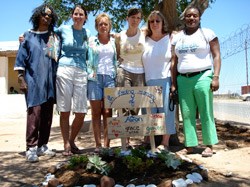
So Steinman recruited her friend and five other grieving women to undertake this project. Each had lost a son or daughter (for one participant, it was her brother). The 17-day journey to South Africa provided them with a rare opportunity to drop their guard and truly be themselves. In each local environment, everyone else had gone on with their lives; the friends of a young suicide were heading off to college. Life beckoned in myriad new ways. But for the grieving survivors time stood still, and it was a relief to be with others who would understand, who would not demand smiles and small talk.
The six moms who took the journey
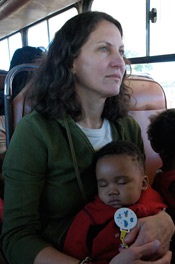
Also, the presence of small children playing, laughing, shouting, and snuggling was itself a hope-restorer. Unexpectedly, smiles began to return. At the end of the trip, the women had been refreshed and strengthened, equipped to go forward with their now less-empty lives.
A great idea for therapy, as I said, but as a movie, I'm not sure. Grief is so internally wracking that the public face can be stony, inexpressive; the grief-stricken have little interest in communicating to an outside world. So there is not a lot to watch here, not much in the way of drama. One of the mothers, Mary Helena, lost a son to a shooting and also had a stroke (she walks with a crutch). She is more enclosed than the others. In one lovely sequence we see the five other women playing cards one night, and they are laughing—incredibly enough, they are laughing. The camera then shows us Mary Helena, who is lying alone on her bed. Then we see the full moon outside her window, as one last melodious note of laughter floats up.
This is about all the character-complication that the movie has, however. Some of the other women feel strongly that Mary Helena should be challenged to break through and take advantage of the trip's opportunities for sharing and growth. As a viewer, I disagreed—wasn't the whole point that grieving mothers be allowed to be themselves? However, the approach works, and Mary Helena becomes a more-open member of the group. As far as plot goes, that's it.
Is grief just a state of mind that doesn't make for fully-engaging film? Well, picture the sequence in Gone With the Wind when Rhett and Scarlett's daughter dies; it's a terrifically strong passage in that movie. Perhaps the most volatile aspects of grieving a lost child are the tensions that result between father and mother; in Motherland, one mom says that 90 percent of marriages fail after the death of a child. (Somewould dispute that statistic.) But that particular source of conflict is absent from this movie, as the children's fathers have no role.
There's a funny sequence at an ostrich ranch, where the moms are given an opportunity to (very briefly) ride an ostrich, "at your own risk" as the management keeps insisting. There are plenty of cheerful and touching moments with the African children.
A surprising absence, however, is that there is no talk of God. At the GetReligion website, which analyzes media treatment of stories involving religion, they use the term "ghost" when religion is mysteriously absent from a story in which it is obviously a significant element. Motherland has a similar ghost, in that religion is never discussed. The women visit a church and hear rousing hymns and sermon, and there are occasional hints of faith on the part of the Africans they meet, but if they themselves took comfort in religion or felt anger toward God it was left on the cutting room floor.
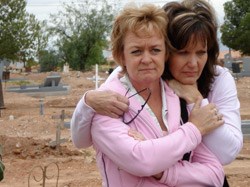
Two of the grieving moms on the trip
There are a few spiritual references, as when one mom says her son was coming into his own and about to "take wing. I didn't know that they would be angel's wings." At other points there are comments that the departed children are "all together now, smiling," and a departed daughter is exhorted to "watch over all these people" as her ashes are sprinkled. These comments indicate beliefs that have not traditionally been part of Christian faith. So it's hard to say what role spiritual beliefs or practices play in the grieving process for these women; from what we are shown, it looks like it doesn't loom large.
Motherland is a well-made documentary that handles its sensitive subject well. It's good to see the healing these women experienced as a result of their trip. Perhaps it's appropriate that such a private and profound grief would not be touched in a way that strangers and outsiders could watch. However, that does put some limits on how effective a movie on this subject can be.
Article continues below
Note: Motherland is now available to watch for $2.99 at Gigantic Digital, which brings commercial-free indie films to the internet.
Talk About It
Discussion starters
One mom speaks of her son getting angel's wings, and others comment that the children are now watching over them, seeing everything they do. Where do such opinions/beliefs come from? Are they accurate? What would the Scriptures say about this?
Though South Africans have experienced so much death that virtually every family is grieving, the children and even adults we meet seem joyous. Why do you think that is?
What was the greatest loss you ever faced? How did it change you? How did you wish other people would treat you, while you were grieving?
The Family Corner
For parents to consider
Motherland has no MPAA rating. There is nothing offensive in the film, though the subject matter would be heavy for children.













 While we pray for peace, we need moral clarity about this war.
 We’ve got little information on Jesus’ appearance and personality. But that’s the way God designed it.españolFrançais
 The plan would organize UMC churches in four global regions, with each given more leeway around same-sex marriage and other theological issues.