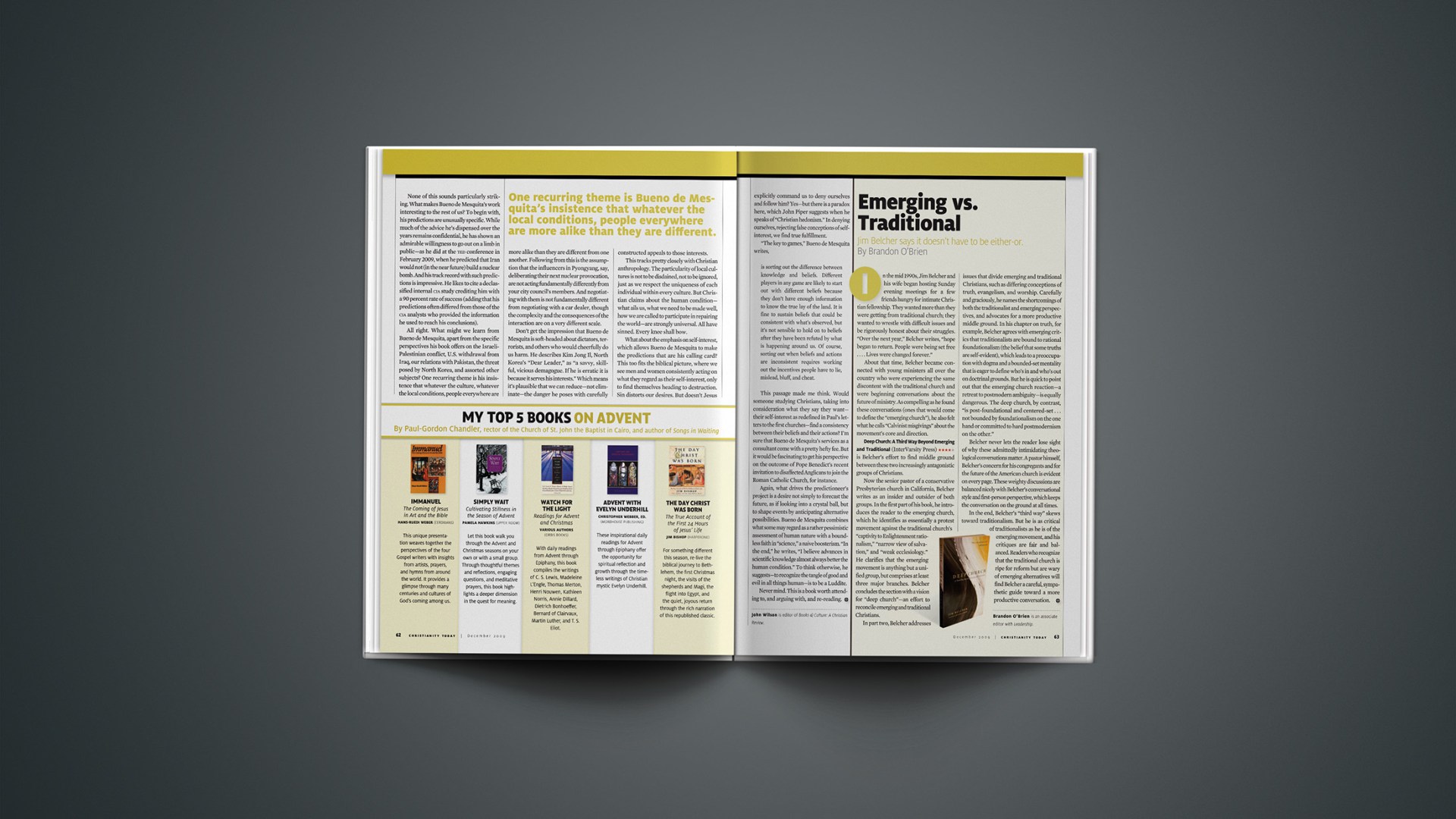

In the mid 1990s, Jim Belcher and his wife began hosting Sunday evening meetings for a few friends hungry for intimate Christian fellowship. They wanted more than they were getting from traditional church; they wanted to wrestle with difficult issues and be rigorously honest about their struggles. “Over the next year,” Belcher writes, “hope began to return. People were being set free …. Lives were changed forever.”

About that time, Belcher became connected with young ministers all over the country who were experiencing the same discontent with the traditional church and were beginning conversations about the future of ministry. As compelling as he found these conversations (ones that would come to define the “emerging church”), he also felt what he calls “Calvinist misgivings” about the movement’s core and direction.
Deep Church: A Third Way Beyond Emerging and Traditional (InterVarsity Press) is Belcher’s effort to find middle ground between these two increasingly antagonistic groups of Christians.
Now the senior pastor of a conservative Presbyterian church in California, Belcher writes as an insider and outsider of both groups. In the first part of his book, he introduces the reader to the emerging church, which he identifies as essentially a protest movement against the traditional church’s “captivity to Enlightenment rationalism,” “narrow view of salvation,” and “weak ecclesiology.” He clarifies that the emerging movement is anything but a unified group, but comprises at least three major branches. Belcher concludes the section with a vision for “deep church”—an effort to reconcile emerging and traditional Christians.
In part two, Belcher addresses issues that divide emerging and traditional Christians, such as differing conceptions of truth, evangelism, and worship. Carefully and graciously, he names the shortcomings of both the traditionalist and emerging perspectives, and advocates for a more productive middle ground. In his chapter on truth, for example, Belcher agrees with emerging critics that traditionalists are bound to rational foundationalism (the belief that some truths are self-evident), which leads to a preoccupation with dogma and a bounded-set mentality that is eager to define who’s in and who’s out on doctrinal grounds. But he is quick to point out that the emerging church reaction—a retreat to postmodern ambiguity—is equally dangerous. The deep church, by contrast, “is post-foundational and centered-set … not bounded by foundationalism on the one hand or committed to hard postmodernism on the other.”
Belcher never lets the reader lose sight of why these admittedly intimidating theological conversations matter. A pastor himself, Belcher’s concern for his congregants and for the future of the American church is evident on every page. These weighty discussions are balanced nicely with Belcher’s conversational style and first-person perspective, which keeps the conversation on the ground at all times.
In the end, Belcher’s “third way” skews toward traditionalism. But he is as critical of traditionalists as he is of the emerging movement, and his critiques are fair and balanced. Readers who recognize that the traditional church is ripe for reform but are wary of emerging alternatives will find Belcher a careful, sympathetic guide toward a more productive conversation.
Brandon O’Brien is an associate editor with Leadership.
Copyright © 2009 Christianity Today. Click for reprint information.
Related Elsewhere:
Deep Church is available at ChristianBook.com and other book retailers.
Christianity Today has a special section on the emergence of the emergent. CT has also written on ancient-future practices in “The Future Lies in the Past.”