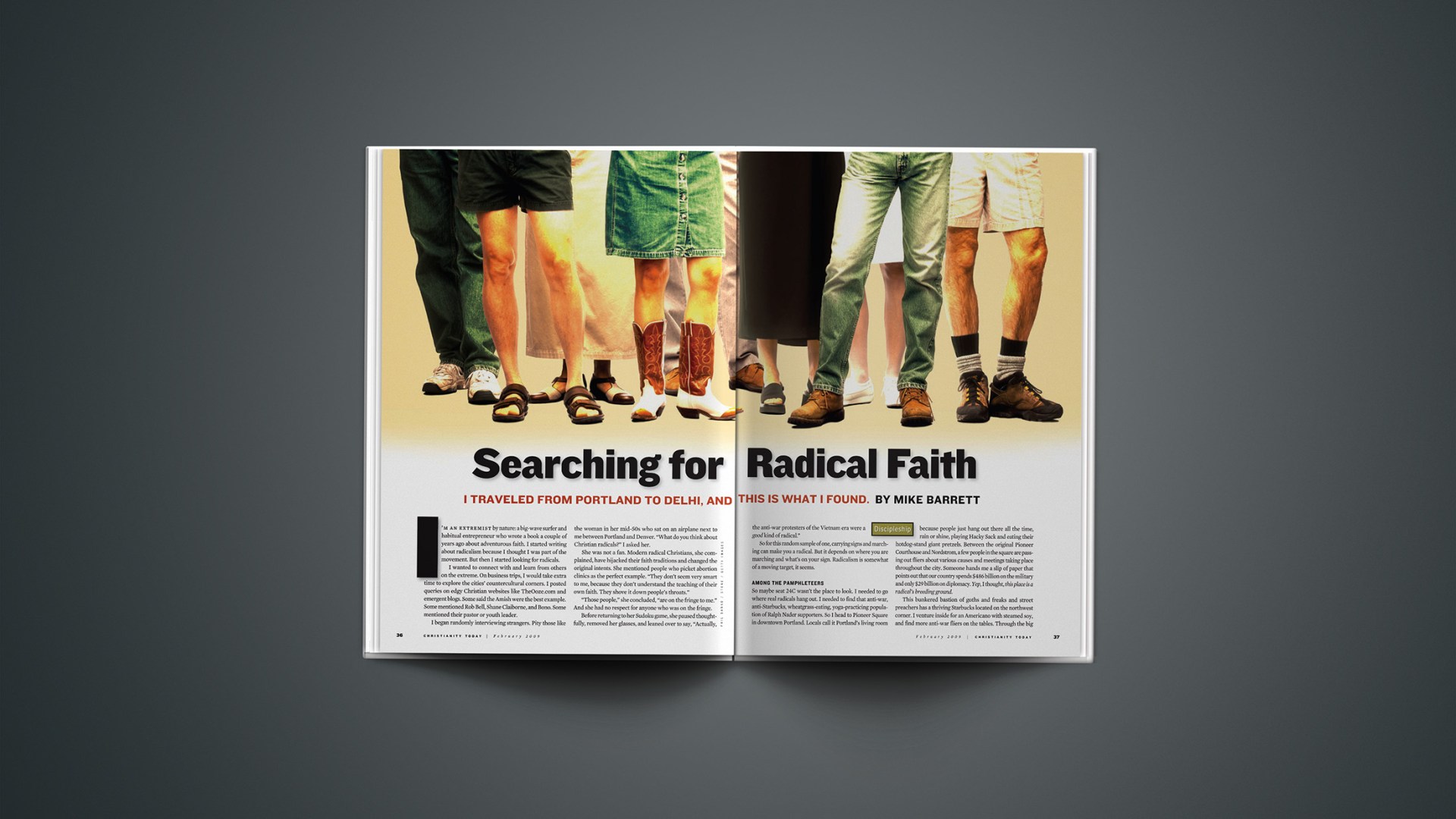

I‘m an extremist by nature: a big-wave surfer and habitual entrepreneur who wrote a book a couple of years ago about adventurous faith. I started writing about radicalism because I thought I was part of the movement. But then I started looking for radicals.
I wanted to connect with and learn from others on the extreme. On business trips, I would take extra time to explore the cities’ countercultural corners. I posted queries on edgy Christian websites like TheOoze.com and emergent blogs. Some said the Amish were the best example. Some mentioned Rob Bell, Shane Claiborne, and Bono. Some mentioned their pastor or youth leader.
I began randomly interviewing strangers. Pity those like the woman in her mid-50s who sat on an airplane next to me between Portland and Denver. “What do you think about Christian radicals?” I asked her.
She was not a fan. Modern radical Christians, she complained, have hijacked their faith traditions and changed the original intents. She mentioned people who picket abortion clinics as the perfect example. “They don’t seem very smart to me, because they don’t understand the teaching of their own faith. They shove it down people’s throats.”
“Those people,” she concluded, “are on the fringe to me.” And she had no respect for anyone who was on the fringe.
Before returning to her Sudoku game, she paused thoughtfully, removed her glasses, and leaned over to say, “Actually, the anti-war protesters of the Vietnam era were a good kind of radical.”
So for this random sample of one, carrying signs and marching can make you a radical. But it depends on where you are marching and what’s on your sign. Radicalism is somewhat of a moving target, it seems.
Among the Pamphleteers
So maybe seat 24C wasn’t the place to look. I needed to go where real radicals hang out. I needed to find that anti-war, anti-Starbucks, wheatgrass-eating, yoga-practicing population of Ralph Nader supporters. So I head to Pioneer Square in downtown Portland. Locals call it Portland’s living room because people just hang out there all the time, rain or shine, playing Hacky Sack and eating their hotdog-stand giant pretzels. Between the original Pioneer Courthouse and Nordstrom, a few people in the square are passing out fliers about various causes and meetings taking place throughout the city. Someone hands me a slip of paper that points out that our country spends $486 billion on the military and only $29 billion on diplomacy. Yep, I thought, this place is a radical’s breeding ground.
This bunkered bastion of goths and freaks and street preachers has a thriving Starbucks located on the northwest corner. I venture inside for an Americano with steamed soy, and find more anti-war fliers on the tables. Through the big window, I can see out into the square; a guy is holding a binder, trying to stop people walking past him. He is trying to gain their support for something. He is about 28 years old, wearing a skull cap, and sporting a full beard. Perfect.
His name is Nate, and he’s the local head of Greenpeace. I tell him about my quest and ask him what it’s like to be a radical.
“I can see why people think we are on the fringe“—he uses that same phrase my airplane seatmate used. “But I don’t think we are radicals at all.” He smiles a genuine smile and gives me a look to suggest he’s about to offer some insider information.
“Greenpeace was actually started by a Quaker—a Christian!” He sees that I am visibly shocked by this claim, which I later find out to be mostly true. The founding members, most of them, anyway, were devout Quakers based in Vancouver, British Columbia.
“Back in 1971, the U.S. government was planning a nuclear test off some islands near Alaska, and this anti-war Christian guy thought it was wrong. So he got another crazy guy to loan his boat for the cause, and they all headed up to put themselves in harm’s way to stop it.” Nate tells me their motivation was based on the value of stewardship of all creation. He actually uses that word: stewardship. He calls it “nonviolent resistance to protect all of life.”
The mission, it turns out, failed to stop the test, and the founders were arrested in the process, but it started a peace movement that continues to this day. Regardless of what Greenpeace has become, the original intent was established by some very average Christians with above-average convictions. I left Pioneer Square that day suspecting that true radicals may not think they are radical, and that the ones who say they are radical maybe aren’t.
So where to find the Christian radicals? I walked the streets of Chicago and Denver looking for someone with an in-your- face Jesus sign hanging on their back, a Snowboarders for Christ meeting, or a skate park evangelism team. If they were around, I couldn’t find them.
Following Teresa and Shane Claiborne
So I head to Delhi. I am going there on a business trip anyway, and figure that if I am going to find a Christian radical, it would be a good city to check. I’m not the first to assume this. Shane Claiborne writes about traveling to India to meet Mother Teresa, because he felt she might have been the only true Christian in the world at the time. I suppose I’m looking for something like that too—a true Christian radical who is going against the tide in a part of the world that has little stomach for Christianity.
I’ve been there four times, enough to know that I don’t really like Delhi. I’m not drawn to a place with severe pollution, the kind you can see, the kind you can taste in the evening when you go to bed and dig out of the corners of your eyes when you wake up in the morning. Dogs and cows roam around with impunity. Men urinate on the sides of the crowded roads. The poverty is unreal. Many people, millions of them, are so poor they live in small huts made from cow manure and have been known to eat dogs to stay alive. India is not a fun place to visit—and as recent headlines have indicated, an even less fun place to do Christian ministry. In many parts of India, it can get you killed.
When business concludes, I set out to meet a man, a true radical, named Rick. I learn that he and his wife, Ellen, moved to Delhi from Atlanta to help plant home-based churches throughout India and Nepal. Because of the inherent difficulties and risk of such a mission, I expect to meet someone who looks more like Indiana Jones than John Edwards. To my complete surprise, I find Rick to be perfectly boring on the outside. He wears glasses to read and drive and, well, to do everything. He has slightly graying hair that is cut like a Chicago businessman’s, and he wears perfectly normal clothing. He’s not big or muscular or sporting any hardware pierced through his nose, eyelid, or ears. It takes me some time to just admit that he looks like my dad. Yet he and his wife are successfully encouraging and mentoring local leaders to plant home churches throughout India and Nepal. They don’t make much money, haven’t written any books, and don’t get any airtime on Christian television. But I’m overcome by their warrior hearts.
Later that same day, Rick and I meet one of his local leaders for coffee. His name is Ramesh, a new church planter and living example of the ministry and mentoring of Rick and Ellen. I learn that Ramesh and his wife are headed into Northern India soon to plant a new church. It dawns on me right then, in a humid coffee shop in Delhi, that true radicalism has horrible pay, it takes years to see its fruit, and it requires that quiet, under-the-radar kind of love for people that Christ gave his life for. God is not speaking more profoundly to the good-looking loud ones. He’s moving powerfully through the simple ones who only wish they had the time and money to be a Snowboarder for Christ.
The Root of the Issue
I fly home. I readjust to my clean freeways and, for a moment, catch myself wondering how my book is selling at Barnes and Noble. I briefly wonder if I should take that new job for better pay and move my family to another city. Then the Lord reminds me of my time with Rick and Ramesh and of the countless other radicals who have chosen a life with fewer options than my own. I realize that I just couldn’t see them before in places like Denver and Chicago because I didn’t know what to look for. I had been tricked into thinking that radicals were somehow flashy, famous, and dangerous. But they’re not. They’re just not.
But classic radicals, the real ones, are alive and well. They are like the nuns taking over for Mother Teresa in Calcutta without anyone knowing their names; anti-abortion activists who have been fighting a seemingly impossible war for over 35 years; homeschooling moms distributing food in La Chureca, Nicaragua; and big-city environmentalists who never back down in their fights with well-funded industrial law firms.
Tattooed or not, pierced or not, these people do affect our lives and culture. They’re quietly praying and fasting for the sick in their church. They’re taking in foster children. They’re taking seriously Christ’s words, “If anyone would come after me, let him deny himself, pick up his cross, and follow me.”
The problem is that Jesus’ call isn’t just for a few heroes. We prefer the “radical” that rides a motorcycle, writes edgy books, does podcasts, speaks at conferences (for top fees), and never really sacrifices much at all. But we’re swallowing a placebo, a sugar pill that claims to make life more interesting.
Radical, in its origins, really means to be rooted. The idea behind the word is to be so grounded, so deeply rooted in a lifestyle direction, that one stands against the social and cultural currents that tear others away from that same path. It’s not so much forcing a change of course, but returning oneself and others to an originally intended path. By this definition, classic radicalism is found in the lives of many historical figures, people who stood up for human rights and religious reform. Today, anyone who adheres to the person and teachings of Christ in the midst of runaway humanism and hedonism is, by definition, a radical. It’s essentially building your house on a rock that doesn’t get torn down in cultural storms. So becoming a true radical is to return oneself and others to a sacred path, and stand against modernity’s eroding influences.
This is the part of the article where I thought I, the guy who wrote the book on radical faith, speaks at conferences, and surfs big waves with gusto, would tell you how to live radically for Christ, too. Instead, I’m struck by how much I’m a guy with a well-paying job and a life mission that doesn’t really cost me anything. I’m not radical at all. I’m not what I thought I was. If the answer were simply to cut my hair, sell my surfboard, and move to Delhi, I’d be grateful. But instead, I’ve found my best image of Christian radicalism in an ancient Hebrew poem—a psalm:
“God is our refuge and strength, a very present help in trouble. Therefore we will not fear though the earth gives way, though the mountains be moved into the heart of the sea, though its waters roar and foam, though the mountains tremble at its swelling. There is a river whose streams make glad the city of God, the holy habitation of the Most High. God is in the midst of her; she shall not be moved; God will help her when morning dawns. The nations rage, the kingdoms totter; he utters his voice, the earth melts. The Lord of hosts is with us; the God of Jacob is our fortress” (Ps. 46:1-7, ESV).
The poet of Psalm 46 describes a world that is literally falling apart. It’s a world much like our own. But through the chaos and the destruction we can picture a big fat beautiful river that cuts through the unstable mountains into the city of God. The river of life and the city of God are immovable. They are profoundly rooted. It’s within their boundaries that we invite others to join us in expanding those lines, the borders of God’s kingdom, down and into the chaotic world to encompass the rejected and tormented.
So, on a night when the outside world pretends to care less, I try to take that bittersweet pill of old-fashioned repentance, hoping to wake up tomorrow morning infected again by the blood of Christ, diseased and unable to extricate myself from his grip. I’m compelled to be a true radical—to be truly rooted—right here in my small hometown, through my little local church, regardless of the cost or how long it takes.
Mike Barrett is the president of Pounce Consulting, the teaching pastor at Coast Vineyard Church in Lincoln City, Oregon, and the author of The Danger Habit: How to Grow Your Love of Risk into Life-Changing Faith (Multnomah).
Copyright © 2009 Christianity Today. Click for reprint information.
Related Elsewhere:
More articles on discipleship include:
Reflections: Discipleship | Quotations to stir heart and mind (July 1, 2004)
The Making of the Christian | Richard J. Foster and Dallas Willard on the difference between discipleship and spiritual formation. (September 16, 2005)