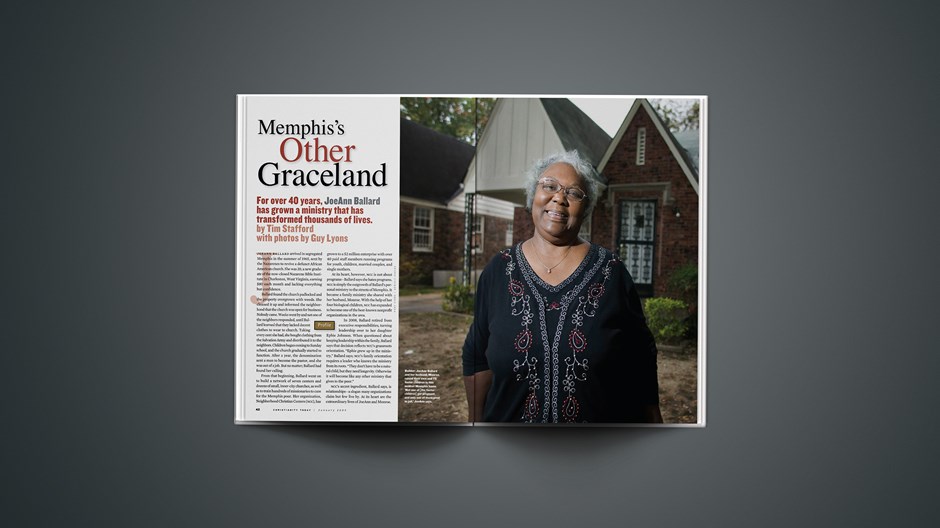
JoeAnn Ballard arrived in segregated Memphis in the summer of 1965, sent by the Nazarenes to revive a defunct African American church. She was 20, a new graduate of the now-closed Nazarene Bible Institute in Charleston, West Virginia, earning $80 each month and lacking everything but confidence.
Ballard found the church padlocked and the property overgrown with weeds. She cleaned it up and informed the neighborhood that the church was open for business. Nobody came. Weeks went by and not one of the neighbors responded, until Ballard learned that they lacked decent clothes to wear to church. Taking every cent she had, she bought clothing from the Salvation Army and distributed it to the neighbors. Children began coming to Sunday school, and the church gradually started to function. After a year, the denomination sent a man to become the pastor, and she was out of a job. But no matter; Ballard had found her calling.
From that beginning, Ballard went on to build a network of seven centers and dozens of small, inner-city churches, as well as to train hundreds of missionaries to care for the Memphis poor. Her organization, Neighborhood Christian Centers (NCC), has grown to a $2 million enterprise with over 40 paid staff members running programs for youth, children, married couples, and single mothers.
At its heart, however, NCC is not about programs—Ballard says she hates programs. NCC is simply the outgrowth of Ballard's personal ministry to the streets of Memphis. It became a family ministry she shared with her husband, Monroe. With the help of her four biological children, NCC has expanded to become one of the best-known nonprofit organizations in the area.
In 2008, Ballard retired from executive responsibilities, turning leadership over to her daughter Ephie Johnson. When questioned about keeping leadership within the family, Ballard says that decision reflects NCC's grassroots orientation. "Ephie grew up in the ministry," Ballard says; NCC's family orientation requires a leader who knows the ministry from its roots. "They don't have to be a natural child, but they need longevity. Otherwise it will become like any other ministry that gives to the poor."
NCC's secret ingredient, Ballard says, is relationships—a slogan many organizations claim but few live by. At its heart are the extraordinary lives of JoeAnn and Monroe.
EXTRAORDINARY LIVES
Monroe Ballard died last summer after a long illness. On the final day of his life, 300 people waited outside his hospital room for a chance to counsel and pray with him. He saw them all, one at a time. Included were nearly all of the 75 foster children he and JoeAnn had helped raise.
In her memoir, I Belong Here: A Biography of a Community, JoeAnn writes, "When I first began the work of compassionate ministry, the Holy Spirit would not let me go. Every child, every man, every woman was magnified in my eyes, and I was drawn to the neediest of them. I was bombarded with the woes of people until I was completely in the will of God. When I reached that turning point, I began to understand that it was not about getting a glimpse of people so much as it was getting a glimpse of Jesus."
Ballard grew up on a small Mississippi farm. "Montee" Benjamin and his wife, Ora Mae, were distant relatives who took her in at six weeks old after her parents had abandoned her and two siblings. She was the last of 45 foster children her adoptive father raised. The family grew its own food and gained a small income through home enterprises. JoeAnn grew up entrepreneurial and self-sufficient. "I'm a survivor," she says. "I could hit the street running and in a year I'd have a million dollars. But life is not about money."
Converted in college, JoeAnn joined her entrepreneurial instincts to a deeply evangelical faith. In Memphis she put all her ingenuity into helping her neighbors. They came from backgrounds like hers, but found themselves isolated and defenseless in city life. Monroe, a sixth-grade teacher whom she met at church, shared JoeAnn's vision. Together they began to take in foster children, often from the network of relationships Monroe had built with his students.
The Ballard foster children were not wards of the court but teenagers over 16 who had burned bridges with the foster-care system or simply grown too old to qualify. The Ballards took in girls and raised them with their own four children. Their small house expanded to nine tiny bedrooms. The house next door was purchased to accommodate boys, then a house across the street for young mothers with children. Everyone squeezed together for meals in the Ballards' dining room. Ballard says with pride, "Not one of them got pregnant, and only one went to jail." Most received Christ and became active church members as adults.
That was partly due to the Ballards' strict regimen: no drinking, smoking, or cussing, a 10 P.M. curfew with devotions every night, and required church attendance. It was hardly boot camp, however. "Everybody responds to love," Ballard explains.
Article continues below
She tells of two young women who would not come to meals. Unaccustomed to family life, they stayed in their rooms and would later scrounge in the kitchen. Instead of laying down the law, JoeAnn and Monroe decided to leave food on the table after the meal. When the girls came from their upstairs bedrooms, they found a meal waiting. Monroe began to sit down with them as they ate, joking and passing the time. Ultimately the girls learned to enjoy socializing during meals, and were gradually absorbed into the family routine.
On another occasion, girls were sneaking fruit from the kitchen up to their rooms, then hiding the banana peels and apple cores under their mattresses. JoeAnn found the rotting mess and consulted with Monroe, who suggested putting fruit bowls in each bedroom, eliminating any need to hoard or conceal.
"It was a different kind of household than they had experienced," JoeAnn says. "You could ask for things and get them." There was plenty of good food, each child was given a used car and a bedroom of his or her own, and many attended college on scholarships the Ballards bargained for at local institutions. They even had a maid to clean their rooms and wash their clothes. If that sounds like luxury, it was, but very much within the means of a poor black community.
The Ballards had no outside source of funds; they just knew how to make money and use it wisely. Today JoeAnn takes great joy from her side business of selling used books on Amazon.com. In describing how she learned to get free boxes of Pampers, she still says, "The dump holds the key to everything."
EARLY CRISES
By 1976 Ballard was working a variety of jobs and coming home to care for her neighbors, her foster children, and her own family. (Her adoptive mother had moved from Mississippi after Montee's death, becoming the family cook and house mother.) The living room was piled with donated clothes and other goods. Compassion was threatening to outgrow the household.
With a $15,000 grant from a well-off Memphis church, Youth for Christ staff helped the Ballards launch a one-person storefront ministry. It primarily operated as a food pantry and clothes closet, with JoeAnn working full-time and Monroe joining her after school.
"In the early years, there were always crises," says Eddie Foster, home missions director at Second Presbyterian Church, which provided the start-up capital. "Time and again I saw how much they believe in prayer. It is JoeAnn's first instinct, and it increased my faith."
Article continues below
Frederick Smith, pastor of New Life Church in Memphis, says Ballard has such insight into people's excuses, "she could work with the cia real well." But compassion and spiritual concern always rule. "What am I going to do?" Ballard said of one couple who, despite being helped several times, insulted her and NCC's efforts. "Should I let their children be thrown out on the street?"
One woman repeatedly stole from the organization. "We always gave them everything they needed, but they would steal more anyway." Instead of banning the woman, Ballard invited her to a Wednesday Bible study. She usually came drunk. Only after six months of being welcomed and provided for did she begin to show up sober and deal with her personal problems. A minister who came to the Bible study invited her to his church, and the woman—along with two of her friends—became Christians. Eventually she became a leader in the church.
"We began to see God's power in this ministry when we coupled spiritual ministry with practical service," Ballard says.
Thirty-two years of incremental changes later, NCC is no longer a ma-and-pa outfit. Headquartered in a modern, roomy community center overseeing storefront operations in Memphis's toughest neighborhoods, NCC has at least 65 churches involved in its network for distributing goods and services, as well as hundreds of missionaries—typically clients who serve as volunteer block captains in their neighborhoods. NCC counts 90,000 client families—a large proportion of the Memphis poor. "The networks in neighborhoods are incredible," says Foster.
But despite its size, NCC remains a homegrown operation dedicated to meeting any need of anyone who walks in off the street. "Any need," says board chair and venture capital executive Jim Witherington. "Whether it's help with a wedding, a funeral, if Medicaid gets cut off, or a utility bill can't be paid." Ballard says the ministry does not have a list of social-service referrals. Staff always try to help personally rather than say, "Try somewhere else." That way, relationships grow.
Not that NCC offers so many handouts. More often, it starts with handouts but moves toward helping the individual or family find long-term answers to problems. One of Ballard's favorite words is ownership. With it comes the responsibility of taking charge of one's life. Before that, however, clients need community. "Poor with community is different from poor with no community," Ballard says. "You can survive in America, but nobody tells you how to do it."
Article continues below
"Neighborhood Christian Centers—they pray to the Lord to bless you with a job," says Pastor Smith. "Then they go out and show you how to get yourself a job."
That's a principal reason Ballard believes in the small black church. Small churches are rooted in the neighborhood. Ballard says she has launched 11 Nazarene congregations in Memphis, part of NCC's network of small churches. Pastor Ricky Floyd's Pursuit of God Church is typical of that network. When it was still meeting in his living room, Ballard "allowed us to do what only a megachurch could do," Floyd says. "We gave out hundreds of Christmas baskets. She brought Truthseekers [NCC's high-school ministry], which we used for our Sunday school. And if kids attended our Truthseekers group steadily for three years, they got a scholarship for college. I have a son in college now because of Truthseekers."
Floyd notes that when he conceived an innovative way to reach out to young, unchurched people in his neighborhood—a rap-based initiative called "Thugs Revival"—Ballard backed him when other church leaders criticized. By working through small churches and providing resources to small churches that could never manage themselves, NCC vastly extends its spiritual impact while staying close to its roots.
SCIENCE AND SPIRIT
One day in August 2008, Ballard sat in on a summit meeting of staff from NCC and the Urban Child Institute (UCI), a Memphis foundation and think tank that targets poverty. UCI is a spinoff of the Memphis medical community that focuses on the physical and mental development of children from conception to age three. The organization's mainly white, professional staff members tend to be more oriented toward statistical findings than prayer. NCC staff, by contrast, are African American and more oriented toward the realities of the street and the gospel. At times, meeting participants struggled to communicate.
UCI gives away millions of dollars every year, but recently decided to invest a large portion of its funding in NCC. CEO Gene Cashman has known Ballard for decades and regards her as a genius at interpreting black culture to the white world and vice versa. Cashman sees NCC as a "laboratory for learning," he says, while by contrast, "universities don't know anything about the communities they are pontificating about."
Medical research indicates that children's welfare is massively affected by their brain development as babies and toddlers. Simple things such as talking to babies in complete sentences can have a lifelong impact. Fifty-seven percent of children born in Shelby County, which includes Memphis, are born to unmarried, mostly poor women. These children often show stunted brain development. Messages to mothers regarding how to raise children are not terribly complex, but they are not getting through to poor Memphians. UCI hopes that NCC can help it communicate to that community, while Ballard hopes that UCI's statistics will help NCC tell its story better.
Article continues below
"It's rare to find someone who can connect with politicians, police, businesspeople, and pastors," says Floyd. "[Ballard] does a tremendous job across racial and economic lines. I don't know anybody else in Memphis, except maybe the mayor, who has a strong relationship with so many pastors."
Ballard spends little time talking about racism. She sees racism as a choice some people make; because they choose to be racists, they are very difficult to change. "It's almost a waste of time to try." The fundamental problems of Memphis cross over black and white lines, she believes. "It's not racism but a selfish, sick society. It's a society that could care less." What she means is basic: people who won't stop and talk to their neighbor. "Everybody is busy. How are you going to help the needy if you have such a busy schedule? You have to go out of your way to do something for somebody else."
One meeting between UCI and NCC is legendary. In the middle of a critical strategic discussion, NCC staff kept creeping in and whispering in Ballard's ear. She stopped the meeting. Something more urgent had come up. All those present, including UCI staff, left for a nearby house to help clean up and move furniture for a family who had lost their home.
That's JoeAnn Ballard's philosophy in a nutshell. It's intensely relational, and it doesn't lend itself to perfect scheduling. But it is making a difference in Memphis.
















 While we pray for peace, we need moral clarity about this war.
 We’ve got little information on Jesus’ appearance and personality. But that’s the way God designed it.españolFrançais
 How groups like Hillsong learned to let go of the literal in favor of creative collaboration.españolPortuguês






