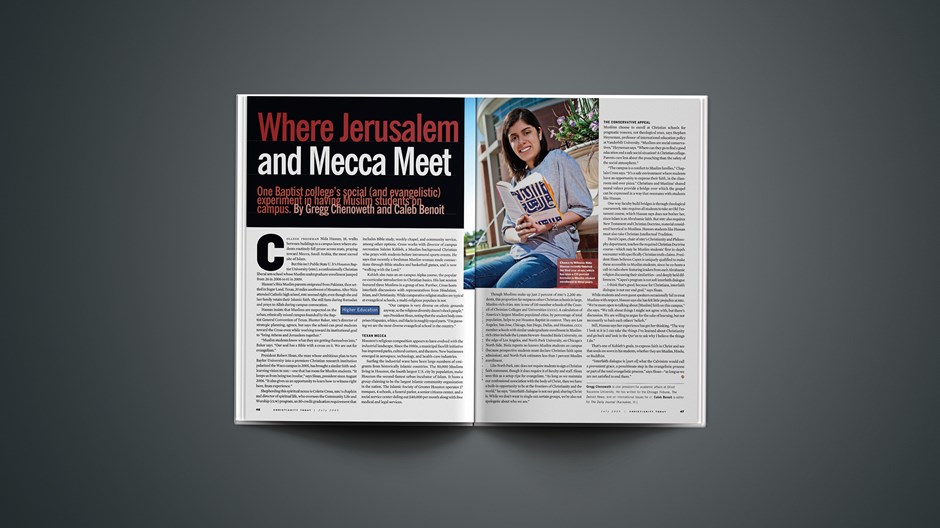
College freshman Nida Hassan, 18, walks between buildings to a campus lawn where students routinely fall prone across mats, praying toward Mecca, Saudi Arabia, the most sacred site of Islam.
But this isn't Public State U. It's Houston Baptist University (HBU), a confessionally Christian liberal arts school whose Muslim undergraduate enrollment jumped from 26 in 2006 to 61 in 2009.
Hassan's Shia Muslim parents emigrated from Pakistan, then settled in Sugar Land, Texas, 20 miles southwest of Houston. After Nida attended Catholic high school, HBU seemed right, even though she and her family retain their Islamic faith. She still fasts during Ramadan and prays to Allah during campus convocation.
Hassan insists that Muslims are respected on the urban, ethnically mixed campus founded by the Baptist General Convention of Texas. Hunter Baker, HBU's director of strategic planning, agrees, but says the school can prod students toward the Cross even while working toward its institutional goal to "bring Athens and Jerusalem together."
"Muslim students know what they are getting themselves into," Baker says. "Our seal has a Bible with a cross on it. We are out for evangelism."
President Robert Sloan, the man whose ambitious plan to turn Baylor University into a premiere Christian research institution polarized the Waco campus in 2005, has brought a similar faith-and-learning vision to HBU—one that has room for Muslim students. "It keeps us from being too insular," says Sloan, president since August 2006. "It also gives us an opportunity to learn how to witness right here, from experience."
Shepherding this spiritual nexus is Colette Cross, HBU's chaplain and director of spiritual life, who oversees the Community Life and Worship program (CLW) program, an 80-credit graduation requirement that includes Bible study, weekly chapel, and community service, among other options. Cross works with director of campus recreation Saleim Kahleh, a Muslim-background Christian who prays with students before intramural sports events. He says that recently a freshman Muslim woman made connections through Bible studies and basketball games, and is now "walking with the Lord."
Kahleh also runs an on-campus Alpha course, the popular co-curricular introduction to Christian basics. His last session featured three Muslims in a group of ten. Further, Cross hosts interfaith discussions with representatives from Hinduism, Islam, and Christianity. While comparative religion studies are typical at evangelical schools, a multi-religious populace is not.
"Our campus is very diverse on ethnic grounds anyway, so the religious diversity doesn't shock people," says President Sloan, noting that the student body comprises Hispanics, whites, and blacks in roughly equal parts. "I'm guessing we are the most diverse evangelical school in the country."
Texan Mecca
Houston's religious composition appears to have evolved with the industrial landscape. Since the 1980s, a municipal facelift initiative has improved parks, cultural centers, and theaters. New businesses emerged in aerospace, technology, and health-care industries.
Surfing the industrial wave have been large numbers of emigrants from historically Islamic countries. The 50,000 Muslims living in Houston, the fourth largest U.S. city by population, make Houston the second-fastest urban incubator of Islam. It hosts a group claiming to be the largest Islamic community organization in the nation. The Islamic Society of Greater Houston operates 17 mosques, 4 schools, a funeral parlor, a senior citizens center, and a social service center doling out $40,000 per month along with free medical and legal services.
Though Muslims make up just 3 percent of HBU's 2,200 students, this proportion far outpaces other Christian schools in large, Muslim-rich cities. HBU is one of 110 member schools of the Council of Christian Colleges and Universities (CCCU). A calculation of America's largest Muslim-populated cities, by percentage of total population, helps to put Houston Baptist in context. They are Los Angeles, San Jose, Chicago, San Diego, Dallas, and Houston. CCCU member schools with similar undergraduate enrollment in Muslim-rich cities include the Lyman Stewart—founded Biola University, on the edge of Los Angeles, and North Park University, on Chicago's North Side. Biola reports no known Muslim students on campus (because prospective students must declare Christian faith upon admission), and North Park estimates less than 1 percent Muslim enrollment.
Like North Park, HBU does not require students to sign a Christian faith statement, though it does require it of faculty and staff. Sloan sees this as a setup ripe for evangelism. "As long as we maintain our confessional association with the body of Christ, then we have a built-in opportunity to be at the frontiers of Christianity and the world," he says. "Interfaith dialogue is not our goal; sharing Christ is. While we don't want to single out certain groups, we're also not apologetic about who we are."
Article continues below
The Conservative Appeal
Muslims choose to enroll at Christian schools for pragmatic reasons, not theological ones, says Stephen Heyneman, professor of international education policy at Vanderbilt University. "Muslims are social conservatives," Heyneman says. "Where can they go to find a good education and a safe social situation? A Christian college. Parents care less about the preaching than the safety of the social atmosphere."
"The campus is a comfort to Muslim families," Chaplain Cross says. "It's a safe environment where students have an opportunity to express their faith, in the classroom and over pizza." Christians and Muslims' shared moral values provide a bridge over which the gospel can be expressed in a way that resonates with students like Hassan.
One way faculty build bridges is through theological coursework. HBU requires all students to take an Old Testament course, which Hassan says does not bother her, since Islam is an Abrahamic faith. But HBU also requires New Testament and Christian Doctrine, material considered heretical to Muslims. Honors students like Hassan must also take Christian Intellectual Tradition.
David Capes, chair of HBU's Christianity and Philosophy department, teaches the required Christian Doctrine course—which may be Muslim students' first in-depth encounter with specifically Christian truth-claims. President Sloan believes Capes is uniquely qualified to make these accessible to Muslim students, since he co-hosts a call-in radio show featuring leaders from each Abrahamic religion discussing their similarities—and deeply held differences. "Capes's program is not soft interfaith dialogue … I think that's good, because for Christians, interfaith dialogue is not our end goal," says Sloan.
While students and even guest speakers occasionally fail to treat Muslims with respect, Hassan says she has felt little prejudice at HBU. "We're more open to talking about [Muslim] faith on this campus," she says. "We talk about things I might not agree with, but there's discussion. We are willing to argue for the sake of learning, but not necessarily to bash each others' beliefs."
Still, Hassan says her experience has got her thinking. "The way I look at it is I can take the things I've learned about Christianity and go back and look in the Qur'an to ask why I believe the things I do."
That's one of Kahleh's goals, to express faith in Christ and see that seeds are sown in his students, whether they are Muslim, Hindu, or Buddhist.
Article continues below
"Interfaith dialogue is [part of] what the Calvinists would call a prevenient grace, a penultimate step in the evangelistic process or part of the total evangelistic process," says Sloan—"as long as we are not satisfied to end there."
Gregg Chenoweth is vice president for academic affairs at Olivet Nazarene University. He has written for the Chicago Tribune, The Detroit News, and on international issues for CT. Caleb Benoit is editor for The Daily Journal (Kankakee, Ill.).















 While we pray for peace, we need moral clarity about this war.
 We’ve got little information on Jesus’ appearance and personality. But that’s the way God designed it.españolFrançais
 The government plans to close its porous border with Myanmar to boost security, separating ethnic groups that straddle the boundary.






