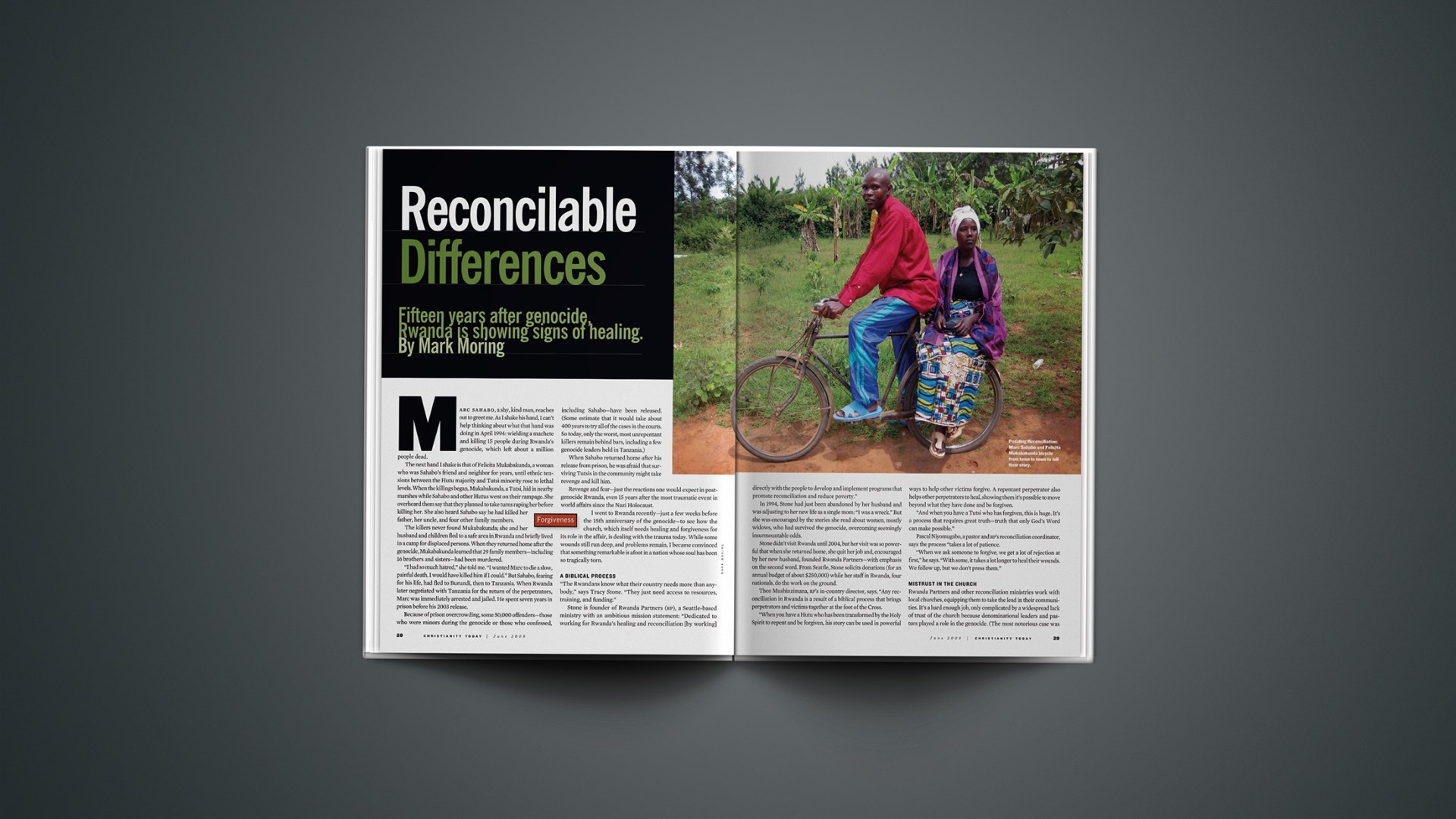

Marc Sahabo, a shy, kind man, reaches out to greet me. As I shake his hand, I can’t help thinking about what that hand was doing in April 1994: wielding a machete and killing 15 people during Rwanda’s genocide, which left about a million people dead.
The next hand I shake is that of Felicita Mukabakunda, a woman who was Sahabo’s friend and neighbor for years, until ethnic tensions between the Hutu majority and Tutsi minority rose to lethal levels. When the killings began, Mukabakunda, a Tutsi, hid in nearby marshes while Sahabo and other Hutus went on their rampage. She overheard them say that they planned to take turns raping her before killing her. She also heard Sahabo say he had killed her father, her uncle, and four other family members.
The killers never found Mukabakunda; she and her husband and children fled to a safe area in Rwanda and briefly lived in a camp for displaced persons. When they returned home after the genocide, Mukabakunda learned that 29 family members—including 16 brothers and sisters—had been murdered.
“I had so much hatred,” she told me. “I wanted Marc to die a slow, painful death. I would have killed him if I could.” But Sahabo, fearing for his life, had fled to Burundi, then to Tanzania. When Rwanda later negotiated with Tanzania for the return of the perpetrators, Marc was immediately arrested and jailed. He spent seven years in prison before his 2003 release.
Because of prison overcrowding, some 50,000 offenders—those who were minors during the genocide or those who confessed, including Sahabo—have been released. (Some estimate that it would take about 400 years to try all of the cases in the courts. So today, only the worst, most unrepentant killers remain behind bars, including a few genocide leaders held in Tanzania.)
When Sahabo returned home after his release from prison, he was afraid that surviving Tutsis in the community might take revenge and kill him.
Revenge and fear—just the reactions one would expect in post-genocide Rwanda, even 15 years after the most traumatic event in world affairs since the Nazi Holocaust.
I went to Rwanda recently—just a few weeks before the 15th anniversary of the genocide—to see how the church, which itself needs healing and forgiveness for its role in the affair, is dealing with the trauma today. While some wounds still run deep, and problems remain, I became convinced that something remarkable is afoot in a nation whose soul has been so tragically torn.
A biblical process
“The Rwandans know what their country needs more than anybody,” says Tracy Stone. “They just need access to resources, training, and funding.”
Stone is founder of Rwanda Partners (RP), a Seattle-based ministry with an ambitious mission statement: “Dedicated to working for Rwanda’s healing and reconciliation [by working] directly with the people to develop and implement programs that promote reconciliation and reduce poverty.”
In 1994, Stone had just been abandoned by her husband and was adjusting to her new life as a single mom: “I was a wreck.” But she was encouraged by the stories she read about women, mostly widows, who had survived the genocide, overcoming seemingly insurmountable odds.
Stone didn’t visit Rwanda until 2004, but her visit was so powerful that when she returned home, she quit her job and, encouraged by her new husband, founded Rwanda Partners—with emphasis on the second word. From Seattle, Stone solicits donations (for an annual budget of about $250,000) while her staff in Rwanda, four nationals, do the work on the ground.
Theo Mushinzimana, RP’s in-country director, says, “Any reconciliation in Rwanda is a result of a biblical process that brings perpetrators and victims together at the foot of the Cross.
“When you have a Hutu who has been transformed by the Holy Spirit to repent and be forgiven, his story can be used in powerful ways to help other victims forgive. A repentant perpetrator also helps other perpetrators to heal, showing them it’s possible to move beyond what they have done and be forgiven.
“And when you have a Tutsi who has forgiven, this is huge. It’s a process that requires great truth—truth that only God’s Word can make possible.”
Pascal Niyomugabo, a pastor and RP’s reconciliation coordinator, says the process “takes a lot of patience.
“When we ask someone to forgive, we get a lot of rejection at first,” he says. “With some, it takes a lot longer to heal their wounds. We follow up, but we don’t press them.”
Mistrust in the church
Rwanda Partners and other reconciliation ministries work with local churches, equipping them to take the lead in their communities. It’s a hard enough job, only complicated by a widespread lack of trust of the church because denominational leaders and pastors played a role in the genocide. (The most notorious case was Rwandan Catholic priest Athanase Seromba, who ordered his sanctuary bulldozed while 2,000 Tutsis sought refuge inside; Seromba is now serving a life sentence.)
“The church is in a tight situation,” says Dwight Jackson, Food for the Hungry‘s national director in Rwanda. “It’s taken some severe identity hits because of stories of church leaders participating in the genocide. The preponderance of evidence is that the church—Catholics and Protestants—is complicit, even at a denominational level.”
RP’s Mushinzimana says some pastors feel a “deep-seated sense of guilt” for not doing more to try to stop the killing. Other church leaders still harbor unresolved ethnic hatred, or aren’t willing to undertake the hard work of pursuing biblical reconciliation.
Anastase Rugirangoga, director of the Peacebuilding, Healing, and Reconciliation Program, a nonprofit, notes: “Pastors say, ‘We have Hutus and Tutsis in our church. For me to talk of forgiveness and reconciliation, it is very difficult, because I am afraid of losing some of them.’ Some feel that if the pastor is asking survivors to forgive, maybe he is taking sides with the Hutus. Or if he asks Hutus to repent, maybe he is siding with the Tutsis. So many pastors just preach in general, because they are afraid to say the hard things.”
But many pastors who want to do the right thing feel overwhelmed by the task of reconciliation, because the trauma still runs deep, even in themselves.
Says Mushinzimana, who lost family members in the genocide, “Pastors have been wounded just like other people.”
Nyirindekwe Celestin, an Anglican priest, says pastors often deal with arguments between Hutus and Tutsis in their congregation: “When pastors see this, their church looks like a broken family.”
But the rifts can be healed, like they were in one church Celestin says was “really divided” over whether Hutus or Tutsis would take leadership. When he later visited and found the two sides fasting and praying together, they told him, “We don’t want this to be a Hutu church or a Tutsi church. We want to stay together.” Though a few ended up leaving, most remained and worked through their differences, deciding to share the leadership. Celestin grins as he says, “That church did not divide.”
He says the squabbles illustrate the need for true reconciliation—not mere peaceful coexistence, but confession and forgiveness he says are possible only through Christ.
“It’s very hard to forgive a killer,” he says. “It takes power from above to transform a person. Our main focus isn’t to tell people to forgive, but to accept Jesus as their Savior, and let him transform you. Only then can you forgive.”
Spiritual response to poverty
Déo Gashagaza, executive director of Prison Fellowship Rwanda (PFR), notes another challenge facing the church: addressing poverty. In a nation where the average income is a dollar a day, and where the genocide left many widowed, orphaned, homeless, and hungry, utter poverty—and the unlikelihood of escaping it—can make people bitter, hard, and unwilling to forgive.
“It’s impossible for a hungry man to take on what we teach,” says Gashagaza, who lost seven family members in the genocide. “We cannot respond to the needs of Christians without enabling them to grow both spiritually and economically.”
That’s one critical reason why reconciliation ministries try to help people escape poverty, usually through microenterprise ventures and business co-ops.
RP affiliate Rwanda Basket Company (RBC) is a prime example, working with co-ops of weavers to make baskets and other art, which are then sold in the U.S.; the profits go back to the artisans. The weavers, all women, earn up to $30 a week, increasing their family income six-fold, enough to lift them out of poverty and into the middle class.
“Our primary work is with the most vulnerable women, mostly widows and orphans,” says Michel Kayiranga, RBC’s in-country director. “We’re hoping to sell more baskets so we can add more weavers and get more women out of poverty.”
Asked about what basket weaving has to do with reconciliation, Kayiranga says, “They are working together. No one thinks about being Hutu or Tutsi. They work together, and talk about everything—their common problems, whatever.”
Another vital part of reconciliation is restitution, one of the principles behind PFR’s four “unity and reconciliation” villages, where released prisoners have built over 400 homes for genocide survivors, and where perpetrators and victims now live side by side.
Laura Waters Hinson, director of the 2008 documentary As We Forgive, has teamed up with PFR to form Living Bricks, which raises funds to help build more such homes. Hinson says more than 10,000 ex-offenders have asked for supplies to build these “houses of hope” to make restitution to their victims, because they cannot afford the supplies themselves. Living Bricks makes it possible. (Hinson’s documentary depicts stories of reconciliation in Rwanda, as does a quasi-companion book, also titled As We Forgive, by Catherine Claire Larson.)
Victim rage
In his job, Rugirangoga is regularly cursed at, spat upon, and worse. And he’s smiling as he tells me about it.
“The insults are terrible,” he says. “Very bad language!”
It’s all in a day’s work for Rugirangoga, who conducts three-day reconciliation workshops around the nation. He invites perpetrators and victims without telling either that the others will attend. When the two sides first arrive, the survivors release their wrath—initially on Rugirangoga: “You bring us here before our killers? You are an accomplice! You are a killer!”
Then their anger—15 years’ worth of it—turns to the perpetrators, and continues through much of the first day; Rugirangoga does little to quell it. He brings local police to keep things from getting violent, but he lets the people shout it out.
“It’s part of the healing process,” he says, “because many people have not had a chance to pour out their suffering. This is their opportunity.”
When the victims’ anger turns to the perpetrators, “The killers do not say anything. They are insulted and spat upon, but they keep quiet, because they feel guilty, and they want these people to forgive them.”
Rugirangoga says he knows God is involved in the workshops because most of the participants on both sides show up for the second day—a day of prayer, of biblical teaching about confession and
forgiveness, even of singing together.
Victims remain skeptical that the killers are repentant, but Rugirangoga tells them, “They are here because they want to change. They might be Christians, but they still feel guilty until you forgive them.
“The survivors ask, ‘Are you sure they are not coming to kill us again?’ We say, ‘We are sure, because they have repented.’ We ask the victims, ‘Do you want them to be killed?’ They say, ‘No, their death will not benefit us. Pastor, we are Christians. We want to go to heaven. They have blood on their hands. We don’t want blood on our hands.’
“Then we say, ‘Okay, if you don’t want to kill them, forgive them. God has forgiven them. God has forgiven you. Now they’re asking for forgiveness. Forgive them.'”
The process continues over the next two days. By the end, many are ready to forgive, but some are not. So Rugirangoga appoints a team of killers and survivors who have reconciled to follow up, “to continue to help them process their anger and their feelings.” Some end up forgiving, but some never do.
“It’s hard work,” Rugirangoga says. “But it’s good.”
The tide is turning
Are the efforts of Rugirangoga, Gashagaza, Mushinzimana, Niyomugabo—and so many others—making a difference?
According to PFR, some 60,000 prisoners—many of those who have been released—have confessed their crimes, and more than 12,000 victims have “openly forgiven” their offenders.
But it’s more than just the statistics; it’s also in the personal stories, like one I heard from Fatuma Ndangiza, executive secretary of Rwanda’s National Unity and Reconciliation Commission (nurc), which runs peace-building programs for all ages. The commission is focusing especially on younger Rwandans; 67 percent of the country is under the age of 25, and 44 percent under 15.
Since old attitudes and ethnic animosities die hard, the nurc hopes to change the way of thinking for the next generation—those 44 percent born since the genocide who didn’t witness 1994’s atrocities and didn’t grow up with their parents’ prejudices.
Ndangiza tells a story that shows the tide is turning. A few years ago, armed Hutu rebels entered a school and told the children to separate—Hutus on one side, Tutsis on the other. The children refused, saying, “We are all Rwandese. We are not Hutu or Tutsi.” The rebels said, “If you don’t separate, we will kill you.” The children embraced each other, and a 13-year-old girl said, “We will not separate. We are all the same. Let us pray, and then you can kill us. But we are all Rwandese.”
The rebels threw grenades, killing several children and badly injuring others. The 13-year-old girl was among the dead, and today is regarded as a national hero. “Although that was a bitter experience,” says Ndangiza, “it was also a testimony that tells me attitudes are changing, and that peace and unity are slowly becoming a reality in Rwanda.”
A ‘holy shower’
The story of Marc Sahabo and Felicita Mukabakunda, introduced at the beginning of this article, is a typical testimony of hope.
After his release from prison, Sahabo was invited to attend a reconciliation workshop led by RP’s Pascal Niyomugabo—who is Mukabakunda’s brother. At first, Sahabo thought it was a trap, that Tutsis would be waiting to kill him. But he attended the workshop anyway, and says, “My heart was changed by Jesus. I wanted to ask the victims for forgiveness, to tell them I was no longer the killer they used to know.”
But Mukabakunda hadn’t been ready to forgive. Her brother, who had already forgiven Sahabo, kept encouraging her. Eventually, she decided it was time.
When they finally met face to face, Sahabo got down on his knees before Mukabakunda, folded his hands, confessed his crimes, and begged for mercy. Mukabakunda put her hand on his shoulder, looked him in the eyes, and said simply, “I forgive you.”
Sahabo says that at that moment, he felt like he “just came out of a shower, a clean man, except it was like a holy shower, because I felt clean on the inside.” For Mukabakunda, a heavy burden lifted, and the migraine headaches and nightmares she had suffered for ten years immediately disappeared and have not returned.
Today, Sahabo and Mukabakunda say they are best friends; on the day I visited with them, they shared a beer and many laughs. Their children play together, and their families regularly share meals. The two of them ride a bike from village to village, telling their story.
“I’m not scared of him anymore,” says Mukabakunda. “Without Jesus, I’d go back to hating Marc. But because of Jesus, I have forgiven Marc, and I love him now.”
Theirs is just one of many similar stories I heard in my short time in Rwanda, and one of thousands more like it, all across the country. One can’t help believing that the torn soul of Rwanda is healing, and that hope is on the near horizon.
Mark Moring is a CT associate editor and editor of CT Movies.
Copyright © 2009 Christianity Today. Click for reprint information.
Related Elsewhere:
Christianity Today has a special section on Rwanda on our site, including:
Forty Days for Rwanda | Rick Warren, Kagame open Purpose Driven campaign. (April 17, 2008)
Appreciate Our Efforts | Don’t patronize or belittle Rwandan Christians committed to progress. (April 1, 2006)
Healing Genocide | Ten years after the slaughter, Rwandans begin to mend their torn nation with a justice that is both biblical and African. (April 1, 2004)
Get a downloadable Bible study for this article at ChristianBibleStudies.com.